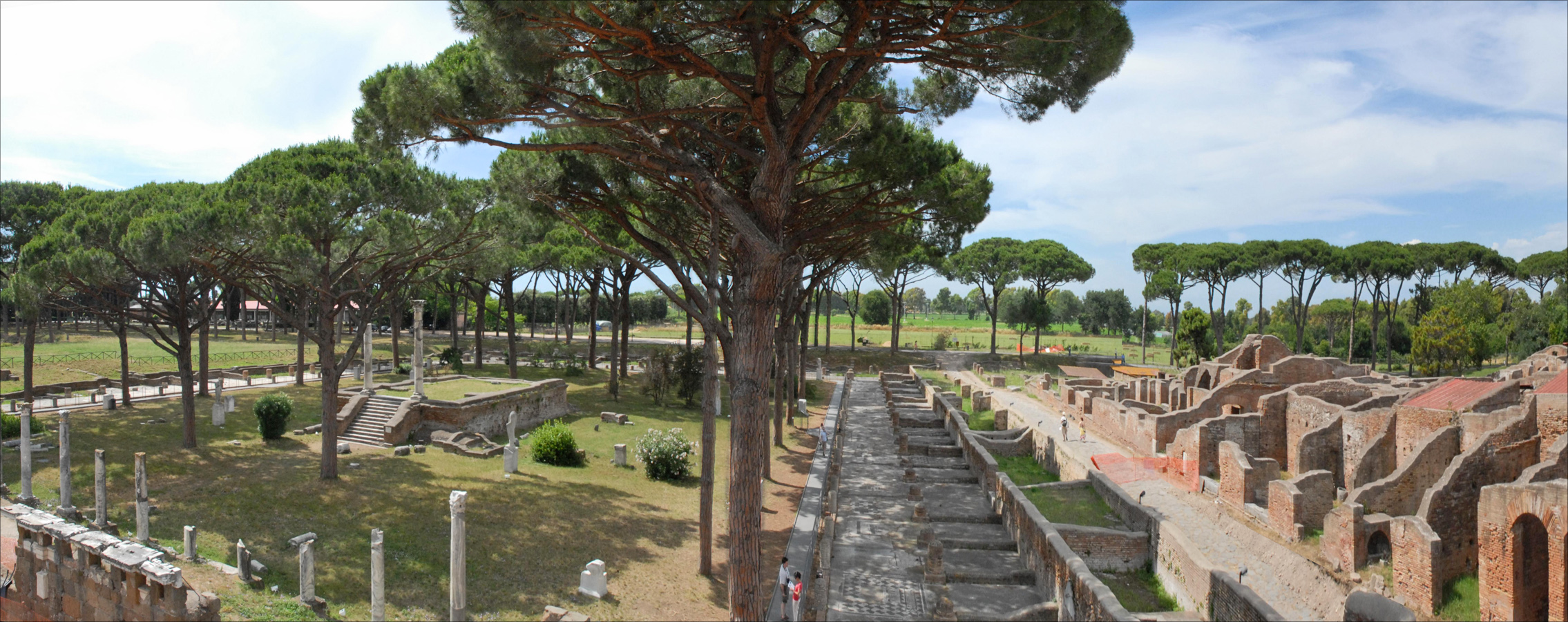
Ostia Antica
In 68 BC, pirates sailed into the harbor of Ostia, set the port ablaze, destroyed the Roman consular war fleet, and kidnapped two senators. The attack triggered such panic in Rome that Pompey the Great was granted extraordinary powers to hunt the pirates down, and within a year he had crushed them across the Mediterranean. That crisis captures something essential about Ostia Antica: this was never a sleepy backwater. For nearly a thousand years, the city at the mouth of the Tiber served as Rome's lifeline to the sea, channeling grain, goods, and people into the capital. Today, three kilometers from the coastline it once fronted -- the sea having retreated behind centuries of silt and sand -- Ostia's ruins preserve an astonishingly complete portrait of urban Roman life.
From Military Camp to Imperial Boomtown
Ostia's name comes from the Latin os, meaning mouth, and the city may have been Rome's first colonia. According to tradition, Ancus Marcius, the fourth king of Rome, founded the settlement in the 7th century BC, though the oldest archaeological remains date to the 4th century BC. The original castrum -- a fortified military camp -- still stands as one of the site's most ancient visible structures. By the time of the First Punic War in 267 BC, Ostia had become a naval base, and during the 2nd century BC it evolved into Rome's primary commercial port, importing the grain that fed a growing capital. Emperor Tiberius ordered the construction of the town's first forum in the 1st century AD. But Ostia's commercial dominance was already under threat: Claudius commissioned a larger harbor at nearby Portus, and Trajan completed an even grander hexagonal basin there in 113 AD. These rivals siphoned away trade, yet Ostia itself continued to thrive, outfitted with a large theater, numerous public baths, taverns, inns, and even a firefighting service.
A Crossroads of Faiths
Walk through Ostia's excavated streets and you encounter an extraordinary patchwork of belief systems. Eighteen Mithraea -- underground temples dedicated to the cult of Mithras -- have been discovered here, more than in any comparable Roman city. The mystery religion, popular among soldiers and merchants, left its secret ritual spaces scattered beneath Ostia's apartments and warehouses. Even more remarkable is the Ostia Synagogue, the earliest synagogue yet identified in Europe, likely constructed in the late 1st century AD. Archaeological analysis reveals it was monumental and purpose-built from the start, undergoing renovations through the 4th century that included the installation of a Torah shrine. In 2025, excavators uncovered what may be the oldest Jewish ritual bath found outside Israel, dating to the late 4th or early 5th century -- a deep immersion pool within a Roman house, accompanied by an oil lamp bearing a menorah symbol. Christianity left its mark too: Saint Monica, mother of Saint Augustine, died here in 387, and the church of Santa Aurea was built over her burial site.
The Long Twilight
Contrary to older assumptions that Ostia declined sharply after Constantine elevated Portus, recent excavations tell a different story. Twenty-six public baths remained in operation during the 4th century, with major repairs to the Neptune Baths completed in the 370s. The city actually expanded beyond its southern walls toward the sea. New churches rose, streets were repaved, and a huge 4th-century villa went up east of the Maritime baths. But entropy eventually won. After the fall of the Western Roman Empire in 476, Rome's population collapsed from roughly 800,000 to 200,000 within a century, and Ostia lost its reason to exist. In 849, the Battle of Ostia was fought offshore between Christians and Saracens. The last inhabitants relocated to nearby Gregoriopolis. Sand dunes crept over the abandoned streets -- and, paradoxically, saved them. Buried under meters of sand, Ostia's buildings, frescoes, and mosaics survived intact while Rome's own ancient fabric was quarried for marble to build Renaissance palazzi.
Pompeii's Quieter Rival
Ostia Antica is often compared to Pompeii, and for good reason: both sites preserve details of Roman urban life that the city of Rome itself cannot offer. But where Pompeii was frozen in a single catastrophic moment, Ostia accumulated its layers gradually over a millennium. The apartment blocks -- insulae rising several stories high -- demonstrate how ordinary Romans actually lived, stacked above shops and workshops in a density that anticipates modern urban housing. The Piazzale delle Corporazioni, a colonnaded square behind the theater, preserves mosaic emblems of the trade guilds that did business here: grain merchants, shipowners, rope makers, each advertising their services in stone tessera on the ground. Massive dolia -- ceramic storage jars -- still stand embedded in the earth at warehouse sites. Under Mussolini, large-scale excavations between 1939 and 1942 exposed much of the city, though significant portions remain unexcavated. The Museo Ostiense on site houses the finest finds, while Ostia's very accessibility -- a thirty-minute train ride from central Rome -- makes it one of Italy's most rewarding and least crowded archaeological destinations.
From the Air
Ostia Antica lies at 41.754N, 12.288E, roughly 25 km southwest of central Rome near the mouth of the Tiber River. From 3,000-5,000 feet AGL, the archaeological site is visible as a large open area amid modern development, distinct from the adjacent modern neighborhood of Ostia. The Tiber River provides a reliable navigation reference running northwest to Rome. Leonardo da Vinci-Fiumicino Airport (LIRF/FCO) is approximately 10 km to the northwest. Rome Ciampino Airport (LIRA/CIA) lies about 25 km to the east. The coastal area is flat, with good visibility typical of the Roman littoral.