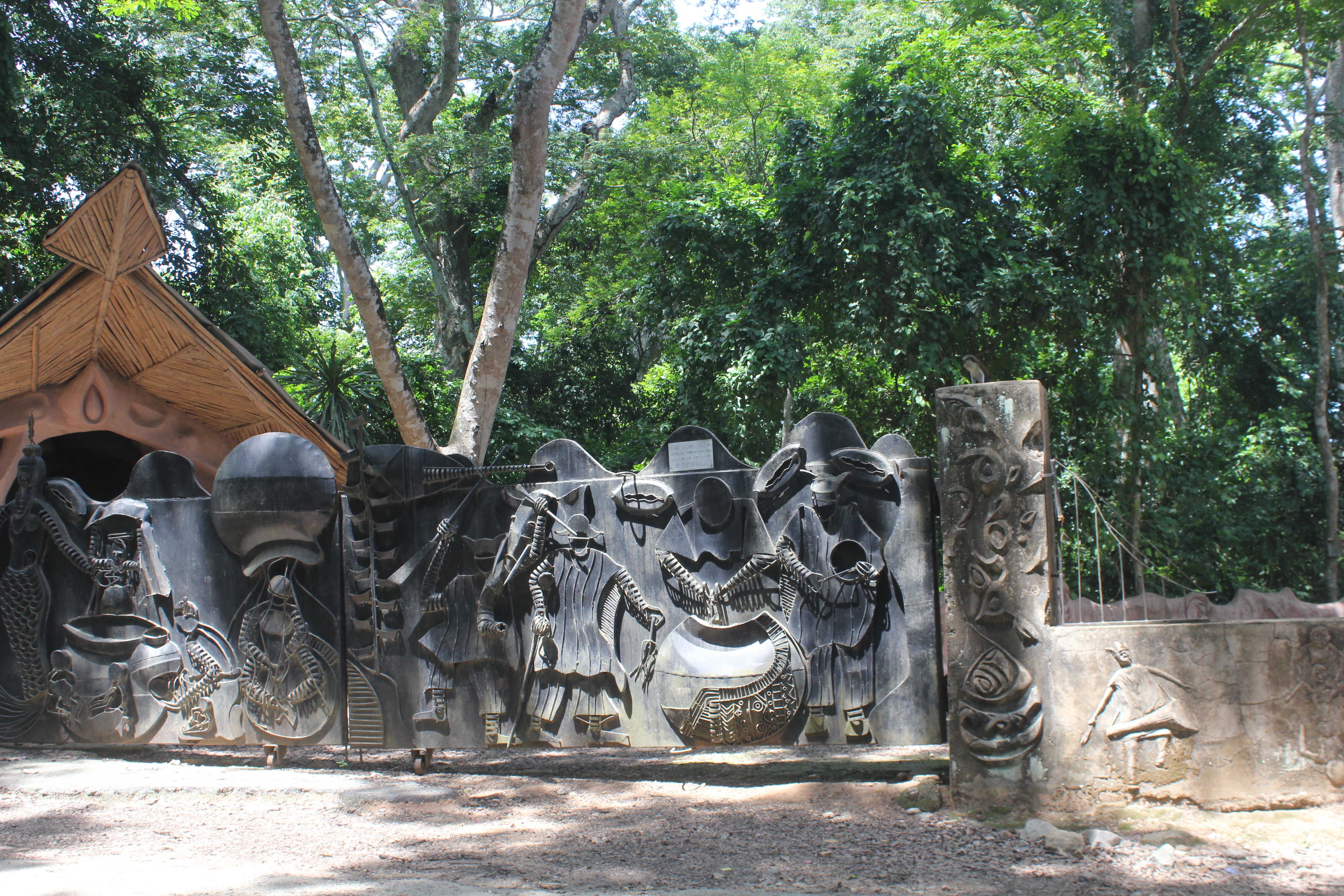
Osun-Osogbo Sacred Grove
Every August, a young woman of royal lineage lifts a sacred calabash and leads a procession through the forest to the banks of the Osun River. She is the Arugba, the calabash carrier, and the sacrifice she bears reenacts a covenant struck more than seven centuries ago between a desperate band of migrants and a river goddess who promised them prosperity in exchange for devotion. Around her, thousands of worshippers, spectators, and tourists from across the world crowd the paths of the Osun-Osogbo Sacred Grove, the last major remnant of the dense sacred forests that once ringed every Yoruba city in southwestern Nigeria.
The Covenant at the River
The story begins with hunger. A group of migrants, led by a great hunter named Olutimehin, settled on the banks of the Osun River to escape famine. According to Yoruba tradition, the river goddess Yeye Osun appeared before Olutimehin and directed him to lead his people to a special place -- the land that would become the city of Osogbo. In return for her protection and the promise of prosperity, she asked for an annual sacrifice. The migrants accepted. That bargain, renewed every year for more than 700 years, is the foundation of the Osun-Osogbo Festival and the reason the grove along the river's banks has been protected as sacred ground across the centuries. The city of Osogbo grew up around its sacred forest rather than consuming it -- an arrangement that held until the forces of urbanization began to press in.
An Austrian in the Sacred Forest
By the 1950s, the covenant was fraying. Shrines fell into neglect. Priests abandoned the grove. People fished, hunted, and felled trees inside its boundaries -- all acts traditionally forbidden. What reversed the decline was an unlikely figure: Susanne Wenger, an Austrian artist who had come to Nigeria and immersed herself in Yoruba spiritual traditions. With the support of the Ataoja, the royal king of Osogbo, and concerned local residents, Wenger formed the New Sacred Art movement. She challenged land speculators, confronted poachers, and began the painstaking work of restoring the grove's shrines and sculptures. Her monumental artworks, woven into the forest's architecture, became inseparable from the grove itself. The Yoruba community honored her with the title "Adunni Olorisha" -- a devotee of the gods. Wenger lived in Osogbo until her death in 2009 at the age of 93, having spent more than half a century as the grove's fiercest protector.
The Two-Week Festival
The Osun-Osogbo Festival is not a single event but a two-week ceremony that unfolds in stages. It begins with the Iwopopo, a traditional cleansing of the city of Osogbo. Three days later comes the lighting of the Ina Olojumerindinlogun, a 500-year-old sixteen-point lamp whose flame marks the formal opening of the sacred season. Then the Iboriade assembles the crowns of past Ataojas for blessings -- a physical gathering of the authority of Osogbo's rulers across generations. The festival culminates in the grand procession to the shrine inside the grove. Drumming, dancing, elaborate costumes, praise poetry recited in Yoruba, and the rituals performed by the Arugba and a committee of priestesses bring the ancient meeting between Olutimehin and Yeye Osun back to life. In 2020, COVID-19 restricted the procession to ritual performers only, but the sacrifice was still made. The covenant, after seven centuries, held.
World Heritage on the Osun's Banks
In 2005, UNESCO inscribed the Osun-Osogbo Sacred Grove as a World Heritage Site, recognizing it as one of the last primary sacred forests in Yoruba culture and a living monument to traditional religious practice. The grove stretches along the banks of the Osun River just outside the city of Osogbo in Osun State, its dense canopy sheltering sculptures, shrines, and sanctuaries that span centuries of devotion. For the people of Osogbo, the festival is more than a tourist attraction -- though it has become one, drawing visitors from across Nigeria and beyond. It serves as a unifying force that transcends the social, economic, religious, and political divisions of modern life. Once a year, the city returns to its founding story, and the river goddess who made a promise to a desperate hunter still receives her due.
From the Air
The Osun-Osogbo Sacred Grove is located at 7.76°N, 4.55°E, along the banks of the Osun River just outside the city of Osogbo in Osun State, southwestern Nigeria. From the air, the grove appears as a conspicuous patch of dense forest on the city's edge -- one of the few remaining primary forest remnants in the region. The nearest airport is Ilorin International Airport (DNIL), approximately 100 km to the north. Osogbo sits in a relatively flat landscape typical of Nigeria's southwestern interior. The Osun River winding through the grove provides a visual landmark from moderate altitudes.