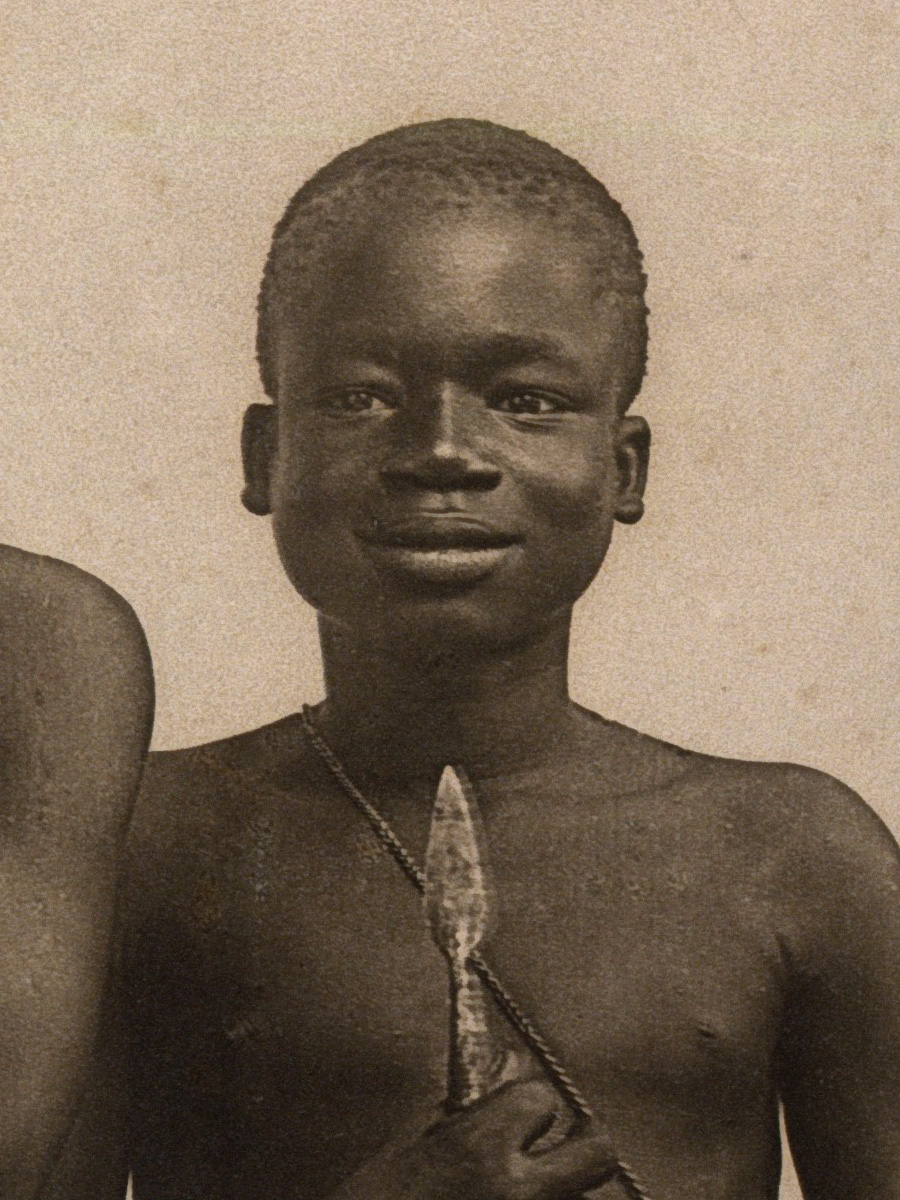
Ota Benga
A sign at the Bronx Zoo's Monkey House in September 1906 read: "The African Pygmy, 'Ota Benga.' Age, 23 years. Height, 4 feet 11 inches. Weight, 103 pounds. Brought from the Kasai River, Congo Free State." The man described in those cold measurements had survived the slaughter of his family by King Leopold II's Force Publique, been sold into slavery for a pound of salt and a bolt of cloth, displayed at the 1904 St. Louis World's Fair, and was now sharing a cage with an orangutan named Dohong. Visitors threw peanuts and jeered. When Benga was given a bow and arrow -- supposedly to enhance his "primitive" image -- he used it to shoot at the people who mocked him. His story is one of the most disturbing episodes in American institutional history, and its final chapter played out not in New York but in the hills of central Virginia.
From the Kasai River to St. Louis
Ota Benga was a member of the Mbuti people, forest dwellers of the equatorial Congo near the Kasai River. His world collapsed when Leopold II's Force Publique -- a militia built to extract rubber through forced labor -- attacked his village while he was away on a hunting expedition. His wife and two children were killed. He was later captured by Bashilele slave traders. In 1904, American businessman Samuel Phillips Verner, under contract to bring African people to the Louisiana Purchase Exposition in St. Louis, purchased Benga from his captors. Verner also recruited Batwa villagers and members of the Bakuba kingdom, including the son of King Ndombe. In St. Louis, Benga became immensely popular. The press mangled his name into variants like "Artiba" and "Ota Bang," promoted him as "the only genuine African cannibal in America," and charged visitors five cents to see his teeth, which had been ritually filed to sharp points in his youth.
The Cage in the Monkey House
After a brief return to the Congo with Verner, Benga chose to come back to the United States, feeling he no longer belonged among the Batwa. Verner arranged for him to stay at the American Museum of Natural History, where Benga wore a Southern-style linen suit and entertained visitors. But confinement tormented him. He once hurled a chair across a room, narrowly missing a wealthy donor's wife. Verner, struggling financially, eventually placed him at the Bronx Zoo, where director William Hornaday and Madison Grant -- later a prominent eugenicist -- arranged for Benga to be displayed alongside apes. African-American clergymen protested immediately. "Our race, we think, is depressed enough, without exhibiting one of us with the apes," said Reverend James H. Gordon. The New York Times responded with an editorial calling pygmies "very low in the human scale." Only after sustained public outcry was Benga released from the zoo at the end of 1906, into Gordon's custody at the Howard Colored Orphan Asylum in Brooklyn.
Virginia's Quiet Years
In 1910, Gordon arranged for Benga to move to Lynchburg, Virginia, where local benefactors paid to have his sharpened teeth capped with dental crowns so he could integrate more easily into society. He adopted the name Otto Bingo, attended elementary school at the Baptist Seminary, studied English, and found work at a local tobacco factory. The community around him offered a measure of stability he had not known since the forests of the Congo. But Benga never stopped wanting to go home. He planned to return to Africa, saving what he could and waiting for passage. Then, in 1914, World War I erupted and all passenger ship traffic to the Belgian Congo ceased. His one remaining hope was severed.
An Unmarked Grave
Stranded permanently in a country that had caged and displayed him, Benga fell into deep depression. On March 20, 1916, he died by suicide. He was buried in an unmarked grave in the black section of Lynchburg's Old City Cemetery, near his benefactor Gregory Hayes. Remarkably, Ishi -- the last surviving member of the Yahi people of California, who had been similarly displayed as a living ethnographic exhibit -- died just five days later, on March 25. At some point, both Benga's and Hayes's remains went missing. Local oral history suggests they were moved to White Rock Hill Cemetery, a burial ground that later fell into disrepair.
Reckoning and Remembrance
Benga's story resurfaced with force in 1992 when Phillips Verner Bradford, Samuel Verner's grandson, published Ota Benga: The Pygmy in the Zoo. The book inspired plays, documentaries, songs, and a 2015 biography by journalist Pamela Newkirk titled Spectacle. The American Museum of Natural History still holds a life mask and body cast of Benga, labeled simply "Pygmy" rather than by name. In 2017, Lynchburg erected a historic marker for Benga -- the city's first formal acknowledgment of his presence. And in 2020, the Wildlife Conservation Society, which operates the Bronx Zoo, issued an official apology for its treatment of Benga and its promotion of eugenics. The apology came 114 years after a man was locked in a cage with an orangutan in the wealthiest city in the world.
From the Air
Located at 37.40N, 79.13W in Lynchburg, Virginia, where Benga spent his final years. The city sits along the James River in the foothills of the Blue Ridge Mountains. The Old City Cemetery, where Benga was originally buried, is visible as a green rectangle on the south side of downtown. Nearest airport: Lynchburg Regional Airport (KLYH), approximately 5 nm to the southwest. Approach from the east following the James River for best orientation. Best viewed at 2,000-3,000 ft AGL to see the cemetery and downtown context.