Otago Central Railway
It took 44 years to finish and 70 to abandon. The Otago Central Railway began construction in 1877 and did not reach its terminus at Cromwell, 236 kilometers inland, until July 1921. Along the way, it climbed through the Taieri Gorge on a route that required 16 major bridges and 10 tunnels in a single 25-kilometer stretch, crossed New Zealand's largest wrought-iron structure, survived a rail disaster that killed 21 people, and outlasted most of the goldfield communities it was built to serve. When the railway finally closed in 1990, the line did something that dead railways almost never do: it found a second life. The Dunedin-to-Middlemarch section became a tourist railway. The rest became a cycling trail. The engineering endures, even if the trains do not.
Building Through the Gorge
The first section, 27 kilometers to Hindon, opened in 1889 after twelve years of construction through some of the most difficult terrain on the South Island. The Taieri Gorge demanded everything engineers of the period could give. The line begins at Wingatui, south of Dunedin, sweeps around a horseshoe curve, and climbs at a gradient of 1 in 50 to a summit at 145 meters, where it enters the 437-meter Salisbury Tunnel -- the longest on the route. Beyond the tunnel, the railway crosses the Wingatui Viaduct, a 197-meter wrought-iron span standing 47 meters above Mullocky Gully. Built in 1887, it has been the largest wrought-iron structure in New Zealand ever since. The gorge section that follows is a relentless sequence of bridges and tunnels: 16 major bridges totaling 1,020 meters of span, and 10 tunnels totaling 1,491 meters of bore, all packed into 25 kilometers. Curved viaducts at Christmas Creek, Deep Stream, and Flat Stream arc across side valleys, and a section called The Notches required three short bridges and cuttings blasted through rocky outcrops.
Slow March Inland
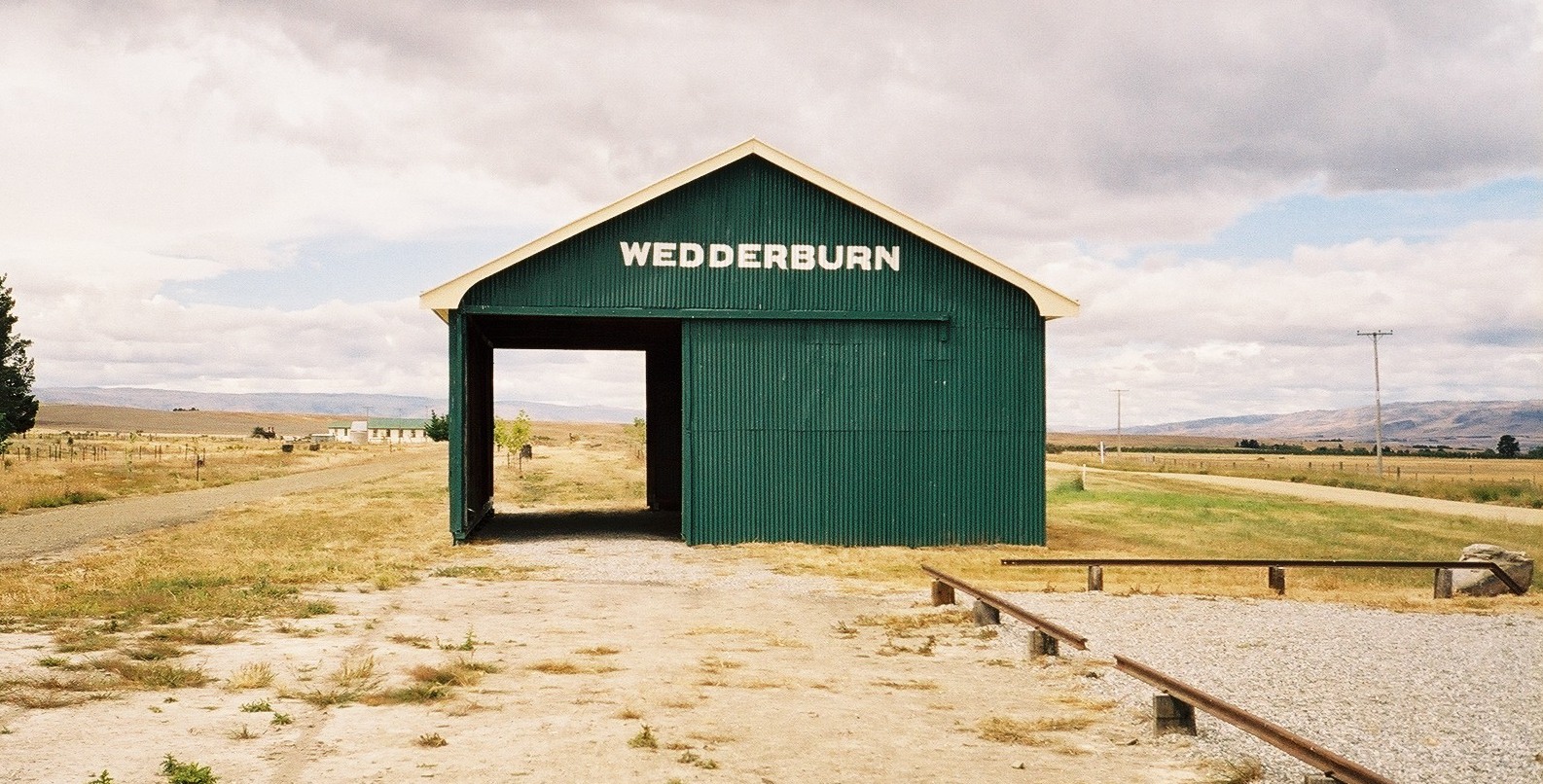
Beyond the gorge, the railway climbed to Pukerangi at 254 meters, then descended onto the Strath Taieri plateau and reached Middlemarch at 64 kilometers. From there, the line pushed deeper into Central Otago in stages that read like a campaign diary: Hyde in 1894, Kokonga in 1897, Ranfurly in December 1898, Wedderburn in 1900, Omakau in 1904, Alexandra in December 1906, Clyde in April 1907. Then came a seven-year pause before construction resumed through the Cromwell Gorge in 1914. The final stretch to Cromwell was not completed until 1921. Each new station name -- Oturehua, Ida Valley, Auripo, Lauder, Chatto Creek -- marked another small settlement sustained by the goldfields or by the sheep farming that replaced them. At its peak, the line connected 37 stations and sidings across the Maniototo Plain and into the heart of Central Otago.
Tragedy at Hyde
On 4 June 1943, a passenger train on the Otago Central line derailed near Hyde, 90 kilometers from Dunedin. Twenty-one people died. At the time, it was New Zealand's worst railway disaster, a record it held until the Tangiwai disaster of 1953. Passenger services had been reintroduced in 1936 after years of running only mixed freight-and-passenger trains. The Hyde disaster cast a shadow over the line, though services continued. Passenger trains were replaced with mixed trains again in 1951, then with Vulcan railcars in 1956. By 1976, even the railcars had stopped running.
Drowning and Rebirth
The railway's final blow came not from declining traffic but from rising water. In 1980, the 20-kilometer section between Clyde and Cromwell was closed to make way for construction of the Clyde Dam, a hydroelectric project on the Clutha River. When the dam was completed in 1990, it flooded the Cromwell Gorge and formed Lake Dunstan, submerging the route the railway had taken through the gorge. With Cromwell cut off, there was little reason to keep the rest of the line. The New Zealand Railways Corporation closed the Otago Central Railway on 30 April 1990. Demolition of the track from Clyde back to Middlemarch began that December and was finished by December 1991. But the Wingatui-to-Middlemarch section was saved. The Otago Excursion Train Trust took it over, operating tourist trains through the Taieri Gorge under the name Dunedin Railways. Meanwhile, the stripped railbed from Middlemarch to Clyde became the Otago Central Rail Trail, one of New Zealand's first and most popular cycling trails. Where steam locomotives once labored up the grades, cyclists now pedal past abandoned goods sheds and through tunnels that echo with nothing but wind.
From the Air
The railway line runs from Wingatui (45.88S, 170.35E), south of Dunedin, 236 km inland to Cromwell (45.05S, 169.19E). The Taieri Gorge section between Wingatui and Pukerangi is the most dramatic from the air -- look for the horseshoe curve, the Wingatui Viaduct (a 197m wrought-iron span), and the sequence of bridges and tunnels threading through the narrow gorge. The Otago Central Rail Trail follows the old railbed from Middlemarch to Clyde across the Maniototo Plain. Nearest airports: Dunedin (NZDN) at the eastern end, Queenstown (NZQN) near the western end. Best viewed at 3,000-6,000 ft to appreciate the gorge engineering.