Oude Kerk, Amsterdam
Walk the cobblestones around the Oude Kerk and look down. Bronze reliefs are set into the pavement, including a small hand cupping a breast, anonymous but unmistakable. Look up, and the medieval church tower lifts into the Amsterdam sky exactly as it has since the 14th century. Look around, and red-lit windows face the churchyard from every side. This is the oldest building in Amsterdam, founded around 1213, standing in the middle of De Wallen. The Old Church and the oldest profession have shared a square for as long as anyone can document, and the city has never quite decided how it feels about that.
Fifteen Generations of Stonework
By 1213 a wooden chapel stood here, on what was then the edge of a small trading port on the Amstel. Replaced by stone, consecrated in 1306 to Saint Nicholas - patron saint of sailors and the people who depended on them - the church grew through the next two centuries as Amsterdam grew. Aisles wrapped around the choir. Transepts pushed north and south to make a cross. Two great fires, in 1421 and 1452, set the work back. Construction limped on until 1460. Fifteen generations of Amsterdammers, according to one count, have added something to this building or taken something away. The painted ceiling panels - too high to reach during the Beeldenstorm of 1566, when iconoclasts smashed the altarpieces and statuary below - are some of the only original medieval Catholic artwork that survives anywhere in the city.
The Year Everything Changed
In 1578 Amsterdam went over to William the Silent and the Dutch Revolt. The Catholic city council was removed in a peaceful coup the Dutch call the Alteratie, and on a single day, the Oude Kerk stopped being Catholic and became Reformed. The Calvinists kept the building but rejected its altars, its saints, and the social messiness that had filled the church for centuries. Vendors had sold things in the nave. The poor had slept in the corners. All of it ended. A century later, in 1681, a heavy oak screen was bolted across the choir. The inscription cut into it reads, in old Dutch, that the prolonged misuse of God's church had been undone again in the year seventy-eight - a stiff Calvinist sentence pointing back across a hundred years of grievance.
Rembrandt's Family Register
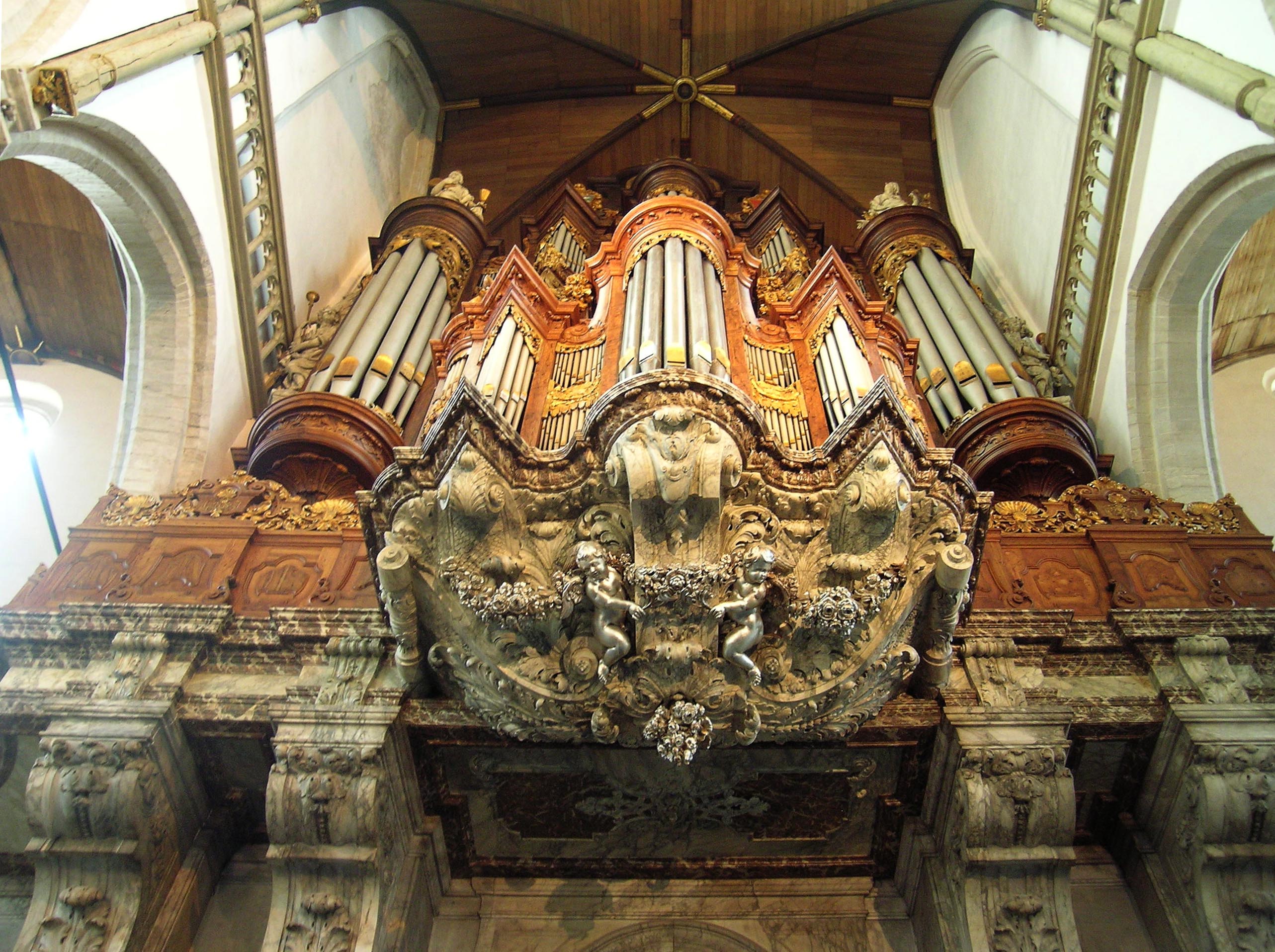
Rembrandt van Rijn lived a few minutes' walk from here on the Jodenbreestraat, and the Oude Kerk became one of the central rooms of his domestic life. His marriage to Saskia van Uylenburgh in 1634 is recorded in the church's register, and the document is still on display inside. Three of their four children were baptised here — the fourth, Titus, was baptised at the Zuiderkerk in 1641. Three of those children died as infants, and Saskia herself died in 1642 at twenty-nine, exhausted by repeated childbirth. She was buried in the Oude Kerk in a rented grave, because Rembrandt could not afford a permanent one. A small shrine in the Holy Sepulchre chapel honours her now. Jan Pieterszoon Sweelinck, the Dutch composer who set all 150 Psalms to music and whose father had been organist here before him, played this church's organ for forty-four years. He is buried here too. The roster of names underfoot reads like a genealogy of the Dutch Golden Age.
The Square Outside
By the late 20th century the area around the Oude Kerk was the most concentrated stretch of legal prostitution in Europe. The church kept its services. The windows kept their lights. In 2007 a bronze statue called Belle was unveiled directly in front of the church doors, depicting a sex worker confidently facing the world, its inscription reading: Respect sex workers all over the world. Since 2012 the church itself has hosted contemporary art exhibitions - installations by Christian Boltanski, Janet Cardiff, Marinus Boezem, and others have filled the medieval nave with sound and light. Each March, in a tradition kept alive since 1881, Catholics walk the Stille Omgang, a silent procession remembering a 1345 eucharistic miracle that allegedly occurred a few streets away. They walk in silence past the windows and the bars, return to a church that has not been Catholic for four and a half centuries, and the city absorbs them as it has absorbed everything else.
From the Air
Coordinates 52.374 N, 4.898 E. The Oude Kerk's tower rises above the dense roofscape of central Amsterdam in De Wallen, just east of Dam Square. From altitude the church reads as a long cross-shaped roof with a square tower at its west end, set among the radiating canals. Recommended viewing altitude 1000-2500 feet AGL for orientation against the canal rings. Nearest airport: Amsterdam Schiphol (EHAM), 12 km southwest. Coastal weather brings frequent low cloud and occasional fog; visibility along the canals can drop quickly in winter.