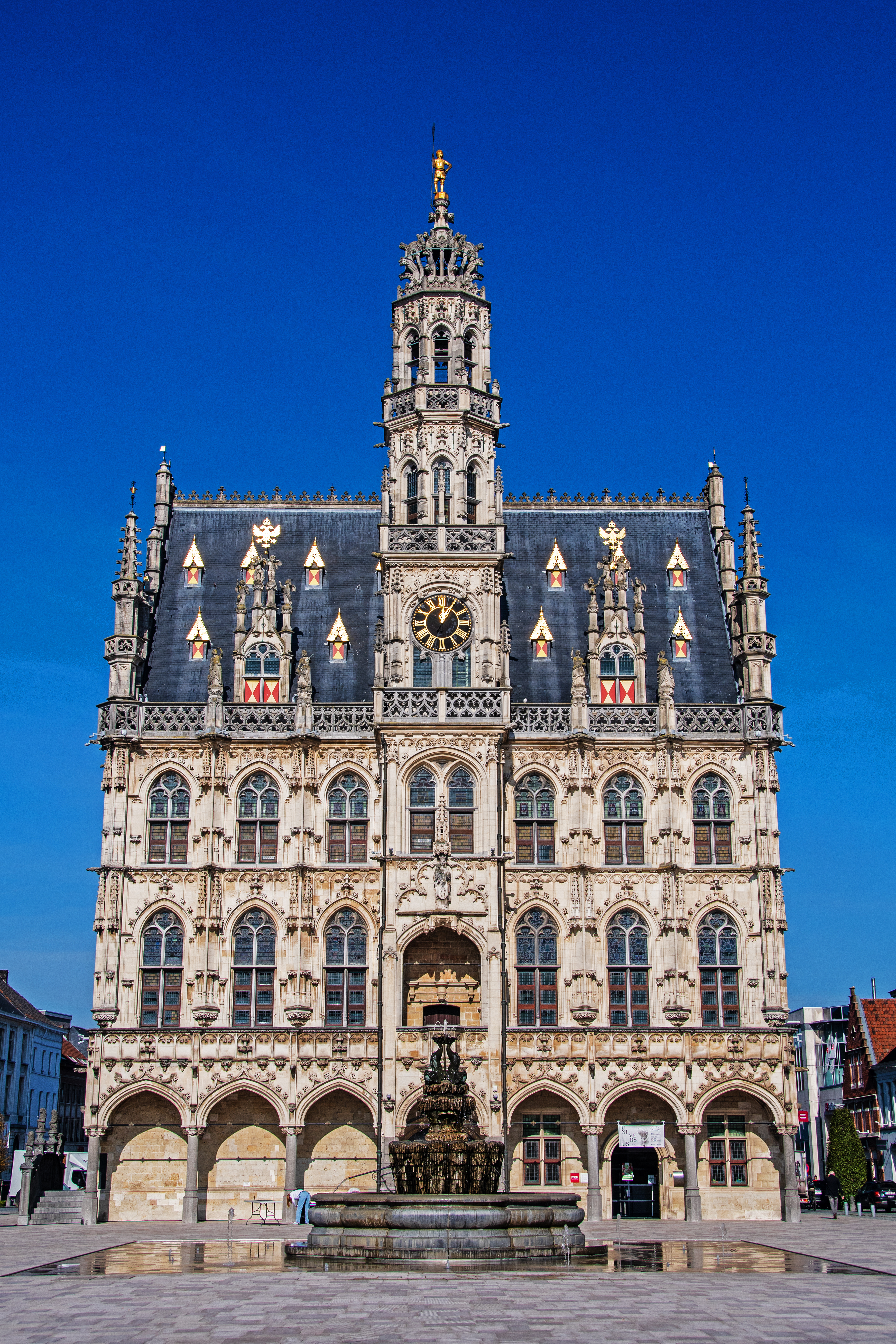
Oudenaarde Town Hall
On top of the central tower of Oudenaarde's town hall, a gilded brass figure rotates slowly in the wind above the market square. He is called Hanske de Krijger - Hans the Warrior - the mythical guardian of the city, and he has stood watch since the building was finished in 1537. The roofline he crowns belongs to one of the last and most extravagant examples of Brabantine Gothic civic architecture, a style that had peaked at Brussels and Leuven a century earlier and was supposed to be over. Oudenaarde missed the memo. The town built its impossibly ornate town hall just as Renaissance forms were sweeping the rest of Europe, and the result is so significant that UNESCO put it on the World Heritage List in 1999.
Built for an Emperor's Memory
Construction ran from 1526 to 1537 under the direction of the architect Hendrik van Pede, replacing a medieval Aldermen's House on the same site. The decorative program was political. A few years earlier, in 1522, the young Emperor Charles V had spent several months in Oudenaarde - and fathered an illegitimate daughter named Margaret of Parma during his stay. Margaret would later become Regent of the Netherlands, ruling over the very provinces her father had inherited. The town hall acknowledges the connection with a stone crown atop the central tower and double-headed Habsburg eagles set over the attic windows. The fourteenth-century Cloth Hall, an older structure on the same lot, was kept and incorporated as a kind of architectural cousin at the back of the new building. Together they form a single complex that combined government and commerce - which is exactly how Oudenaarde wanted itself to be seen.
The Last Brabantine Gothic
Brabantine Gothic was the regional architectural language of the Low Countries' great civic projects - Brussels city hall, Leuven city hall, Middelburg in Zeeland - with its richly decorated facades, pointed-arch windows separated by canopied niches, and steep dormered roofs surrounded by an openwork stone parapet. By the 1520s the style was very old-fashioned. Oudenaarde built it anyway, in part because the town wanted to claim the same civic dignity as Leuven and Brussels. The result is a facade so loaded with carving that the empty statue niches feel like the building's only restrained gesture - they were designed to hold figures of dignitaries and saints, but the statues were never installed. Above the ground-floor arcade with its vaulted ceiling, the upper stories rise in a stone composition that resembles a piece of metalwork blown up to architectural scale. The central belfry tower of six stories rises in three terraced setbacks and is topped by a stone crown that Hans the Warrior balances on, leaning into the prevailing wind.
Inside the Building
The ground floor was reserved for trade from the very beginning - a Corn House, a Weighhouse, and a Lower Cloth Hall - and today it accommodates the town's tourism office, the same building still doing roughly the same job. The second floor is where the civic ceremony lives. An elaborate portal carved by Pauwel van der Schelden in the early sixteenth century opens into the Schepenzaal, the council chamber where the aldermen of Oudenaarde met to govern the city. The People's Hall takes up the front of the same floor and opens onto the terrace overlooking the market square, where receptions and banquets were held and where, on at least a few occasions, the building's residents made formal addresses to the crowds gathered below. The third floor houses the Silver Room - Oudenaarde was famous for its silversmiths between the fifteenth and eighteenth centuries - and the Municipal Museum, with art and artifacts pulled together from the city's long history.
Tapestries on the Wall
What hangs inside the Lower Cloth Hall and the adjacent fourteenth-century Cloth Hall building is what really made Oudenaarde rich. The Oudenaarde tapestries of the fifteenth through eighteenth centuries were exported across Europe, sold in markets from Madrid to Krakow, and considered second only to those of Brussels in quality. The most accomplished weavers worked from cartoons designed by Flemish painters and produced hangings depicting everything from biblical scenes to military victories to landscapes of pastoral fantasy. Many of the surviving examples are in foreign museums now, but the town hall keeps a representative selection at home, mounted as the building's designers always intended. The story of UNESCO's 1999 inscription explicitly recognized the building's role in representing the civic influence and architecture of the town - which is to say, the building exists because Oudenaarde was wealthy enough on tapestries to commission it, and the building is itself part of how tapestries got sold. The blue-stone facade now darkening into another century still does the same work it did in 1537: announcing to anyone walking into the market square that this city takes itself seriously.
From the Air
Oudenaarde Town Hall stands at 50.84°N, 3.60°E in the center of Oudenaarde, on the Grote Markt overlooking the Scheldt river in East Flanders. From the air the central belfry tower with its stone crown is the most prominent landmark in the city, visible from cruising altitude as a distinct vertical against the surrounding red-roofed townscape. The Church of Saint Walburga nearby provides a second navigation reference. Nearest airports are Brussels (EBBR) approximately 50 km east-northeast and Lille-Lesquin (LFQQ) roughly 40 km southwest. The terrain is the flat Scheldt valley with the Flemish Ardennes hills rising visibly to the south.