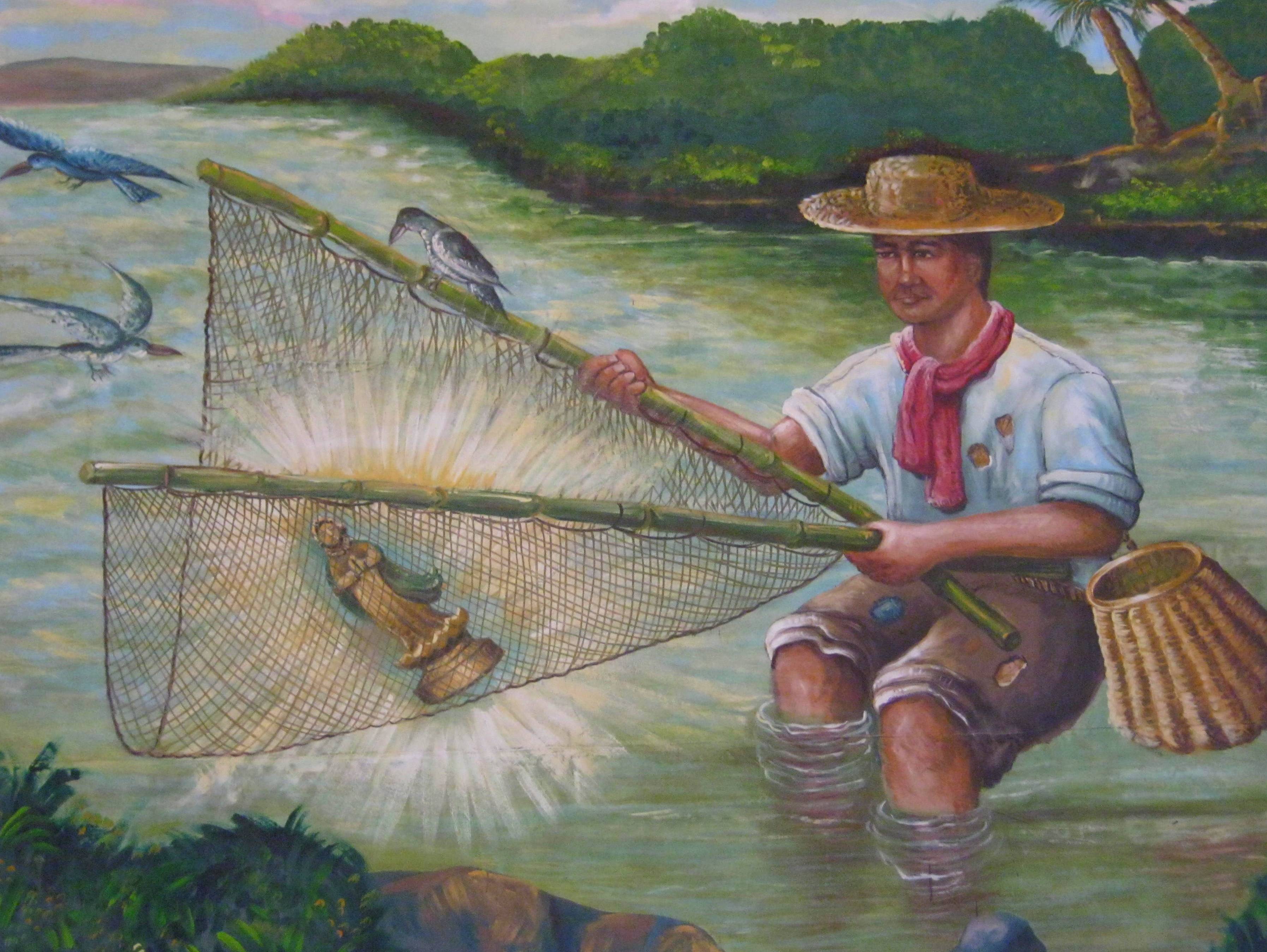
Our Lady of Caysasay
A fisherman named Juan Maningcad cast his net into the Pansipit River in 1603, expecting fish. What he pulled from the water instead was a small wooden statue of the Virgin Mary, barely 272 millimeters tall, waterlogged but luminous. Maningcad fell to his knees on the riverbank in the tiny barangay of Caysasay, part of the town of Taal in Batangas province. He could not have known that this figure -- one eye slightly larger than the other, dressed in a red tunic with a green shawl -- would generate the first documented Marian apparitions in Philippine history, survive one of the deadliest volcanic eruptions in the archipelago's memory, and still draw pilgrims to a hillside well more than four hundred years later.
Pulled from the Current
Nobody knows how the statue ended up in the Pansipit River. One theory holds that Spanish sailors cast it into the sea off Batangas to calm the waters during an expedition, and that tides and currents carried it upstream. Others suggested a river explorer had dropped it accidentally, or that it had come from China -- plausible given the centuries of trade between Chinese merchants and the Philippine coast. Whatever its origin, word of Maningcad's catch traveled fast. The parish priest, Fray Juan Bautista Montoya, and the vicar representing the King of Spain went to the fisherman's house to investigate. Upon seeing the image, both men knelt and venerated it on the spot. The statue was entrusted to Dona Maria Espiritu, the widow of the town's judge, who commissioned a carved wooden urna -- a canopied shrine with glass panes -- to house it in her home.
The Wandering Virgin
Then the image began to disappear. Every evening, Dona Maria found the urna empty; every morning, the statue was back in its place. When she told the priest, he came to witness it himself and saw the shrine standing open with no figure inside. As they watched, the urna opened of its own accord and the statue reappeared. Volunteers were gathered to keep vigil, and they too saw the carved doors swing open, the image depart, and then return. The priest organized the villagers to follow the statue with lighted candles the next time it left. The procession tracked it to Caysasay, to the very spot on the riverbank where Maningcad had first drawn it from the water. Montoya moved the image to the Basilica of Saint Martin de Tours for safekeeping, but it continued to vanish until one day it was gone entirely.
Light in the Darkness
News of the disappearance reached Juana Tangui, a servant from the nearby town of Bauan who had long suffered from a burning eye disease that left her nearly blind. She traveled to the rock where people said the Virgin had appeared, bathing in a stream that locals believed could heal the sick. During her bath, in full darkness with neither sun nor moon, she noticed an unexplained shadow beside her. Then she felt invisible hands turning her body. When she looked in the direction she had been turned, she saw a brilliant light -- like an enormous candle burning in the night. Returning with a young companion, Juana saw the image of the Virgin dressed in white, crowned, with a cross on her forehead. The figure appeared alive, moving and blinking. It spoke to her, thanking her for remembering and returning. The apparitions documented between 1611 and 1639 by Father Casimiro Diaz -- then a deputy of the order's Mexican center, as the Philippines fell under the autonomous Mexican vicariate -- became the first officially recorded Marian apparitions in the country.
Fire from Below
In 1754, the Taal Volcano unleashed its most violent eruption in recorded history, a convulsion that lasted more than eight months. Ejecta buried the towns ringing Taal Lake under layers of volcanic deposits. The townspeople of Taal and their parish priest fled their settlement and sought refuge at the Church of Our Lady of Caysasay. The eruption blocked the entrance of the Pansipit River, raising lake levels until entire sections of five towns -- Tanauan, Lipa, Sala, Bauan, and Taal itself -- were permanently flooded. All five communities relocated to higher ground, away from the volcano and the swollen lake. The shrine survived. The statue that had already proven impossible to confine to a single location endured the worst the volcano could deliver, becoming a symbol of persistence through catastrophe for the communities rebuilt on the hills above.
Sacred Water on the Hillside
Behind the Caysasay Church, the Saint Lorenzo Ruiz Steps descend toward a hillside spring. An inconspicuous walkway leads visitors to the Balon ng Sta. Lucia -- the Well of Saint Lucy -- where, according to tradition, two women named Maria Bagohin and Maria Talain once saw the Virgin's reflection in the water. A beautifully carved coral stone arch bearing a bas-relief of the Virgin was built over the spring at some unknown date, forming twin wells at a site the locals call Banal na Pook, the sacred place. The spring water flowing nearby is known as Banal na Tubig -- sacred water. Why the well bears Saint Lucy's name has been forgotten, one of those details lost to four centuries of oral tradition. But the devotion has not faded. The feast day of Our Lady of Caysasay falls on December 8 and 9 each year, and the image -- still unrestored, still bearing its original complexion, still titled the Queen of the Archdiocese of Lipa -- continues to draw the faithful to a riverbank where a fisherman once cast his net and pulled up something he could not explain.
From the Air
The Archdiocesan Shrine of Our Lady of Caysasay sits at approximately 13.88N, 120.92E in Taal, Batangas, Philippines. Taal Lake and the dramatic Taal Volcano island are clearly visible from altitude to the northeast. The Pansipit River connects the lake to Balayan Bay. Nearest airports include Ninoy Aquino International (RPLL) in Manila to the north. The town of Taal sits on elevated terrain southwest of the lake, relocated after the 1754 eruption. Best viewed at 5,000-8,000 feet to see the relationship between the town, the lake, and the volcano.