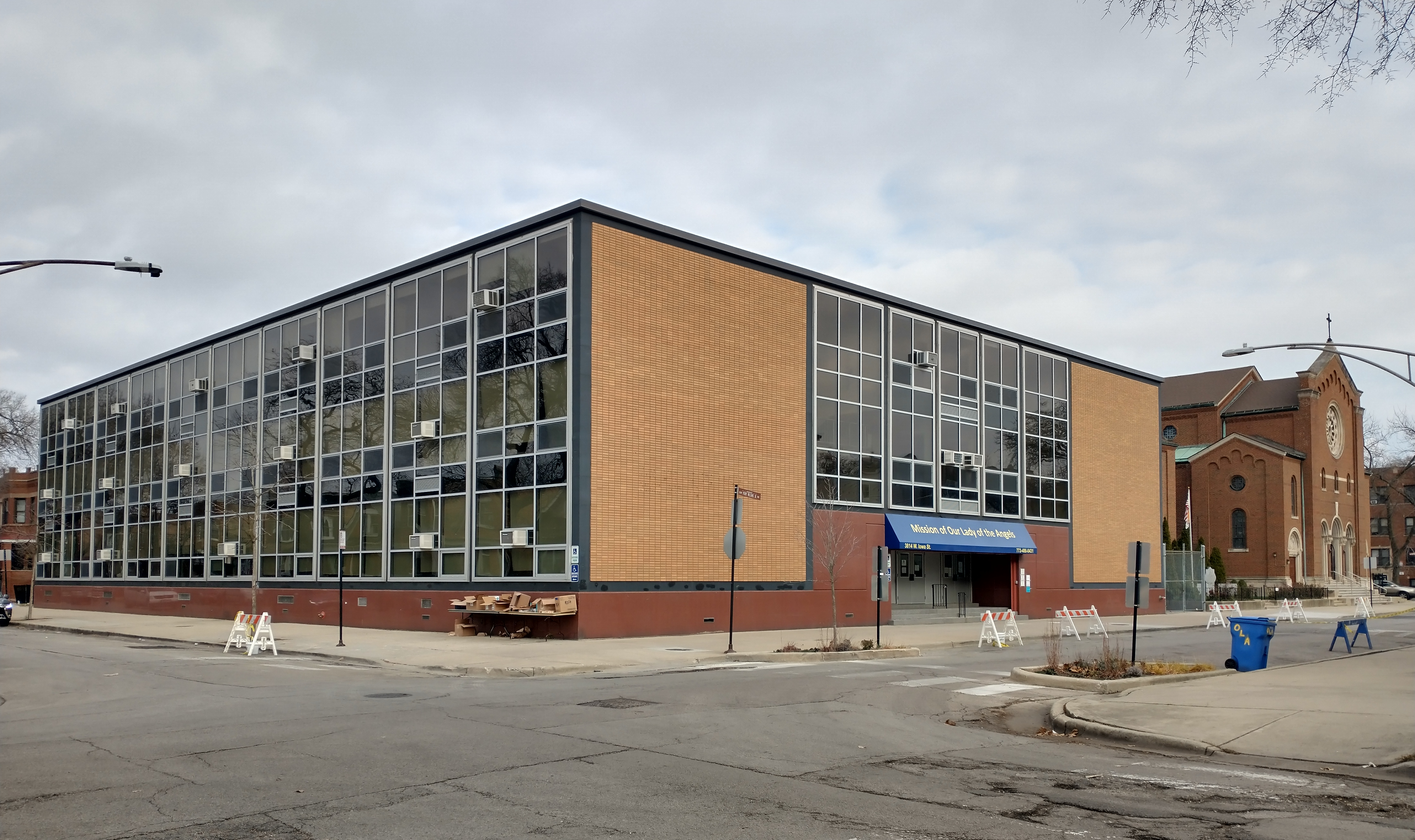
Our Lady of the Angels School Fire
In the neighborhood surrounding 909 North Avers Avenue, people still call it simply "the fire." No other words are needed. Carmen Mele, sibling of one of the victims, explained why: "There is no need to introduce the topic with another adjective." On Monday, December 1, 1958, shortly before classes were to be dismissed for the day, fire broke out in the basement of Our Lady of the Angels School in Chicago's Humboldt Park neighborhood. By the time it was over, 92 children and three nuns were dead -- trapped on the second floor of the north wing by smoke, superheated gases, and flames that turned their classrooms into sealed furnaces. The disaster made headlines across the United States, Europe, and Canada. Pope John XXIII sent his condolences from the Vatican. And every fire safety code governing American schools was about to change forever.
A Building Made to Burn
The north wing of Our Lady of the Angels was a two-story structure built in 1910, originally a combination of church on the first floor and school above. By 1958 it was an all-school building serving roughly 1,600 students in the parish. Its brick exterior satisfied a city code written after the Great Chicago Fire of 1871 -- fires would not jump between buildings. But behind that brick shell, nearly everything was combustible: wooden stairs, wooden walls, wooden floors, wooden doors, cellulose fiber ceiling tiles, and a roof coated many times over with thick tar. The floors had been waxed repeatedly with petroleum-based products. There was no automatic fire alarm, no heat detectors, no direct connection to the fire department, no fire-resistant stairwells, and no fire doors protecting the second-floor corridor. Four fire extinguishers hung high on the walls, out of reach of children and most adults. The nearest street-level fire alarm box was a block and a half away. Because the building had a raised basement, second-floor windows stood nearly three stories above ground -- and below them, only concrete and crushed rock.
Forty Minutes of Invisible Death
Sometime between 2:00 and 2:20 p.m., fire ignited in a cardboard trash barrel near the northeast stairwell. It smoldered undetected for roughly twenty minutes, feeding superheated air into an open pipe chase that ran straight up to the cockloft above the second-floor classrooms. At about 2:25 p.m., three eighth-grade girls returning from an errand encountered thick grayish smoke in the corridor and rushed into Room 211. Their teacher, Sister Mary Helaine O'Neill, opened the classroom door to the hallway and found it impassable. She kept her students inside. When a window shattered at the base of the stairwell, fresh oxygen transformed the smoldering fire into an inferno. A roll of tarred building paper ignited, filling the stairway with thick, oily black smoke. The wooden staircase became a chimney. Meanwhile, the janitor, James Raymond, spotted a red glow through a window and ran to the rectory to have someone call the fire department. An unexplained delay meant the first call did not reach firefighters until 2:42 p.m. -- more than twenty minutes after the danger was first observed. A second call came one minute later from Barbara Glowacki, owner of a candy store on the alley beside the school.
Rooms Without Escape
The pipe chase delivered superheated gases to the cockloft, which eventually flashed over, sending fire down through ventilation grates and shattering the glass transom windows above every classroom door. For 329 children and five nuns on the second floor, the corridor was gone. Their only options were to jump from windows nearly three stories high or wait for rescue. In Room 209, Sister Mary Davidis Devine ordered her students to stack books and furniture against the doors, buying precious minutes. Of her 55 students, 53 survived. In Room 210, where 57 fourth-graders sat with Sister Mary Seraphica Kelley, 29 died -- the highest toll of any classroom. The smaller children could not climb the high window sills. In Room 212 at the far end of the corridor, flames never entered, but toxic smoke killed 26 of the 55 fifth-graders and their teacher, Sister Mary Clare Therese Champagne. Every death in Room 212 was from asphyxiation. A photograph of firefighter Richard Scheidt carrying ten-year-old John Jajkowski's body from that room became one of the most recognizable fire safety images in American history.
A City in Mourning
Firefighters arrived within four minutes of being called but were initially directed to the wrong address. By the time they repositioned, the fire had burned unchecked for as long as forty minutes. They rescued more than 160 children, but many were already dead. A locked iron picket fence around a courtyard delayed ladder access to Rooms 209 and 211 -- firefighters spent two minutes battering it before ramming it with a truck. A crowd of more than 5,000 parents and onlookers gathered behind police lines as bodies were removed. National television interrupted programming to cover the disaster. The funeral for 27 of the children was held at the Illinois National Guard Armory beside Humboldt Park because no single church in the archdiocese could hold the crowd. Cardinal Francis Spellman traveled from New York. Mayor Richard J. Daley ordered flags across Chicago lowered to half-staff. The Chicago American devoted its entire front page to photographs of the deceased students under the headline "Chicago Mourns."
Old Lessons, Finally Learned
Percy Bugbee, president of the National Fire Protection Association, said after the fire: "There are no new lessons to be learned from this fire; only old lessons that tragically went unheeded." The school had passed a routine fire inspection just weeks before the disaster, but a grandfather clause in the 1949 building code exempted older structures from modern safety requirements. The fire's cause was never officially determined. In 1962, a ten-year-old student at the time of the blaze confessed to setting it, but a judge found the evidence insufficient. Within a year of the disaster, 16,500 older school buildings across the United States were brought up to modern fire codes. Chicago's city council mandated fire alarm boxes outside schools, required interior alarms to connect to street boxes, and called for sprinkler systems in vulnerable buildings. Fire investigators came from as far as London to study the lessons. The ruins were demolished in 1959, and a new school opened on the same site in September 1960, built to the highest safety standards with sprinklers, fire doors, and alarms -- funded in part by donations from around the world. Among the survivors was nine-year-old Jonathan Friga, who would grow up to become Jonathan Cain, keyboardist for the rock band Journey. The school closed in 1999 after decades of declining enrollment. Today the building serves as a multipurpose outreach center for Mission of Our Lady of Angels, and the parish church next door remains in operation. A memorial that was installed at the church, briefly relocated, was returned in 2022 -- a quiet marker for the day that a neighborhood, and a nation, learned what fire codes are written in.
From the Air
The site of Our Lady of the Angels School is at approximately 41.898N, 87.722W, at the corner of West Iowa Street and North Avers Avenue in the Humboldt Park neighborhood of Chicago's West Side. The replacement school building (now a community center) occupies the same block. Nearby landmark: Humboldt Park itself is one block east. The surrounding area is dense residential urban grid. Nearest airports: Chicago O'Hare International (KORD), approximately 12nm northwest; Chicago Midway International (KMDW), approximately 7nm south-southwest. From altitude, the Humboldt Park green space and the grid pattern of the West Side provide orientation.