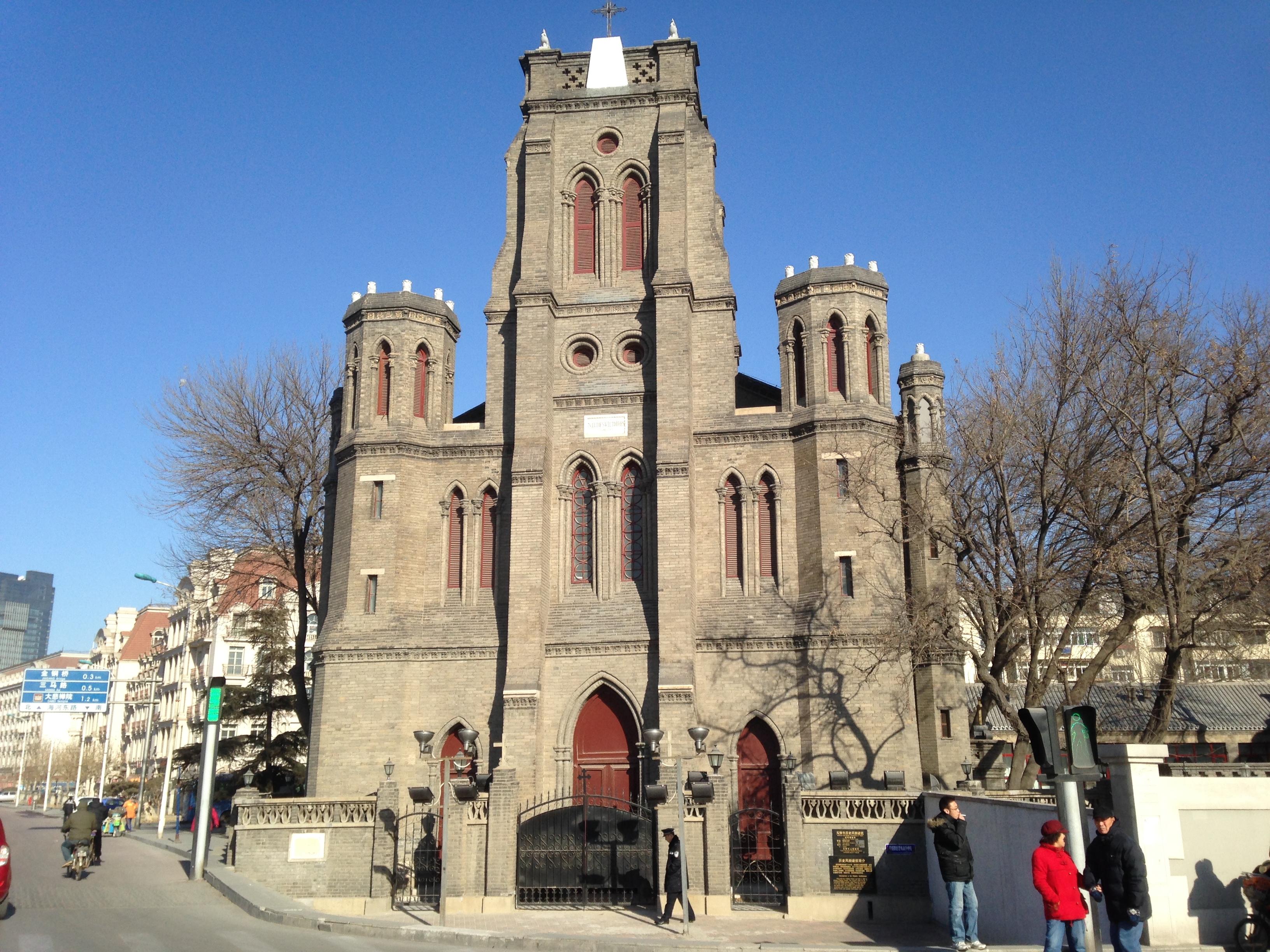
Our Lady of Victory Church, Tianjin
Four times destroyed, four times rebuilt. Our Lady of Victory Church -- known locally as Wanghailou Church -- has endured a cycle of violence and resurrection that mirrors the turbulent history of Christianity in northern China. The site where it stands, overlooking the Hai River in Tianjin, has been a place of consequence since 1773, when salt merchants built a three-story structure that served as a temporary residence for the Qianlong Emperor, who named it the Haihe Building. What replaced it has been burned, bombed, vandalized, and shaken to its foundations, and it is still standing.
From Imperial Lodging to French Church
The transformation began in 1862, when a French missionary priest negotiated through the French consulate and the Qing minister Chonghou to obtain a parcel of land that included the former imperial waystation. By 1869, the old structure had been demolished and replaced with a church dedicated to Our Lady of Victory. The conversion was more than architectural -- it was a statement of foreign power on ground that had once hosted an emperor. The church stood for barely a year before it was consumed by the Tianjin Massacre of 1870, a violent anti-Christian, anti-foreign uprising in which Chinese mobs attacked the church and other Catholic sites in the city, killing French nuns, priests, and Chinese converts.
Built, Burned, Built Again
In 1897, the church was rebuilt using reparation funds extracted from the Qing government -- a financial arrangement that exemplified the unequal power dynamics of the era. The reconstruction lasted three years before the Boxers arrived in Tianjin in 1900, attacking foreigners and Chinese Catholics alike. The church was destroyed a second time. In 1903, it was rebuilt once more, again with Qing reparation money. This pattern of destruction and reconstruction, funded by the very government whose subjects had carried out the violence, reveals the impossible position of the late Qing state: too weak to protect the foreigners it was treaty-bound to accommodate, and then forced to pay for the damage its people inflicted.
Cathedral, Closure, and the Cultural Revolution
In 1912, Rome officially established the Diocese of Tianjin, and Our Lady of Victory was designated its cathedral. The elevation was brief: by 1916, the larger and more imposing St. Joseph's Cathedral (Xikai Church) took over as the diocesan seat. After the Communist revolution in 1949, the church was closed, though it was partially reopened later. The Cultural Revolution brought fresh destruction when Red Guards attacked the building, vandalizing its interior in a campaign against the "Four Olds" that targeted religious sites across China. The church survived the ideological assault, only to face a natural one.
The Earth Itself
On July 28, 1976, the catastrophic Tangshan earthquake -- one of the deadliest in recorded history, with an officially recorded death toll of over 242,000 -- struck approximately 110 kilometers northeast of Tianjin. The city suffered severe damage, and Our Lady of Victory was heavily damaged once more. In 1983, the Tianjin municipal government rebuilt the church, an act of preservation by a secular state that recognized the building's historical significance regardless of its religious function. The church that stands today is the product of that reconstruction -- the fourth iteration on a site that has hosted imperial residences, foreign cathedrals, and nearly two centuries of China's most convulsive history. Postcards from 1898 and 1900 show earlier versions of the building, each one a ghost of the present structure.
From the Air
Located at 39.15°N, 117.19°E on the north bank of the Hai River in central Tianjin, near the junction with the Ancient Culture Street area. The church's Western architectural style makes it distinguishable from surrounding Chinese buildings at lower altitudes. Nearest airport: Tianjin Binhai International (ZBTJ), approximately 15 km east. Beijing Capital International (ZBAA) is about 120 km northwest. The Hai River provides a clear navigational reference; the church sits on its north bank near the Jintang Bridge.