Ourense Cathedral
Eight canons once held the title Cardenales -- cardinals -- a privilege so ancient that Pope Innocent III declared it "immemorial" when he confirmed it in 1209. They served at a cathedral that had already been standing, in one form or another, for more than six centuries. Ourense Cathedral, dedicated to Saint Martin of Tours, is not the grandest church in Galicia. But it may be the most layered, its walls a palimpsest of Romanesque, Gothic, Renaissance, Baroque, and Neoclassical work stretching from the 6th century to the present.
A Church That Refused to Stay Down
The first cathedral in Ourense was likely the church of Santa Maria la Madre. Then, around 550, the Suevian king Chararic built a second church on the present site, dedicating it to Saint Martin of Tours. An arch bridge rose nearby over the Mino River, giving access to the thermal springs that had drawn settlers since Roman times. But the cathedral's early centuries were violent. Moors destroyed it. Vikings -- the Northmen, as Galician records call them -- destroyed it again. Each time, it was rebuilt. The current structure took shape as a Romanesque church in the 12th and 13th centuries under Bishop Lorenzo, who also constructed a new bridge and the bishop's palace. Gothic additions continued until the early 16th century. In June 1931, the cathedral was classified as a national monument, and it has officially been designated a basilica since 1887.
The Portal of Paradise
The cathedral's North Door reveals the full complexity of its architectural history. Originally Romanesque in design, it accumulated Gothic additions over the centuries. The tympanum is crowned by a cross depicting Mary receiving Christ's body, while carved figures include Saint Martin tearing his cloak in two -- the famous miracle in which the soldier-saint shared his garment with a beggar -- and the figure of the Apostle James. The turrets flanking the entrance were added for protection after Rodrigo Alonso Pimentel destroyed the doorway in 1471. But the cathedral's sculptural crown is the Portal of Paradise, enriched with figures of angels and saints. The antique cloisters, erected in 1204 by Bishop Ederonio, connect the cathedral to the Capilla de la Maria Madre, which was restored in 1722.
Altarpieces and Tombs
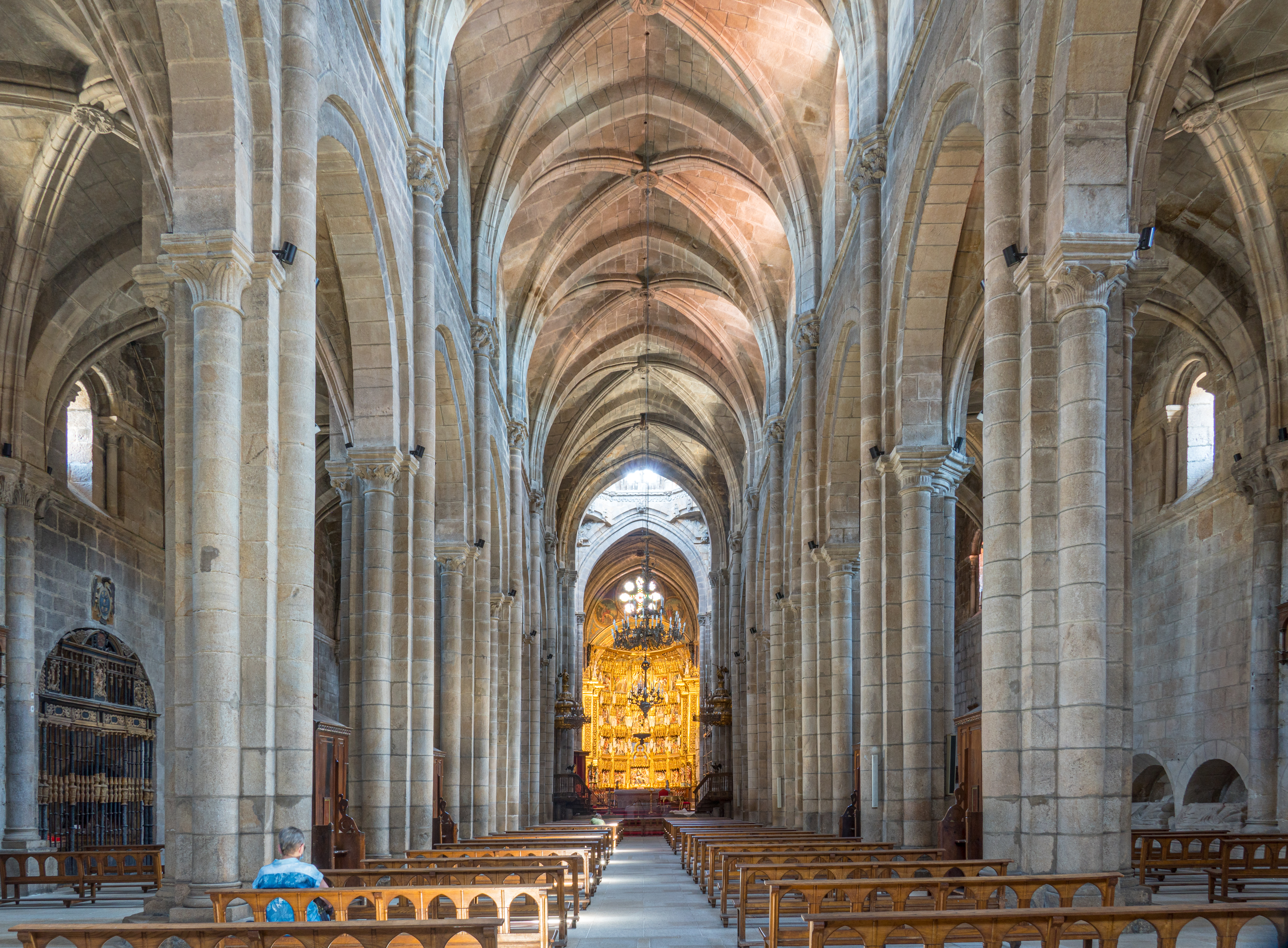
Inside, the Gothic nave opens upward through decorative arches and a vaulted ceiling. The main altarpiece, attributed to the Flemish sculptor Cornielles de Holanda, fills the chancel with five vertical panels divided into horizontal compartments. Saint Martin presides in the central panel while scenes from the lives of Jesus and Mary surround him. On either side stand altars dedicated to Ourense's martyred saints: Facundus, Primitivus, and Euphemia. Christ's Chapel draws particular devotion. Bishop Vasco Perez Marino commissioned it so he might be buried as close as possible to the figure of Christ, and it is decorated in flamboyant Baroque style with a Renaissance screen by Juan Bautista Celma and a canopy by Domingo de Andrade. The chapel contains an image of Christ brought in 1330 from a small church at Cape Finisterre -- a crucifix held in deep reverence across all of Galicia.
Treasures Behind the Cloisters
Through a Romanesque door, visitors enter the Gothic cloisters known as Claustra Nova and the cathedral's museum. The collection ranges widely across centuries and media. Among its treasures is El Incunable de Monterrey, the first book published in Galicia, printed in 1494. Enrique de Arfe's processional cross glints with metalwork skill. Thirteenth-century enamels from Limoges demonstrate the reach of medieval trade networks into this corner of Spain. The museum also holds the Treasure of San Rosendo and what may be its most quietly remarkable artifact: the oldest known Christian tombstone in Galicia, excavated from Banos de Bande. These objects tell a story that extends beyond the cathedral itself, tracing the threads of faith, commerce, and artistry that connected Ourense to the broader European world across a millennium and a half.
From the Air
Located at 42.336N, 7.863W in the city of Ourense, in inland Galicia, Spain. The cathedral sits in the center of the old city, near the Mino River and the historic Ponte Vella bridge. Ourense does not have a commercial airport; nearest is Vigo-Peinador (LEVX, ~90 km southwest) or Santiago de Compostela (LEST, ~105 km northwest). Best viewed at 3,000-5,000 ft AGL. The Mino River valley and surrounding hills provide clear landmarks for navigation.