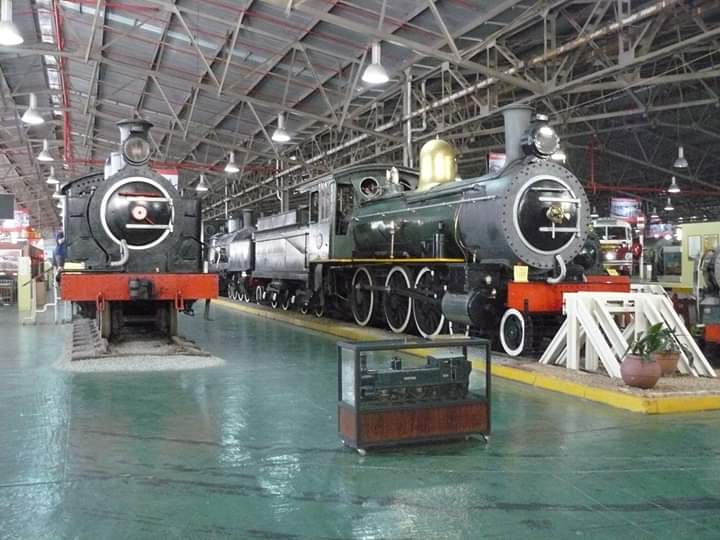
Outeniqua Transport Museum
The sign on the guards van was supposed to read "Whites" and "Non-whites" in Afrikaans. Instead, a well-meaning English modeler in Poole translated "Blankes" and "Nie blankes" as "Smoking" and "Non smoking." It is a small, absurd detail from a miniature world, but it captures something essential about the Outeniqua Transport Museum: here, in a former goods shed in the Garden Route town of George, the grand and the granular sit side by side, and every artifact carries a story larger than itself.
Iron Horses in the Garden Route
The museum opened on 24 September 1998 in the old PX-goods shed of George station, one of the Transnet Heritage Foundation's collection of railway museums. Its holdings are formidable: 21 steam locomotives and 22 coaches, along with road vehicles, model trains, and rolling stock that span more than a century of South African transport. The oldest locomotive dates to 1889, a 14 Tonner built by Maschinenfabrik Esslingen in Germany for the Netherlands-South African Railway Company. A Class A tank engine, also from 1889, was built by Dubs & Company in Glasgow for the Natal Government Railways. These machines hauled ore and passengers through the Transvaal and Natal before union, before apartheid, before the age of diesel. Standing among them in the shed, with daylight slanting through high windows, the scale of early railroading in southern Africa becomes tangible.
Coach 49 and the Victoria Falls Bridge
Among the rolling stock, White Coach 49 stands apart. Built by the Metropolitan Carriage & Wagon Company in England and placed in service in June 1947, the coach was designed for the Governor-General's White Train, not for ordinary passengers. Its saloon features a single long table seating sixteen, satin-finished timber paneling, a stainless steel kitchen, and air conditioning. For nearly three decades it served as the State President's dining car. But its most remarkable chapter came in August 1975, when the White Train was positioned at the center of the Victoria Falls Bridge for peace negotiations over the Rhodesian conflict. Coach 49 became, briefly, a diplomatic stage suspended above the Zambezi gorge. President Nico Diederichs withdrew the train from service shortly afterward, and it found its way here, to George, where visitors can peer through its windows at a table where history was debated.
Captain Baxter's Perfect Replicas
The museum's model train collection owes much to Captain John Baxter, born in Natal to a station master's family. After serving in the South African Navy during World War II and captaining merchant ships for Clan Line, Baxter retired to South Africa in 1967 with an obsession: building flawless S-scale replicas of South African Railways locomotives. Working from a garage in Westville, outside Durban, he produced a procession of miniature machines, each mechanically functional and visually precise. A 16E, an 8th class, a Class 14R, a GO, a 12AR. His technique approached perfection, though his signwriting did not, which is how that Poole model club member's well-intentioned mistranslation entered railway lore. The collection now includes replicas of the Blue Train and Orange Express, built for the Van Riebeeck Tercentenary Exhibition in Cape Town.
From Steam Vans to Intercity Buses
The museum's scope extends beyond rail. A rare four-wheeled Thornycroft, one of the few surviving examples of its kind, represents the early days of British road transport. John Isaac Thornycroft built his first steam lorry in 1896, and the company manufactured coaches, buses, and trucks until 1977. Nearby sits a Canadian Brill intercity bus, one of 113 ordered in 1947 from Canadian Car & Foundry at a cost of seven thousand pounds each. These coaches were designed for South Africa's long-distance routes, where mechanical reliability mattered as much as passenger comfort. The Brill Company had been building transportation vehicles in America for eighty years before merging with American Car & Foundry in 1944. Together, the road and rail collections trace the way South Africa's vast distances shaped its transportation choices, from narrow-gauge steam to diesel buses built to cross a continent.
From the Air
Located at 33.96S, 22.47E in George, along the Garden Route of South Africa's Western Cape. Nearest airport is George Airport (FAGE), approximately 10 km west. The museum sits adjacent to George railway station. The Outeniqua Pass and mountains are visible to the north. Best viewed at 3,000-5,000 ft AGL when following the N2 highway along the coast.