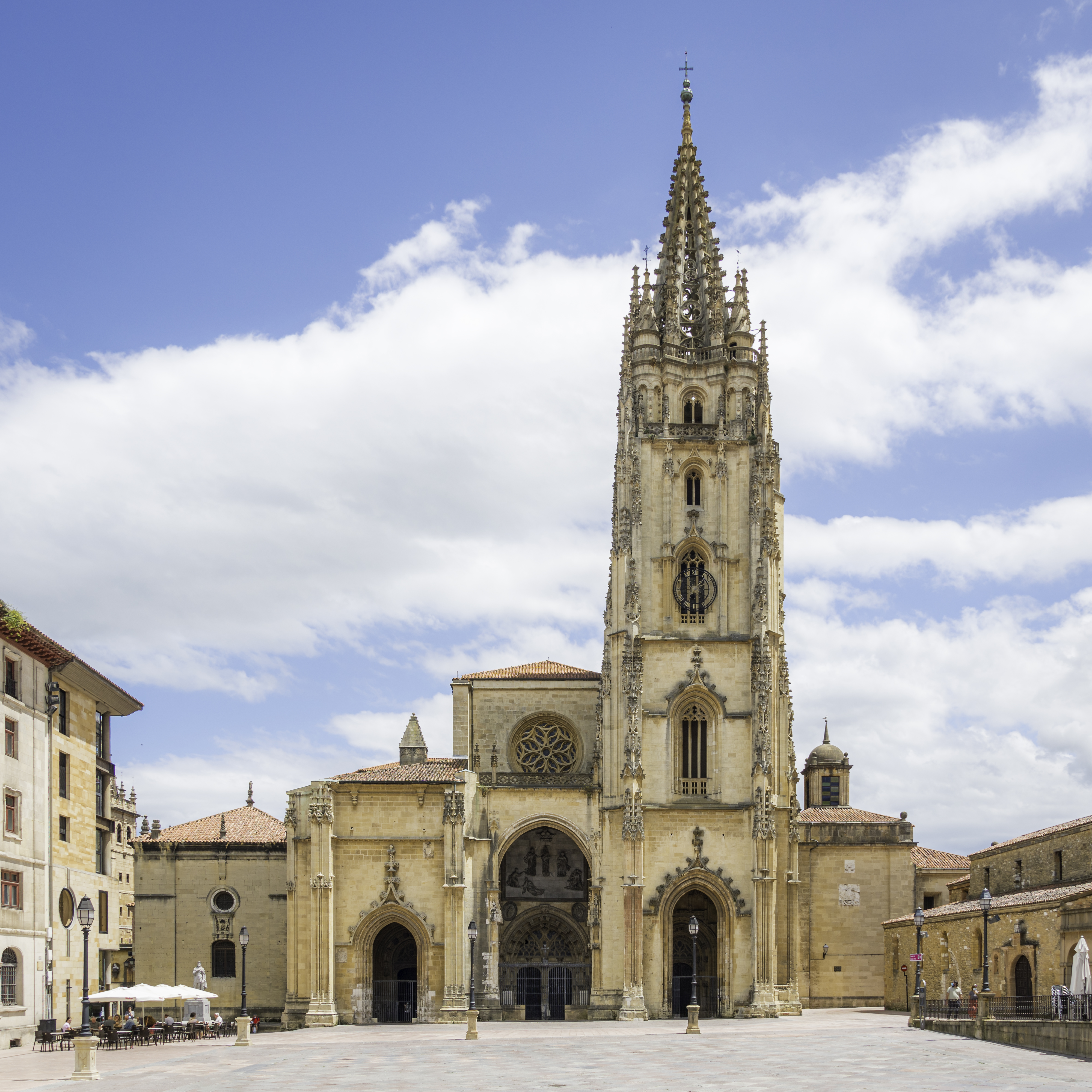
Oviedo Cathedral
In the 16th century, Bishop Cristobal de Sandoval y Rojas tried to open the Agate Box - a casket said to have been carried from Jerusalem to Africa to Spain, containing relics so sacred that even kings approached it with caution. The bishop could not bring himself to do it. Overcome, the records say, with religious fear, he left the box sealed. It remains in the Camara Santa of Oviedo Cathedral today, alongside the Cross of the Angels and the Victory Cross, treasures that have anchored this site since an Asturian king first raised a church here in the late 8th century.
A Kingdom's Cornerstone
Oviedo Cathedral began not as a place of worship alone but as the spiritual heart of a political complex. When Alfonso II of Asturias made Oviedo his capital around 802, he built a pre-Romanesque basilica at the center of a compound that included a royal palace, monasteries, baths, and stables. The basilica was consecrated to the Holy Saviour and the Apostles, its straight-shaped sanctuary fronted by three aisles in the distinctive Asturian style. When the royal court moved south to Leon in 910, Oviedo lost its political primacy but gained a different kind of importance. The settlement became an episcopal seat and a key stop on the northern branch of the Way of St. James, drawing pilgrims who came for the relics as much as for the route.
The Sacred Chamber
The Camara Santa is the oldest surviving structure from Alfonso II's original complex. This two-story rectangular building shelters royal burials on its lower floor and a collection of relics and treasures above, including the Cross of the Angels, crafted in 808, and the Victory Cross, dating to 908. Both became powerful symbols of the Asturian monarchy. During the 12th century, the constant flow of pilgrims prompted renovations: the upper aisle was decorated with late Romanesque column statues of the Apostles, and a barrel vault replaced the original wooden-beam ceiling. The cathedral earned the name Sancta Ovetensis for the sheer quantity and quality of what the chamber contained. Kings, bishops, and the faithful traveled across Iberia to stand before objects they believed had touched the holiest sites in Christendom.
Gothic Ambitions, One Tower
Beginning in the late 13th century, Oviedo's bishops decided their ancient basilica was outdated. Over the next 250 years, the pre-Romanesque structure was gradually demolished and replaced with Gothic elements. The chapter room, built between 1293 and 1314, became the cathedral's oldest Gothic space - a square hall under an eight-sided dome where noble families installed their tombs. The cloister took even longer, started around 1300 and not finished until the mid-15th century, its tracery windows documenting the evolution from early classic to late flamboyant Gothic. Northern European master builders Nicolás de Bar and Nicolás de Bruselas introduced the flamboyant style around 1450. By 1500, Juan de Badajoz designed a narthex that doubled as a covered street through the cramped medieval neighborhood. The original plan called for two towers, but the bishops chose a single massive bell tower instead - a fashionable choice in late medieval Europe, not, as legend claims, a concession to tight budgets.
Lightning, Altarpieces, and Layers
The tower was completed in 1551, crowned with a pierced Gothic spire. Then, in 1575, lightning destroyed it. Rodrigo Gil de Hontañon rebuilt the spire, blending Gothic and Renaissance elements in a combination that captures the cathedral's defining quality: no single era dominates. The main chapel's altarpiece mixes late Gothic statuary with Renaissance painting in a gilded wooden frame. The ambulatory, designed by Juan de Naveda in the early 17th century, added a Baroque dimension. Side chapels followed, each in the prevailing taste of its moment. In the 18th century, the adjacent pre-Romanesque church of Santa Maria del Rey Casto - Alfonso II's royal burial pantheon - was torn down and replaced with exuberant late Baroque. A major restoration from 1998 to 2002 stabilized the complex, but the cathedral remains what it has always been: not a building frozen in time, but a living record of every century that contributed to it.
Resting Place of Kings
The burials beneath the cathedral read like a roll call of early Iberian royalty. Fruela I of Asturias, who founded the original church in 781, lies here alongside his wife Munia of Alava. Alfonso III of Asturias and his wife Jimena of Pamplona rest nearby. Garcia I of Leon, Ordoño I, Ramiro I - the names trace the lineage of a dynasty that held northern Spain while much of the peninsula remained under Moorish control. Among the non-royal burials is Saint Pelagius of Cordoba, a boy martyr killed between 912 and 925. Their presence beneath this floor transforms the cathedral from a church into an archive of early medieval Spain, a place where stone and bone preserve the memory of a kingdom most visitors have never heard of.
From the Air
Located at 43.36N, 5.84W in the center of Oviedo, capital of Asturias in northern Spain. The cathedral tower is the tallest structure in the old city and identifiable from the air. Nearest airport is Asturias Airport (LEAS), approximately 40 km northwest. Approach from the Bay of Biscay coast offers views of the Cantabrian Mountains rising to the south. Best viewed at 3,000-5,000 feet in clear weather. The green, hilly terrain of Asturias contrasts sharply with the drier meseta to the south.