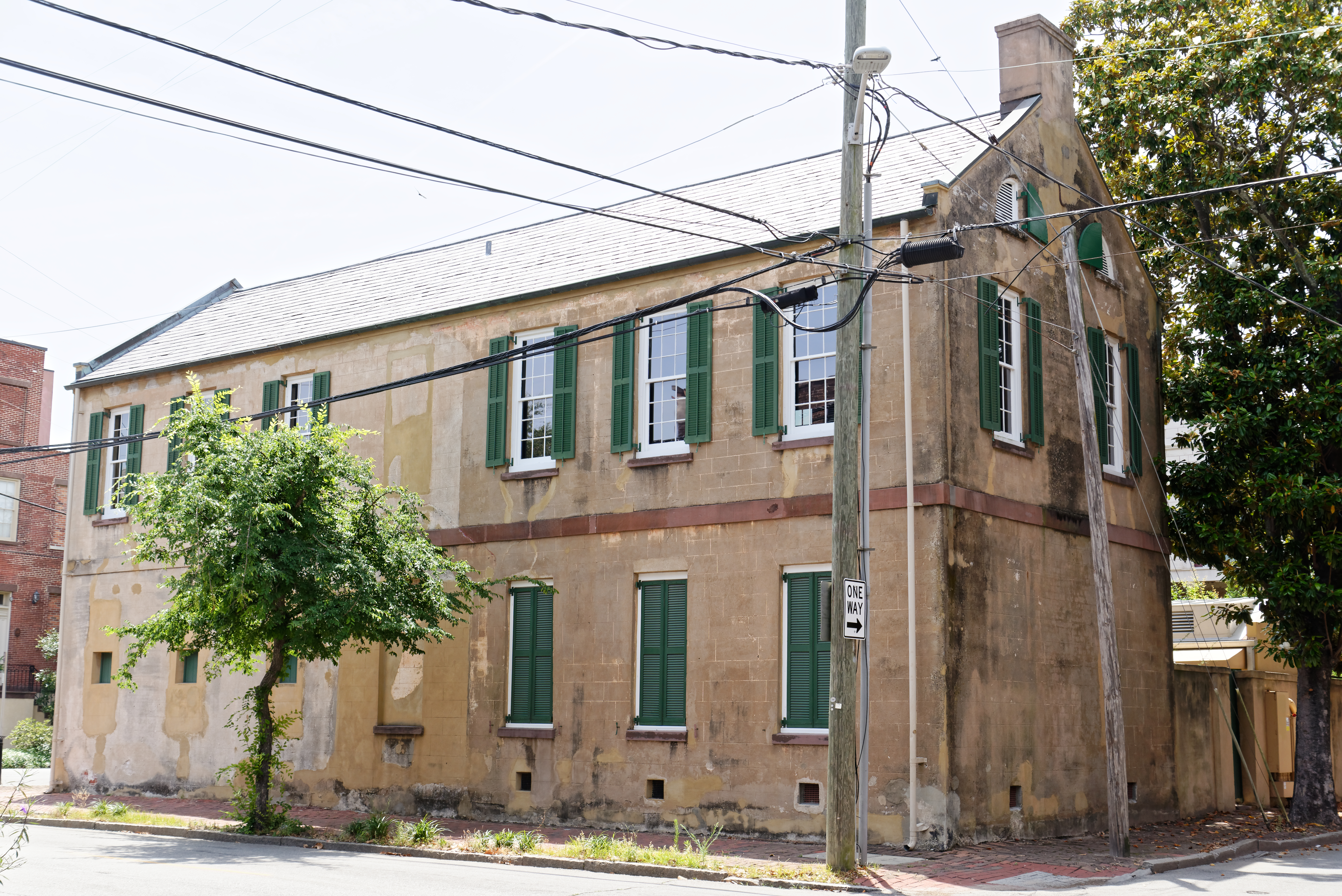
Owens-Thomas House: The Ceiling Painted to Ward Off Ghosts
Look up in the slave quarters of the Owens-Thomas House and the ceiling is blue. Not just any blue - haint blue, a shade the Gullah people believed would trap restless spirits, preventing them from crossing the threshold into the rooms of the living. It is the largest surviving swath of haint blue paint in North America, hidden for decades beneath layers of renovation, rediscovered in the 1990s when workers peeled back the walls of a carriage house and found one of the oldest and best-preserved urban slave quarters in the American South. The main house, just steps away, is something else entirely: North America's finest example of English Regency architecture, designed by a 24-year-old English architect who had never set foot in America when he drew the plans. The Owens-Thomas House holds both stories simultaneously - the architect's ambition and the enslaved workers' quiet resistance painted across a ceiling.
A Young Architect's Ambition
William Jay was barely out of his twenties when he designed the Richardson House, as it was originally known. Born into English architectural circles and trained in the neoclassical traditions of Sir John Soane and John Nash, Jay drew the plans while still in England, sending architectural elevations across the Atlantic to Savannah workers he had never met. The commission came through family connections: cotton merchant Richard Richardson's wife Frances was related to Jay's sister's husband. When the house was completed in 1819, it introduced Savannah to a level of architectural sophistication the city had not seen. The cast-iron veranda on the south facade was shipped from England in pieces and assembled on site - one of the earliest large-scale structural uses of cast iron in American architecture. Jay went on to design several other Savannah landmarks, including the Scarborough House and the Telfair House, before leaving the city in the 1820s.
Lafayette's Balcony
In 1825, the Marquis de Lafayette returned to America for a triumphant farewell tour of the nation he had helped create. When he reached Savannah, it was from the cast-iron veranda of the Richardson House that he addressed the assembled citizens - standing on those elaborate acanthus scroll supports, looking out over a crowd gathered in what is now Oglethorpe Square. The moment cemented the house's place in Savannah's civic memory. Five years later, in 1830, local attorney and politician George Welshman Owens purchased the mansion for $10,000. The Owens family would hold it for over a century. When George Owens's granddaughter, Margaret Thomas, died in 1951, she bequeathed the house to the Telfair Academy of Arts and Sciences, the South's oldest art museum, ensuring its preservation as a house museum on the northeast corner of Oglethorpe Square at 124 Abercorn Street.
What the Walls Concealed
For decades, the tour of the Owens-Thomas House was a tour of Regency elegance - fine porcelain, Federal-period furniture, textiles dating to the 1790s. The carriage house at the rear was an afterthought. Then came the 1990s renovation. Behind layers of plaster and paint, workers uncovered the living quarters of the people who had actually kept the house running: the nanny, the cook, the butler. The slave quarters had survived largely intact, their haint blue ceiling a vivid remnant of Gullah spiritual practice. The Telfair Museums launched the Slavery and Freedom Project to research and present the lives of the enslaved people who had lived and worked on the property. Symposiums in 2008 and 2020 brought scholars together to deepen that understanding. Today, the slave quarters are a central focus of the museum tour - not an appendix to the main house but an essential counterpart, telling the story the original architects never intended visitors to hear.
The Collection Behind Glass
Inside the main house, the Owens-Thomas collection preserves a window into early 19th-century Savannah. English Georgian and American Federal-period furniture fills the rooms alongside early Savannah textiles, silver, and Chinese Export porcelain. Most pieces date from 1790 to 1840, spanning the years when Savannah was a thriving cotton port and wealth flowed through mansions like this one. Outside, a small parterre garden was redesigned in 1954 by Savannah landscape architect Clermont Huger Lee in an 1820 English-American style. Lee maintained the garden for fourteen years, shaping a formal green space that complements the Regency architecture above it. The house was designated a National Historic Landmark in 1976, recognized as one of the nation's finest expressions of the English Regency style that William Jay introduced to the American South.
From the Air
Located at 32.077°N, 81.089°W on the northeast corner of Oglethorpe Square in Savannah's Historic District. From the air, the house sits within the distinctive grid-and-square pattern that defines Savannah's layout - Oglethorpe Square is one of the city's original 22 squares, visible as green openings in the canopy of live oaks. The nearest airport is Savannah/Hilton Head International (KSAV), approximately 9 miles northwest. Best viewed at low altitude when the geometric pattern of Savannah's squares becomes apparent. The house is a block south of the Savannah River waterfront.