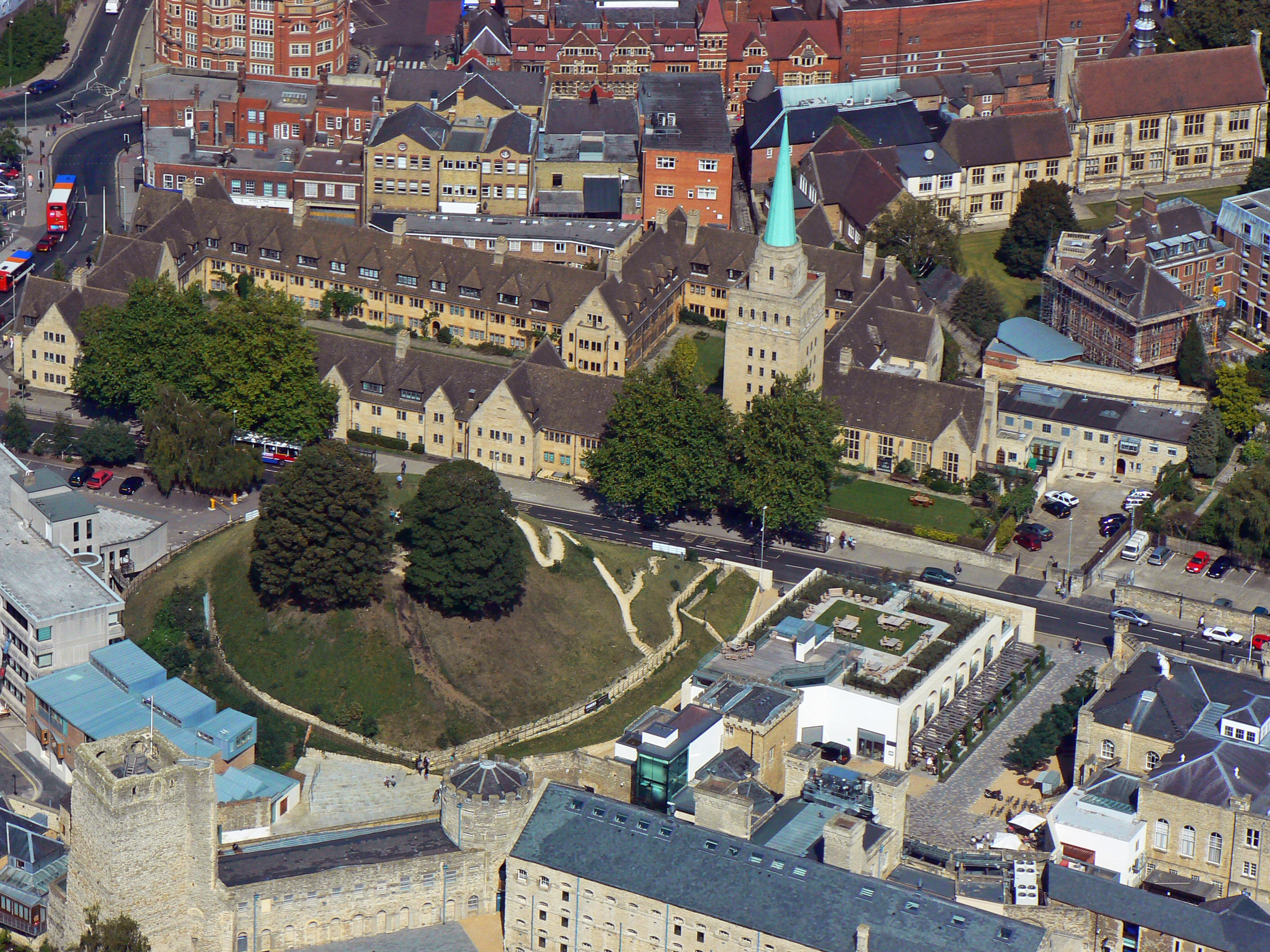
Oxford Castle
In December 1142, Empress Matilda was trapped. Stephen's forces had besieged Oxford Castle for three months, and the garrison was starving. On a winter night, with the Thames frozen solid and snow covering the ground, Matilda escaped -- lowered from the castle walls with three or four knights, all dressed in white cloaks to blend with the snow. They crossed the frozen river on foot, passing through the enemy lines unseen, and reached safety at Wallingford. The story may be embellished, but the escape was real, and it remains the most famous episode in the thousand-year history of a castle that has served as fortress, prison, and now boutique hotel.
Before the Normans
The rectangular St George's Tower, which still stands at the castle site, is now believed to pre-date the Norman castle entirely. Historians think it was a Saxon watch tower associated with the original western gate of the city, making it one of the oldest surviving secular buildings in Oxford. The Norman castle itself was built in 1071 by Robert D'Oyly, a baron of William the Conqueror, following the standard motte-and-bailey design: an earthen mound topped by a wooden keep, surrounded by a ditch and defensive enclosure. The wooden structures were gradually replaced in stone during the late twelfth and early thirteenth centuries. A well in the castle crypt, said to reach 60 feet deep, fed the garrison during sieges.
Matilda's Castle
Oxford Castle's most dramatic chapter came during the Anarchy, the civil war between King Stephen and Empress Matilda for the English throne. In September 1142, Matilda entered Oxford, but Stephen's forces pursued her and laid siege to the castle. By December, after three months of blockade, the garrison was running out of food. Matilda's escape across the frozen Thames is one of the great adventure stories of medieval England, whether it happened exactly as the chroniclers describe it or not. The castle changed hands several times during the Anarchy and saw further military use, but by the fourteenth century its strategic importance had waned. Oxford's importance was increasingly academic rather than military, and the castle began its long transformation from fortress to administrative centre.
The Prison Years
From the fourteenth century onward, Oxford Castle served primarily as the county seat and prison. Much of the medieval fabric was destroyed during the English Civil War, when Parliamentary forces slighted the defences. By the eighteenth century, the remaining buildings had become Oxford's local gaol. A new prison complex was built on the site from 1785, expanded in 1876, and became HM Prison Oxford, a working facility that operated until 1996. For two centuries, the medieval motte, St George's Tower, and the Norman crypt sat within the walls of a functioning prison -- a juxtaposition of medieval and Georgian architecture that was visible but inaccessible to the public. The crypt of St George's Chapel, beneath the tower, preserves some of the oldest Romanesque architecture in Oxford.
Unlocked
When HM Prison Oxford closed in 1996, the site underwent one of the more remarkable redevelopments in English heritage. The prison wings were converted into a Malmaison hotel, where guests sleep in converted cells. The medieval remains -- the motte, St George's Tower, and the crypt -- became a public visitor attraction, Grade I listed and designated a Scheduled Monument. Visitors can climb the motte, ascend the Saxon tower for views across Oxford's dreaming spires, and descend into the crypt where the college city's oldest stonework still stands. The castle mound itself, rising in the heart of the city beside the modern Westgate shopping centre, is an incongruous lump of medieval earth surrounded by twenty-first-century commerce. It is a reminder that Oxford existed as a fortified town long before it became a university, and that its history runs deeper than any library.
From the Air
Located at 51.75N, 1.26W on the western side of central Oxford. The castle mound is visible as a raised green area near the Westgate shopping centre, with St George's Tower rising beside it. The distinctive spires and quadrangles of the university colleges extend to the east. The Thames (Isis) curves south of the city. Nearest airports: EGTK (Oxford Kidlington, 5nm north), EGUB (RAF Benson, 12nm southeast).