Oxford Mission Church
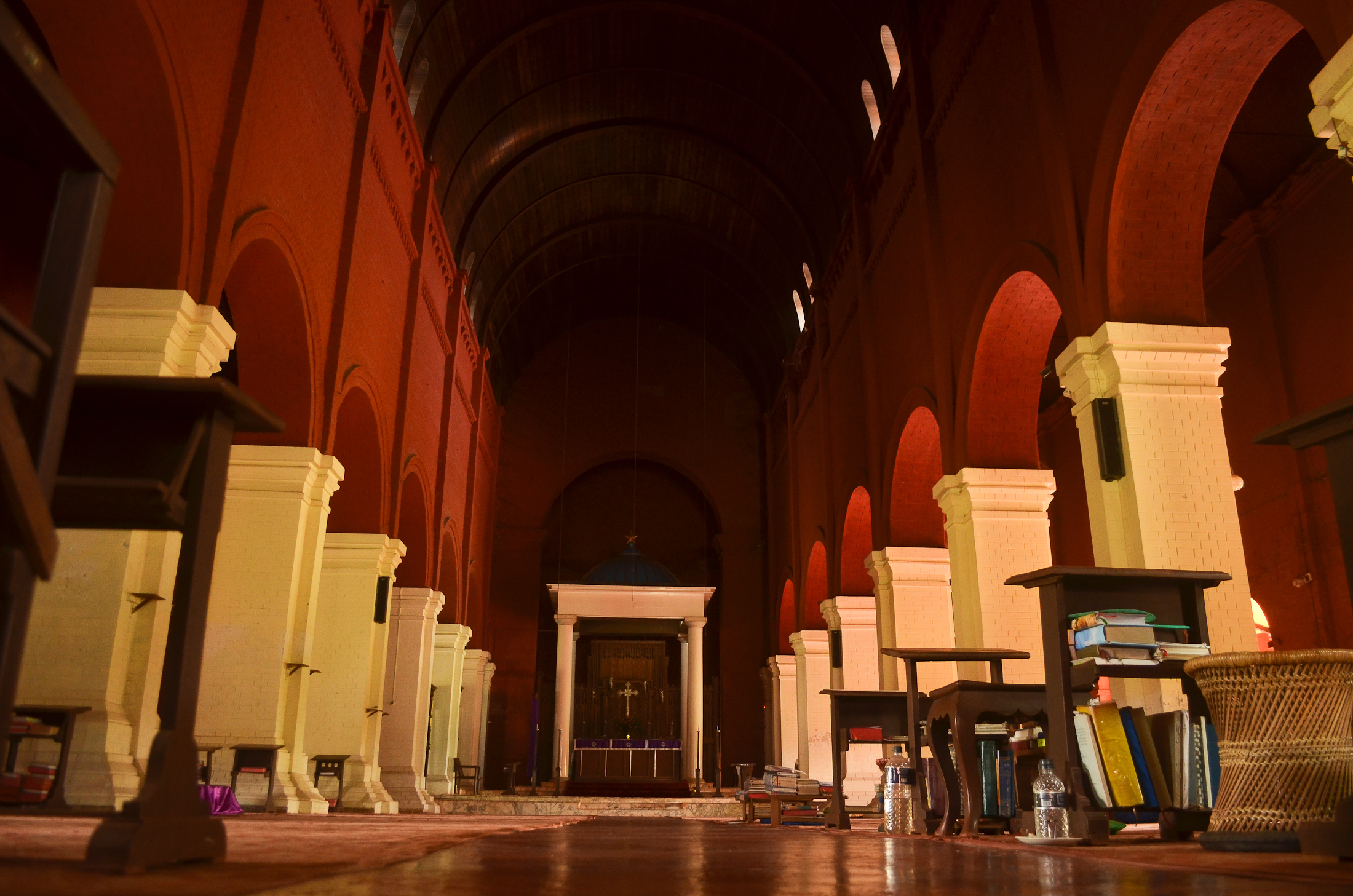
Seven times a day, a giant bell rings from a red brick tower in Barisal, Bangladesh, calling the faithful to prayer five minutes before each service begins. The Oxford Mission Epiphany Cathedral Church - the largest church in Bangladesh and arguably the second largest in Asia by land area - rises from a lush compound of ponds, schools, and gardens in this ancient river port city in the south of the country. From the outside, it looks like a five-story building. Step inside, and you discover it is all one soaring floor: a single vast prayer hall ringed by 40 archways and corridors on three sides.
Brotherhood on the Brahmaputra
Barisal's waterways drew Christian missionaries as early as the 18th century, but it was the Oxford Mission - an England-based Anglican society - that left the most enduring mark. In 1895, the mission established the Brotherhood of the Epiphany in this deltaic city where rivers serve as highways and monsoon floods reshape the landscape each year. Seven years later, in 1902, Father E. L. Strong guided the formation of a Sisterhood to work alongside the brothers. Together, the two orders built an ambitious compound on Bogra Road: an English boarding school, Christian youth hostels, an orphanage, a primary school, and a medical center. The sisters' work, led by Edith Langridge, extended broadly into evangelism, medical care, and women's education. A branch house eventually opened at Jobarpar, Agailjhara, thirty miles to the north.
Sister Edith's Sketch Made Stone
The Epiphany Church itself was born from a drawing. Sister Edith sketched the original design, and the church was established and inaugurated on 26 January 1903. Father Strong oversaw the completion of the final design and a second construction phase that finished in 1907. What emerged was a building that blends Greek architectural ambitions with the practical realities of the Bengal delta. The structure's deceptive exterior - appearing multi-storied but containing a single monumental interior - creates a dramatic effect when visitors cross the threshold. Doors open on three sides, flooding the prayer hall with the humid air and river light of southern Bangladesh. The large cross adorning the main altar was brought from Bethlehem, Palestine, linking this remote corner of Bengal to Christianity's holiest geography.
Red Brick and Marble
The interior rewards close attention. Wood carvings line the walls, and marble tiles decorate the floor and the baptism bath basin. But it is the exterior that commands the skyline: deep red brick walls and a bell tower that has become one of Barisal's most recognizable landmarks. The bell tower doubles as the church's office room, a pragmatic touch in a compound where every space serves multiple purposes. Surrounding the church, thirteen ponds - small and large - dot the grounds alongside the Oxford Mission High School, a hospital, a library, a students' hostel, and living quarters for the fathers and sisters. The compound functions less like a single building than like a self-contained village, its institutions layered over more than a century of continuous use.
Survival in the Delta
Bangladesh is a country shaped by natural disasters - cyclones, floods, and river erosion have repeatedly devastated its southern regions. That the Oxford Mission Church has survived more than 120 years in this environment speaks to both the solidity of its construction and the community's determination to preserve it. The church has been formally recognized as a cultural heritage site, and its red brick walls show the patina of monsoon seasons beyond counting. When the Church of India, Burma and Ceylon merged with other Protestant denominations to form the Church of Bangladesh, the Epiphany Cathedral became part of the Diocese of Barisal in the new united body. The transition preserved continuity: the bell still rings seven times daily, the archways still frame the same prayer hall, and the compound still shelters the institutions the Brotherhood and Sisterhood established over a century ago.
From the Air
Located at 22.70°N, 90.36°E in Barisal, a major river port city in southern Bangladesh. The church compound sits along Bogra Road and is identifiable by its red brick bell tower amid dense greenery. Nearest airport is Barisal Airport (VGBR), approximately 5 km to the west. From altitude, Barisal is recognizable by its network of rivers and channels - the city sits where the Kirtankhola River meets broader delta waterways. Best viewed at 2,000-3,000 ft to appreciate the compound's scale against the surrounding city.