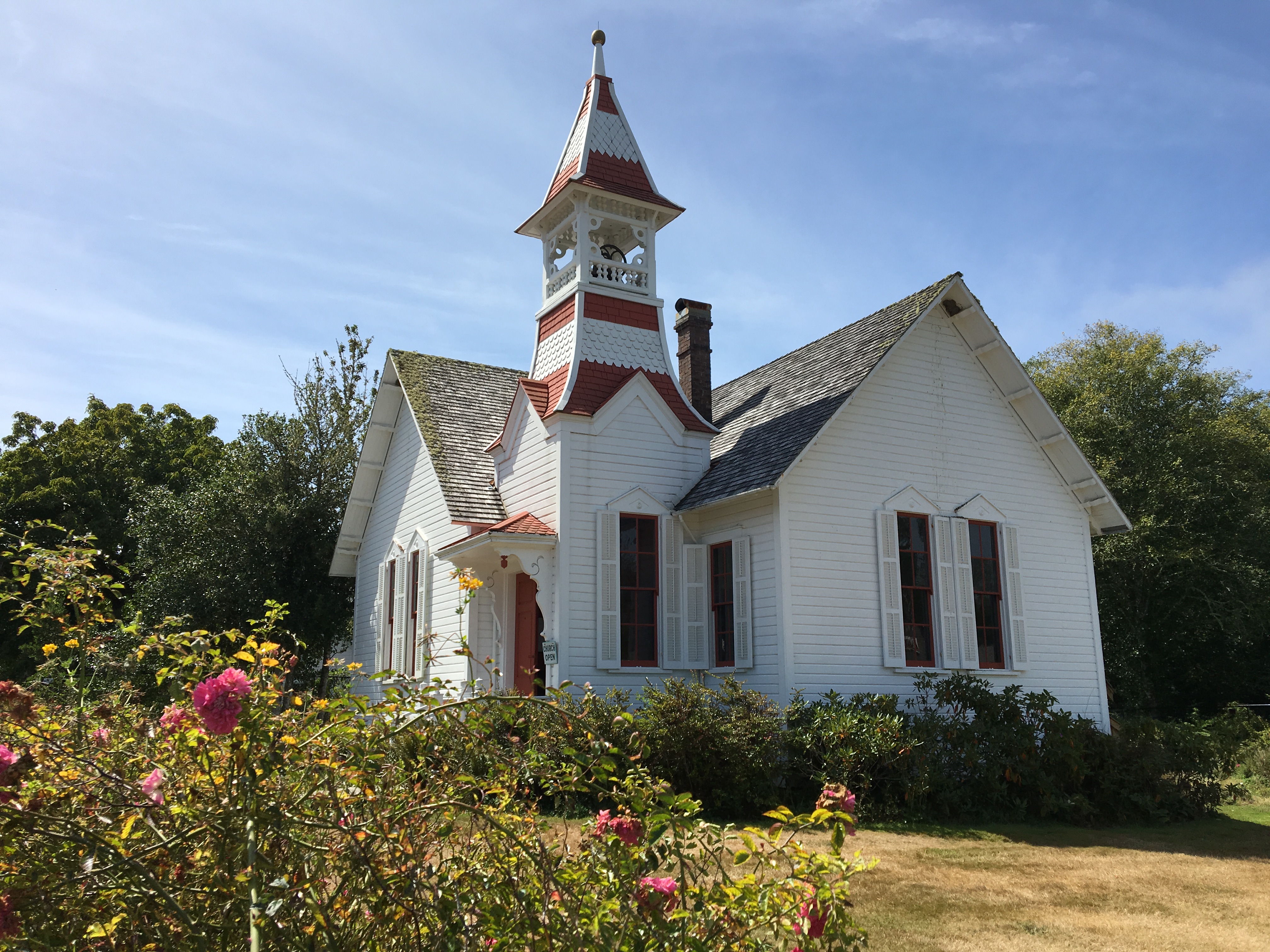
Oysterville, Washington
On February 5, 1893, a group of men from South Bend arrived in Oysterville, loaded the county's official records and books into wagons, and drove away. It was, technically, theft -- but the voters had already decided to move the county seat, and Oysterville lacked the manpower to argue. A sign across from the old schoolhouse still tells the story, which captures something essential about this place: Oysterville has always been too small to fight back against the forces acting on it, whether rival towns, depleted oyster beds, or the Pacific Ocean itself. Today about twenty people live here, in an unincorporated community on Willapa Bay that the National Register of Historic Places recognized in 1976 as worth preserving -- a town whose best days ended before most of its buildings were fifty years old.
Shellfish and Gold Fever
Indigenous people cultivated and harvested shellfish along Willapa Bay long before Europeans arrived. The bay's native oyster beds were extraordinary -- dense, accessible, and seemingly inexhaustible. When J.A. Clark founded and named Oysterville in 1854, the settlement existed for a single purpose: pulling oysters from the shallows and shipping them to market. San Francisco's Gold Rush had created a city of newly wealthy men with appetites for luxury, and Willapa Bay oysters became a delicacy shipped south by the barrel. The town boomed. It became the seat of Pacific County, the most important settlement on the peninsula. Houses went up, a schoolhouse was built, and families like the Espys put down roots that would last generations.
The Raid and the Reckoning
Prosperity required oysters, and the oyster beds were not infinite. By the 1880s, overharvesting had thinned the native stocks, and Oysterville's economic engine was sputtering. South Bend, a town on the mainland side of Willapa Bay with better road and rail connections, began agitating for the county seat. Voters agreed. But the transfer of power stalled, and South Bend's partisans decided to force the issue. The February 1893 raid -- county records physically seized and hauled away on a Sunday, when they knew Oysterville's residents would be at church -- remains one of the more colorful episodes in Washington's county seat wars. Oysterville never recovered its political status, and with the oyster industry fading, it had little else to hold onto.
What the Sea and the Elements Spared
Most of Oysterville's buildings are gone. The town that once filled a stretch of the peninsula's eastern shore has been reduced by storms, tides, rot, and neglect. What survives is remarkable for its age: several structures predate 1880, including the John Crellin House, built in 1867, and the Ned Osborne House, built in 1874. The old schoolhouse still stands. These buildings earned Oysterville its listing as a National Register Historic District, and they give the village a presence that its population of twenty would not otherwise command. Walking through Oysterville is walking through a place that time has whittled down to its bones -- a few wooden structures on a narrow spit of land between the bay and the ocean, standing because no one has knocked them down yet.
Words and Legacy
Oysterville produced at least two notable figures whose lives carried the peninsula's story outward. Willard R. Espy, born into one of the founding families, became a writer and philologist known for his playful books on the English language. Clara C. Munson, also connected to Oysterville, became the first woman to serve as mayor of an Oregon city in the twentieth century. Just outside town, the Oysterville Cemetery -- established in 1858 -- holds plots for many of the founding families and memorials to the Shoalwater Bay Tribe, unknown sailors, and the last Native American chieftain of the Long Beach Peninsula. The cemetery may be the fullest record of who lived here and what they endured: a two-acre document written in stone, telling the story the remaining buildings cannot quite complete.
From the Air
Located at 46.5489N, 124.027W on the Long Beach Peninsula in Pacific County, Washington. Oysterville sits on the east side of the narrow peninsula, facing the shallow, sheltered waters of Willapa Bay. From the air, the peninsula is unmistakable -- a long north-south sand spit separating Willapa Bay from the Pacific Ocean. The village is roughly 5 miles north of Ocean Park and 15 miles north of Long Beach. Best viewed below 3,000 feet AGL. Nearest airports: Willapa Harbor Airport (2S1) approximately 20nm northeast, Astoria Regional Airport (KAST) roughly 25nm south across the Columbia River mouth.