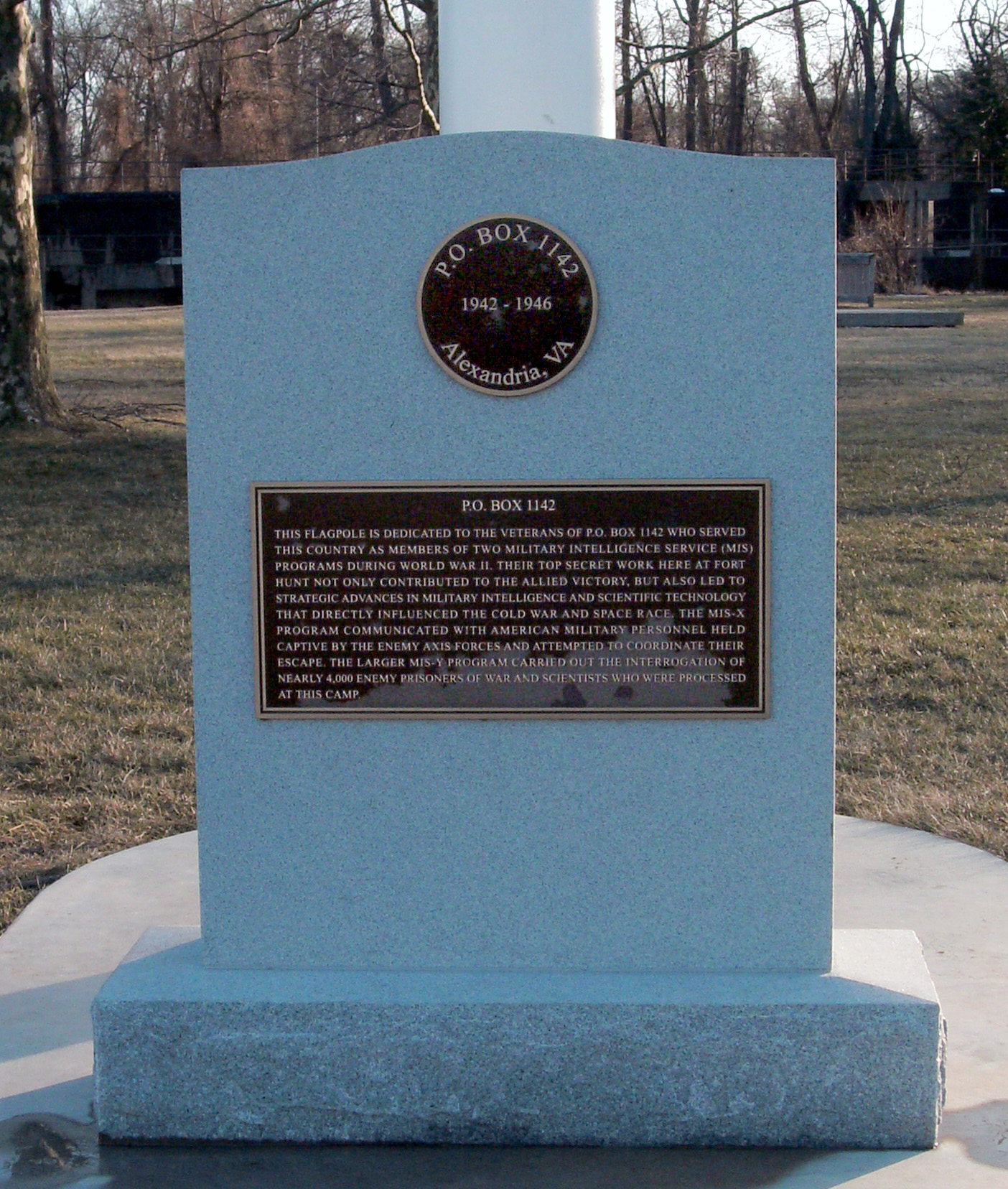
P.O. Box 1142
The return address said only "P.O. Box 1142, Alexandria, Virginia." No building name, no unit designation, no hint of what happened inside. That anonymity was the point. Behind the bland postal code, at Fort Hunt along the Potomac River, the United States Military Intelligence Service ran one of the most consequential interrogation programs of World War II. Between 1942 and 1946, more than 3,400 German prisoners passed through the facility. Among them were rocket scientist Wernher von Braun, spymaster Reinhard Gehlen, and infrared detection pioneer Heinz Schlicke. The intelligence extracted here -- about rocketry, jet engines, acoustic torpedoes, and advanced weapons systems -- helped reshape the American military and accelerated technologies that would define the Cold War. And the men who pulled those secrets loose did it with conversation, not coercion.
The Interrogators Who Knew the Enemy
Many of the interrogators at P.O. Box 1142 were Jewish immigrants who had fled Germany as children. They spoke fluent German, understood the culture they had escaped, and carried a personal stake in defeating the Nazi regime that had driven their families from their homes. The Military Intelligence Service selected them precisely for these qualities -- linguistic fluency, cultural intuition, and motivation that no training manual could instill. These men sat across the table from captured U-boat commanders, weapons engineers, and intelligence officers, and they extracted information through psychological acuity rather than physical force. Former interrogators who later broke their decades of silence confirmed they never used torture. They employed psychological techniques instead: building rapport, exploiting rivalries between prisoners, and occasionally threatening to hand uncooperative captives over to the Soviets. The results were extraordinary. Information gleaned at Fort Hunt led directly to the development of effective acoustic torpedo countermeasures, giving the U.S. Navy a critical advantage in the Battle of the Atlantic.
Two Wings of a Secret War
P.O. Box 1142 housed two distinct programs under one roof. MIS-Y handled the interrogation of German prisoners of war, the operation that gave the facility its codename mailing address. MIS-X worked the other side of captivity -- devising ways to help American POWs held in German camps escape and evade recapture. The two programs operated in parallel, each exploiting the intelligence the other gathered. MIS-X smuggled escape tools and coded communications to American prisoners in Europe, hidden inside care packages and personal items. MIS-Y, meanwhile, systematically debriefed incoming German captives, cataloging everything from troop movements to technical specifications for weapons the Allies had never encountered. The facility operated under strict secrecy from its founding in July 1942 through September 1945, cycling through four post commanders in just over three years. The secrecy held for decades. Most of the interrogators carried their silence into old age, bound by oaths they had taken as young men in uniform.
The Paperclip Pipeline
As the war wound toward its end, P.O. Box 1142 took on a new and controversial role. The facility became a processing station for Operation Paperclip, the American program to recruit German scientists before the Soviet Union could seize them. More than 500 of the 3,400 prisoners who passed through Fort Hunt were scientists funneled into the United States through this pipeline. The Joint Intelligence Objectives Agency oversaw the operation, with a particular focus on researchers who had worked on Hitler's V-2 rocket program. These were men who had built weapons aimed at London, now sitting in a Virginia interrogation room being assessed for their usefulness to American defense. The moral calculus was stark: accept former enemy scientists in exchange for technological advantage in the emerging Cold War. Fort Hunt was where that calculation became real -- where the transition from wartime prisoner to peacetime asset began, one debriefing at a time.
Secrets Finally Spoken
For more than half a century, the men of P.O. Box 1142 said nothing. The program remained classified, and the interrogators honored their oaths. Then, in 2001, German historian Sonke Neitzel discovered approximately 150,000 pages of interrogation reports and transcripts of bugged conversations from Fort Hunt and its British counterpart at Trent Park. The dam began to break. Former guards and interrogators, many now in their eighties and nineties, began sharing their stories publicly for the first time. The National Park Service honored them at Fort Hunt Park, where a memorial now marks the site. The Washington Post profiled them in 2007 under the headline "Fort Hunt's Quiet Men Break Silence on WWII." Their accounts revealed a program that had been remarkably effective precisely because it rejected brutality. Today Fort Hunt Park is a quiet stretch of green along the George Washington Memorial Parkway, popular with picnickers and cyclists. Nothing about the landscape suggests what once happened here -- which is, of course, exactly how it was designed.
From the Air
P.O. Box 1142 / Fort Hunt Park sits at 38.715N, 77.053W along the George Washington Memorial Parkway on the Virginia side of the Potomac River, approximately 8nm south of the National Mall. From the air, look for the large open parkland along the riverbank south of Alexandria. The park occupies a wooded bluff above the Potomac with distinctive picnic pavilions and circular road loops visible at lower altitudes. Nearest airport is Ronald Reagan Washington National (KDCA), approximately 5nm north along the river. Caution: this area falls within the Washington D.C. Special Flight Rules Area (SFRA). Best viewed at 2,000-3,000 feet AGL following the Potomac southbound from the National Mall.