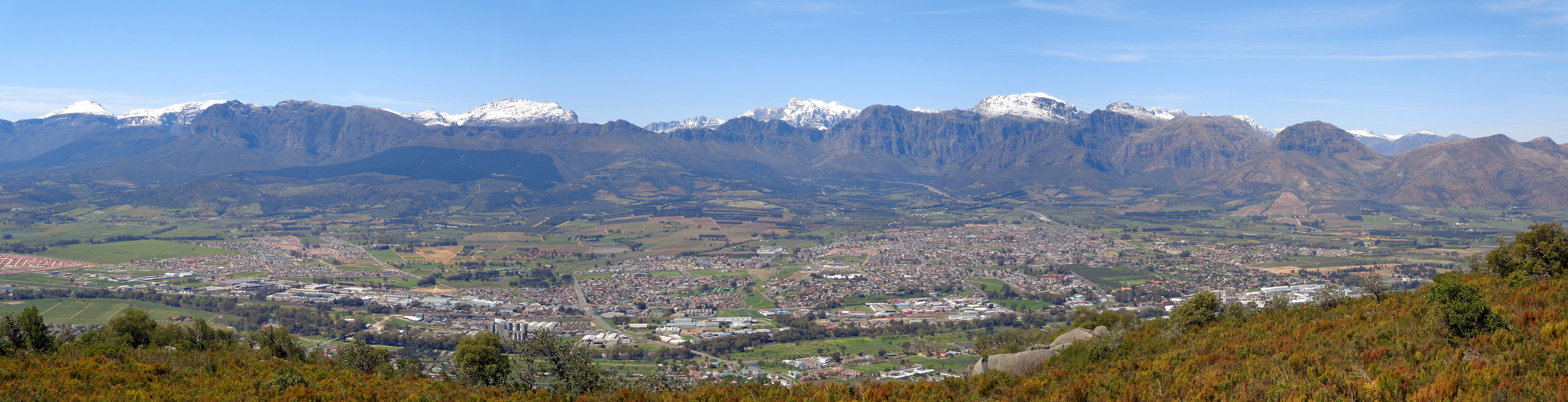
Paarl
After rain, the massive granite dome above town catches the light and gleams. The early Dutch settlers saw this and thought of a pearl -- paarl in Dutch -- and the name stuck. Paarl Rock is one of the world's largest granite outcrops -- second in size only to the Sierra Nevada Batholith in California -- a geological anomaly that has watched over the Berg River valley since long before the first Europeans arrived in the 17th century. The town that grew beneath it, founded as South Africa's third-oldest settlement, sits approximately 60 km northwest of Cape Town in the heart of the Cape Winelands. It is a place where geology, language politics, and the wine industry converge in ways that are particular to this corner of the Western Cape.
The Rock and the River
Paarl Rock dominates the landscape east of town, a smooth dome of granite rising from the surrounding hills with the kind of geological authority that makes human constructions feel temporary. It is often compared to Uluru in Australia and the Sugar Loaf in Rio de Janeiro, though Paarl Rock is less famous than either. The Berg River runs through the valley below, providing the water that sustains the vineyards and orchards that have defined the local economy for centuries. The combination of granite soils, river water, and a Mediterranean climate with cool ocean breezes has made Paarl one of the Winelands' most productive regions. Wine estates line the roads radiating out from the town centre, offering tastings of everything from Shiraz to brandy in settings that range from grand Cape Dutch homesteads to modest family cellars.
A Monument to Language
High on a hillside overlooking Paarl stands the Afrikaans Language Monument, a striking modernist sculpture completed in 1975 to celebrate the development of Afrikaans as a language in its own right, distinct from its Dutch origins. The monument is a point of contention as much as a point of pride. Afrikaans was the language of apartheid's bureaucracy, the language in which forced removals were ordered and discriminatory laws were drafted. It was also the language of the Soweto uprising of 1976, when students protested the mandatory use of Afrikaans in Black schools. But Afrikaans did not originate as a language of power alone -- it evolved at the Cape from a creole spoken by enslaved people, indigenous Khoisan communities, and Dutch settlers alike. The monument, whatever one's feelings about its politics, sits in a landscape of extraordinary beauty, with views across the valley to the Winelands and the mountains beyond.
Where the Winelands Begin
Paarl occupies a strategic position at the northern gateway to the Cape Winelands, sitting on the N1 highway that connects Cape Town to Johannesburg. Metrorail trains run from Cape Town, including the Boland Business Express aimed at commuters, and long-distance Shosholoza Meyl trains between Cape Town and Johannesburg stop here. The town functions as a hub from which visitors fan out to Stellenbosch, Franschhoek, and the smaller wine villages tucked into the surrounding valleys. Wine estates in the Paarl area are known for bold reds and excellent brandy. The Fairview estate, with its famous goat tower where goats climb a spiral structure, has become one of the most photographed vineyards in the country. Beyond wine, hiking trails wind through the surrounding mountains, ranging from short walks to multi-day routes that take trekkers through fynbos-covered slopes with views over the entire Boland basin.
Small Town at the Centre
Paarl's Main Road stretches for 11 km through town, making it one of the longest main streets in South Africa. Along it, restaurants serve Cape Malay-influenced cuisine alongside traditional braai, and wine estates maintain tasting rooms for visitors who prefer not to venture into the surrounding hills. The town has the feel of a place that has always been a crossroads -- between Cape Town and the interior, between the Winelands and the wheat-producing Swartland to the north, between the old farming economy and the tourism industry that has grown up around it. From Paarl, all the main attractions of the Western Cape are reachable within 30 to 45 minutes, except for the Cape of Good Hope and Cape Point at the peninsula's southern tip. It is a quiet town beneath a very large rock, and it knows exactly what it is.
From the Air
Located at 33.72S, 18.96E in the Berg River valley at the northern edge of the Cape Winelands. Paarl Rock, one of the world's largest granite outcrops, is the dominant visual landmark east of town. The Afrikaans Language Monument is visible on the hillside. Cape Town International Airport (FACT) is approximately 45 minutes by car. The N1 highway runs through town connecting Cape Town to the north. Recommended viewing altitude: 3,000-5,000 ft to see the rock formation and vineyard patterns.