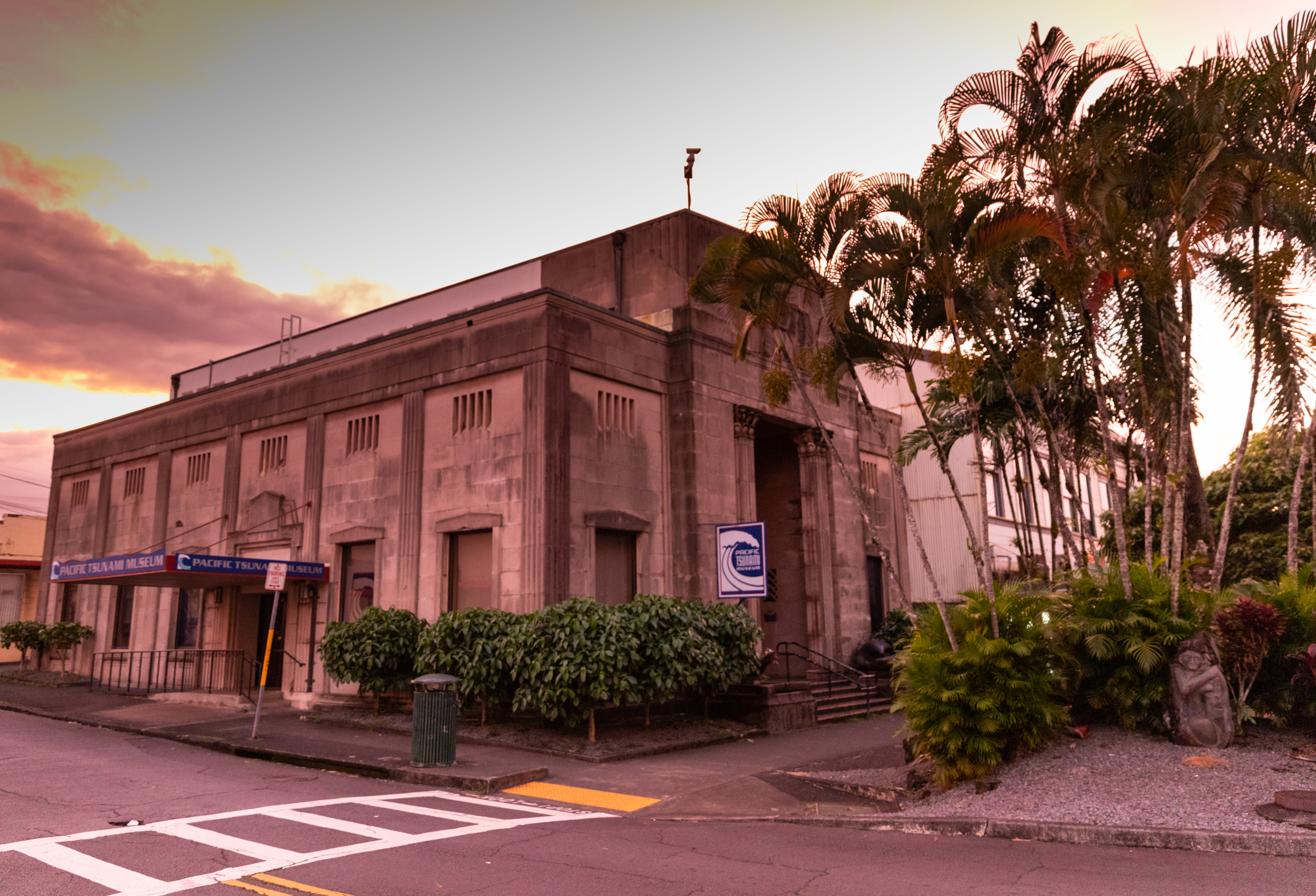
Pacific Tsunami Museum
Jeanne Branch Johnston was four years old when the ocean disappeared. On the morning of April 1, 1946, the sea pulled back from Hilo Bay, exposing the reef in a way no one had seen before. Then it returned - not as a wave but as a wall, thirty-two feet high, moving faster than anyone could run. The tsunami killed 96 people in Hilo alone and leveled the bayfront business district. Johnston survived. Forty-seven years later, she decided the dead deserved a museum, and the living deserved a warning.
Twice Struck
Hilo occupies a crescent bay on the Big Island's windward coast, a geography that funnels tsunami energy directly into town. The 1946 wave, generated by a magnitude 8.6 earthquake near the Aleutian Islands, crossed the Pacific at roughly 500 miles per hour and arrived without warning - no sirens, no system, no protocol. Children at Laupahoehoe Point, twenty miles up the coast, were gathering fish left exposed by the receding water when the third and largest wave swept them away. Twenty students and four teachers died there. Fourteen years later, despite a warning system established in response to the 1946 disaster, the ocean came again. On May 23, 1960, a magnitude 9.5 earthquake off Chile - the most powerful ever recorded - sent waves racing across the Pacific. Warnings went out more than five hours before arrival, but only a third of Hilo's residents evacuated. Thirty-five-foot waves bent parking meters flat and killed 61 people downtown.
A Survivor's Mission
Johnston co-founded the museum with Dr. Walter Dudley, a University of Hawaii oceanographer, in 1993. Their first task was urgent: recording the stories of survivors before time silenced them. Johnston, Dudley, and researcher Michael Childers compiled an oral history archive spanning not just Hawaii but Alaska, India, Sri Lanka, Thailand, and the Maldives - more than 450 individual accounts of people who faced the ocean and lived. The museum was incorporated in August 1994, initially under the name Hilo Tsunami Museum. Early exhibits occupied temporary space in the nearby S. H. Kress & Co. building before First Hawaiian Bank donated its Kamehameha Branch building as a permanent home in 1997. The location felt fitting: the old bank sits at the intersection of Kamehameha and Kalakaua Avenues in downtown Hilo, in the same bayfront area where both tsunamis had done their worst.
Through Stories, Survival
What distinguishes this museum from a standard natural history exhibit is its insistence on the human voice. The archived accounts are not abstractions - they are specific, personal, and often harrowing. A woman describes clinging to floating debris. A man recalls the silence between waves. The museum's educational mission extends far beyond Hawaii: exhibits cover global tsunami science, including the devastating 2004 Indian Ocean tsunami that killed more than 230,000 people across fourteen countries. A newer exhibit addresses Hawaii's broader natural hazards, and plans are in progress for a display about the 2022 Hunga Tonga-Hunga Ha'apai eruption and tsunami. The building itself was retrofitted with photovoltaic arrays in 2014, a small but deliberate nod toward resilience.
An Uncertain Future
The museum's own survival has not been guaranteed. It closed temporarily during the COVID-19 pandemic and reopened with permanent hours in March 2023. But in November 2024, the board laid off its entire ten-person staff and suspended operations due to financial difficulties. Some former employees volunteered their labor to keep the doors open - an act of devotion that mirrors the museum's founding impulse. A place built on the determination that memory must outlast disaster now faces a quieter but no less existential threat. The irony is sharp: a museum dedicated to warning people about the power of the ocean may itself be swept away, not by water but by the slow erosion of funding. Hilo's bayfront still curves toward the open Pacific, still funnels whatever the ocean sends. The stories archived inside 130 Kamehameha Avenue remain as relevant as the day they were recorded.
From the Air
Located at 19.726°N, 155.087°W on the bayfront of Hilo, on the windward (east) coast of Hawaii Island. The museum sits at the intersection of Kamehameha and Kalakaua Avenues in downtown Hilo, visible along the crescent-shaped Hilo Bay. Best viewed at 2,000-3,000 feet AGL approaching from the east over the bay. Nearest airport: PHTO (Hilo International Airport), approximately 2 miles southeast. The bayfront area is notable from the air for its wide green buffer zone - parkland that replaced the destroyed neighborhoods after the 1960 tsunami.