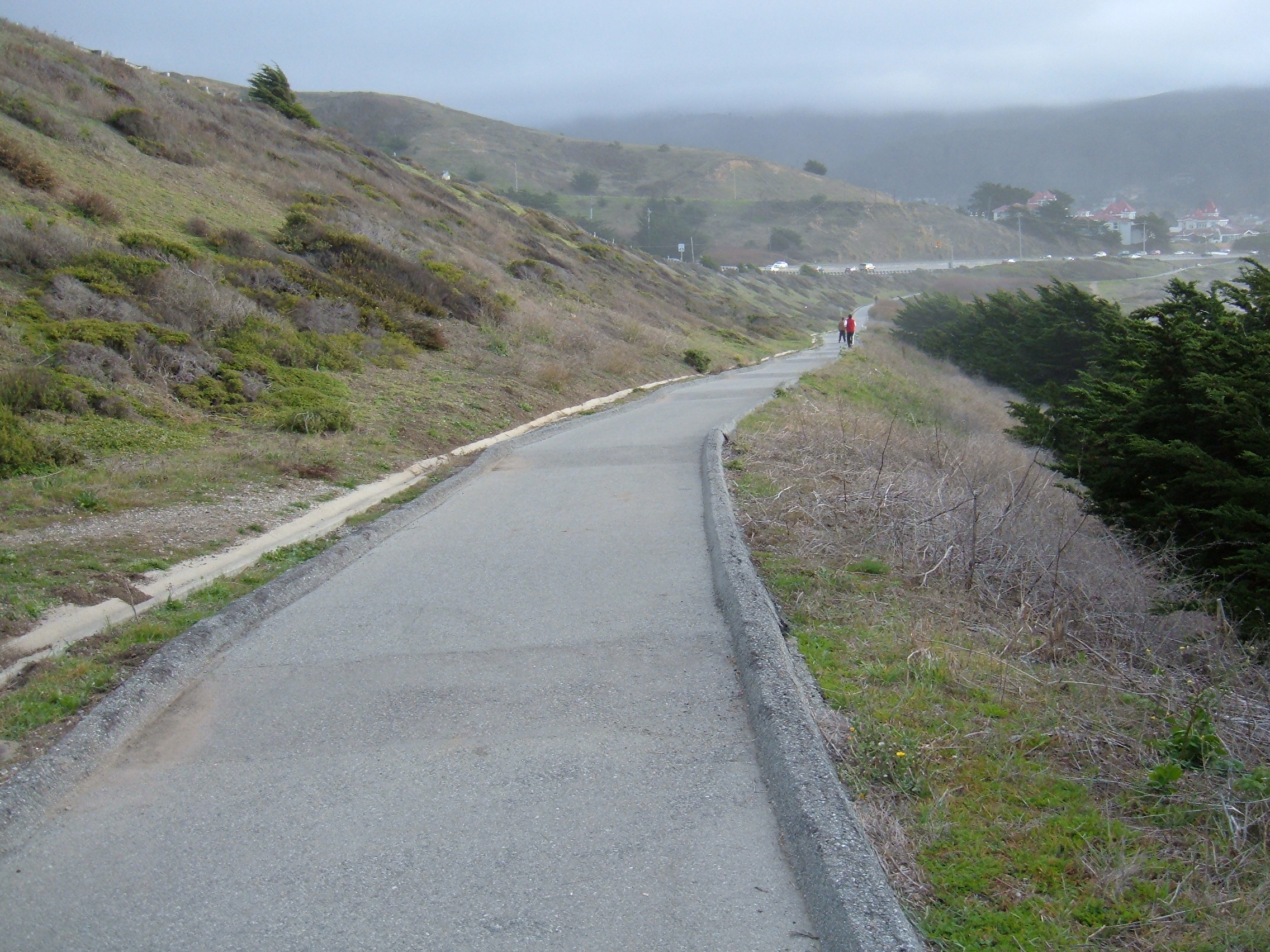
Pacifica State Beach
The Taco Bell on Pacifica State Beach went viral on TikTok in 2020. A travel influencer posted a video showing what Conde Nast Traveler had already noticed in the 1990s: this fast-food restaurant, built in the late 1960s as an A&W, has one of the most spectacular oceanfront locations of any chain restaurant in the world. That it exists at all is a grandfather clause -- California voters banned new construction west of Highway 1 in 1972, but the existing building was allowed to stay. It is a fitting symbol for Pacifica State Beach, a place where the absurd and the sublime coexist without contradiction.
A Beach That Chose Retreat
Between 1989 and 2005, Pacifica State Beach underwent one of California's most ambitious coastal restoration projects. In 2002, the city partnered with the Pacifica Land Trust and the California Coastal Conservancy to purchase and demolish two oceanside homes for $2.2 million, giving the beach and estuary room to recover. The project was one of the first in California to use managed retreat -- deliberately moving human development back from the shoreline -- as a method of coastal protection. The American Shore and Beach Preservation Association named it a Top Restored Beach in 2005, citing the involvement of ten regulatory agencies, eight funding sources, and eight environmental groups. The beach and estuary now provide habitat for four threatened and endangered species, including the western snowy plover.
Surfing Dogs and Linda Mar Legends
Surfers know this beach as Linda Mar, named for the adjacent neighborhood. It is one of the most popular beginner surfing spots in the San Francisco area, with manageable waves breaking across a crescent-shaped shoreline at the mouth of San Pedro Valley. Over one million people visit annually. Since 2016, the beach has hosted the World Dog Surfing Championships, a competition that is exactly what it sounds like: dogs in life vests riding waves while their owners cheer from shore. The event has become a signature Pacifica spectacle, drawing national media coverage and the kind of earnest absurdity that defines California beach culture at its best. Across the highway from the sand, the Pacifica Skatepark offers a concrete alternative for those who prefer their boards without water.
Plovers, Erosion, and the Taco Bell Question
The western snowy plover, a small shorebird threatened under the Endangered Species Act, nests on this beach. Its survival here depends on the same managed-retreat philosophy that saved the beach itself. But the Taco Bell -- that grandfathered remnant of pre-regulation construction -- raises a harder question. A Los Angeles Times article pointed out that the restaurant, perched on prime oceanfront real estate in a community increasingly vulnerable to coastal erosion and sea level rise, could be seen as a sign that Pacifica itself is exceeding its intended lifespan. The tension between preservation and inevitability runs through this beach like the riptide it is named for. For now, the plovers nest, the dogs surf, the Taco Bell sells burritos with an ocean view, and the Pacific continues its slow, patient work of rearranging the coastline.
From the Air
Located at 37.60°N, 122.50°W in downtown Pacifica at the mouth of San Pedro Valley. The crescent beach is visible along Highway 1, with the distinctive Taco Bell building at the beach's edge. San Francisco International (KSFO) is approximately 9 nm east-northeast. Half Moon Bay Airport (KHAF) is 7 nm south. The beach faces west and is exposed to Pacific swells.