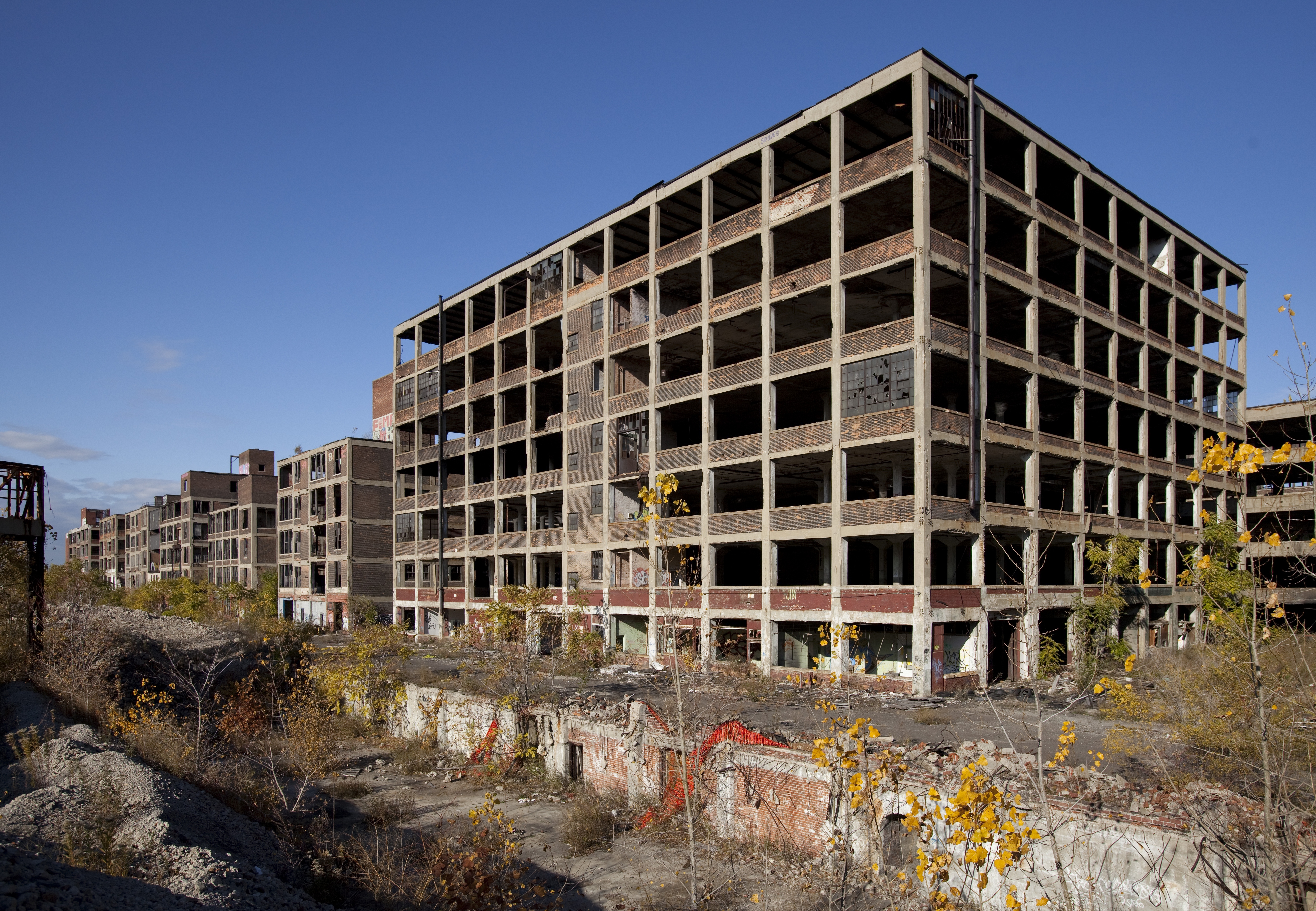
Packard Automotive Plant
In 2009, a group of urban explorers pushed a dump truck through a fourth-floor opening of the Packard Automotive Plant and watched it fall. The truck landed in a heap of rubble and joined the wreckage of a factory that had once employed 40,000 people in over eighty skilled trades. By then, scrappers had stripped the wiring, graffiti artists had claimed the walls, and paintballers used the cavernous interior as a battlefield. A Banksy mural appeared somewhere in the ruins in 2010 and later sold for $137,500 at a Beverly Hills gallery. For decades, the Packard Plant was simultaneously Detroit's greatest shame and its most perverse tourist attraction - a 3.5-million-square-foot monument to what happens when industry moves on and nothing moves in. The plant's demolition, finally completed in late 2024, closed a chapter that began in 1903 when Packard opened what was then the most advanced automobile factory on Earth.
Cathedral of Industry
The Packard plant was designed by Albert Kahn Associates, the same firm that would shape Detroit's industrial skyline for decades. When it opened in 1903, its 10,000 square feet of floor space represented the cutting edge of automobile manufacturing - modern, efficient, and built using the first reinforced concrete in American industrial construction, supplied by the Trussed Concrete Steel Company. Packard's ambitions scaled as fast as the automobile market. By 1908, the factory was six times its original size, occupying over fourteen acres along East Grand Boulevard on Detroit's east side. At its peak, the complex sprawled across 3.5 million square feet, and the craftsmen inside practiced over eighty different trades to build luxury automobiles that competed with Rolls-Royce and Cadillac. From 1903 to 1956, Packard cars rolled off the line here, interrupted only by World War II, when the factory switched to producing the Packard V-1650 Merlin engine - the powerplant that gave the P-51 Mustang its legendary performance.
The Slow Collapse
Packard merged with Studebaker in 1954, and automobile production at the plant ended in 1956. The factory complex closed entirely in 1958. But the reinforced concrete Albert Kahn had specified proved remarkably durable - the structures stood firm through decades of neglect, weather, and abuse, even as everything inside them was hollowed out. Other businesses occupied portions of the complex for storage and light industry through the late 1990s. Chemical Processing stayed for 52 years before announcing its departure in 2010. The city of Detroit claimed most of the property in 1994 after owners defaulted on taxes. Parts continued operating as the Motor City Industrial Complex until 1999. By the early 2010s, the Packard Plant had become perhaps the most famous ruin in America. Urban explorers traveled from around the world to wander its floors. Filmmakers shot 'Only Lovers Left Alive,' 'It Follows,' and 'Transformers: The Last Knight' amid the decay. In the 1990s, the vast spaces had hosted legendary underground techno raves, including Richie Hawtin's infamous Spastik parties.
Failed Resurrections
The Packard Plant's second life was a saga of ambitious plans and missed deadlines. When the 43 parcels composing the plant went to auction in September 2013 with a starting bid of $975,000 - the amount owed in back taxes - there were no takers. A second auction that October started at $21,000, roughly $500 per parcel. A Texas physician bid $6 million but missed her payment deadline. A Chicago developer bid $2 million and couldn't raise the funds. Finally, Spanish investor Fernando Palazuelo purchased the complex for $405,000 in December 2013 and announced a $350 million, 15-year redevelopment plan encompassing residential, retail, office, industrial, recreational, and artistic uses. He envisioned luring a Big Three parts manufacturer with free rent, creating artist workspaces, even building an upscale go-kart track. By August 2016, not a single element of the plan had materialized. One bright spot emerged independently: the Display Group, a Detroit event company, purchased Building 22 in 2014 and spent $750,000 converting it into production headquarters - the same building where Packard-Merlin engines had once been assembled for the P-51 Mustang.
The End and What Endures
On April 7, 2022, Wayne County Circuit Court Judge Brian Sullivan ordered the Packard Plant demolished as a public nuisance. Demolition began in October 2022, halted, then resumed in earnest in March 2024. The city used funds from the American Rescue Plan to clear the site. On October 10, 2024, the plant's iconic southern water tower was toppled by two guy-wires. By late December 2024, nearly all structural components had been razed. Two facades were preserved for their historical significance: administrative building 13 and building 27, facing each other across East Grand Boulevard like bookends to a story that has been erased between them. In 2013, someone had placed aluminum placards spelling 'Arbeit macht frei' - the Nazi concentration camp slogan meaning 'work makes one free' - in the windows of the Grand Boulevard bridge. Community volunteers removed them immediately. The gesture was grotesque, but the impulse to project meaning onto the Packard Plant was universal. For over six decades, the ruin served as a screen onto which Detroit's story was projected: industrial ambition, racial upheaval, economic collapse, and the stubborn question of what comes next.
From the Air
Located at 42.38°N, 83.03°W on East Grand Boulevard on Detroit's east side. The site, now largely cleared, previously occupied a massive footprint visible from altitude as one of the largest contiguous industrial complexes in the region. Two preserved facades along E. Grand Boulevard mark what remains. Detroit City Airport (KDET) is approximately 3 miles to the south. Detroit Metropolitan Wayne County Airport (KDTW) is about 20 miles southwest. The nearby I-94 freeway runs just south of the site, and the urban grid of Detroit's east side surrounds the former complex.