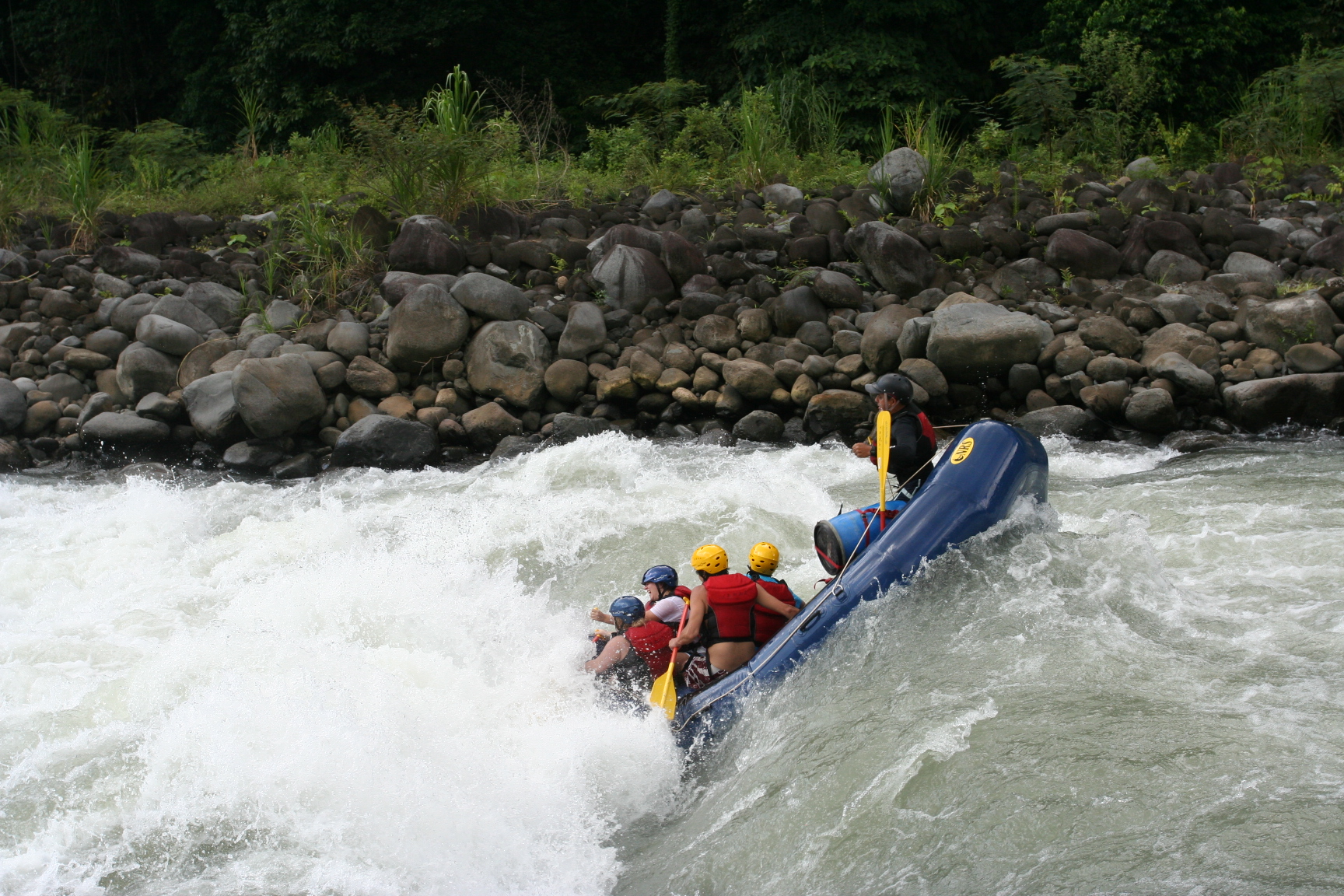
Pacuare River
February 1981. Four paddlers - Nick Hershenow, Sharon Hester, Jerry Kaufman, and Rudy Koller - put a twelve-foot Avon Redshank raft into a river that no commercial outfitter had ever run. They divided the Pacuare into upper and lower sections starting at a bridge crossing, and five days later they flagged down a narrow-gauge train to ride back to San Jose. A few months earlier, Polish kayakers had become the first to run the river at all, threading its rapids on their way from Central to South America. Within a year, commercial trips began. Within a decade, the Pacuare had earned its reputation as one of the five finest whitewater rivers in the world. The rainforest that walls in the gorges has never been cut.
108 Kilometers From the Mountains to the Sea
The Pacuare begins in the Cordillera de Talamanca and flows approximately 108 kilometers to the Caribbean. Along the way it drops through roughly sixteen distinct sections, though rafters and kayakers typically run three: the Upper Upper, the Upper, and the Lower. The Upper Upper stretches about sixteen miles of Class II through IV rapids - manageable whitewater that serves as a warm-up for what follows. The Upper section is the technical heart of the river, ten miles of Class IV and V rapids interspersed with waterfalls, most commonly run in creeking-style kayaks by paddlers who know what they're doing. The Lower section is the one the Pacuare is famous for: twenty-three miles of Class III and IV whitewater dropping roughly 1,200 feet from Finca La Cruz to the town of Siquirres, through the Huacas River Gorge where waterfalls pour directly into the rapids.
The Dam That Never Was
In 1986, Costa Rica's state-owned electricity agency, the Instituto Costarricense de Electricidad, proposed a hydroelectric dam on the Pacuare. For nearly two decades the plan lingered as a possibility, casting a shadow over the river's future. Rafting companies that had built their businesses around the Pacuare watched and lobbied. Ecologists catalogued the biodiversity that would be drowned. Tourism advocates calculated the revenue that would vanish. In 2005, the government finally rejected the proposal, citing concerns about pollution and the damage to both the river's ecology and its tourism economy. The decision was a rare case of a developing country choosing a living river over generated electricity - a choice made easier by the fact that the nearby Reventazon River had been dammed in 1998, pushing rafters and outfitters to concentrate on the Pacuare and making its economic value harder to ignore.
Jaguars in the Gorge
The rainforest flanking the Pacuare is first-generation growth - it has never been logged. That distinction matters, because old-growth tropical forest supports a complexity of life that secondary growth takes centuries to rebuild. Jaguars have been spotted near the Huacas River Gorge, and a melanistic jaguar - a so-called black panther - was seen approximately two kilometers from the river in 1986. Ocelots prowl the same territory. Anteaters, river otters, iguanas, capuchin monkeys, and sloths inhabit the corridor, and howler monkeys make their presence unmistakable on the lower sections after the Dos Montanas canyon. Five species of snake are common in the area, including the coral snake, the bushmaster, and the fer-de-lance - three of the most venomous serpents in the Americas.
Wings and Color Through the Mist
The chestnut-mandibled toucan appears most reliably when rain or fog softens the air, its oversized bill cutting through the gray like a flag. Blue morpho butterflies - electric blue and impossible to photograph in flight - drift above the water on the calmer stretches. Parakeets flash green in the canopy after Dos Montanas. Oropendolas weave their hanging nests from branches overhanging the river, kingfishers dive from exposed rocks, and tiger herons stalk the shallows alongside snowy egrets and sunbitterns. Hawks and ospreys patrol from above, while the king vulture, with its striking orange and white head, soars on thermals rising from the gorge walls. The birding is incidental to the rafting, which is what makes it remarkable - you don't come looking for wildlife, but the wildlife finds you.
The Outfitters Who Built an Industry
Michael Kaye started Costa Rica Expeditions in 1978, and by the winter of 1981-82 he was running commercial trips on the Pacuare - making his company among the first to take paying customers down the river. Rafael Gallo, a former Kaye employee, gathered four rafts and founded Rios Tropicales in the early 1980s. Aventuras Naturales joined in the mid-1980s, and Tico's River Adventures launched from Turrialba, the closest city, in 1986. These companies didn't just sell adventure tourism; they created the economic argument that ultimately saved the river from the dam. When the Reventazon was dammed in 1998, the Pacuare absorbed the displaced demand, and its commercial value became undeniable. The river that four people in an inflatable raft first explored in 1981 now anchors one of Costa Rica's signature tourism experiences.
From the Air
Located at 10.22N, 83.28W in eastern Costa Rica, flowing from the Cordillera de Talamanca approximately 108km northeast to the Caribbean coast. The river is visible from altitude as a winding waterway cutting through dense, unbroken rainforest canopy, particularly dramatic in the Huacas River Gorge section. The town of Siquirres marks the lower takeout point. Turrialba, the nearest city, is to the west. Limon International Airport (MRLM/LIO) is approximately 40km to the east on the Caribbean coast. Juan Santamaria International Airport (MROC/SJO) is approximately 100km to the west.