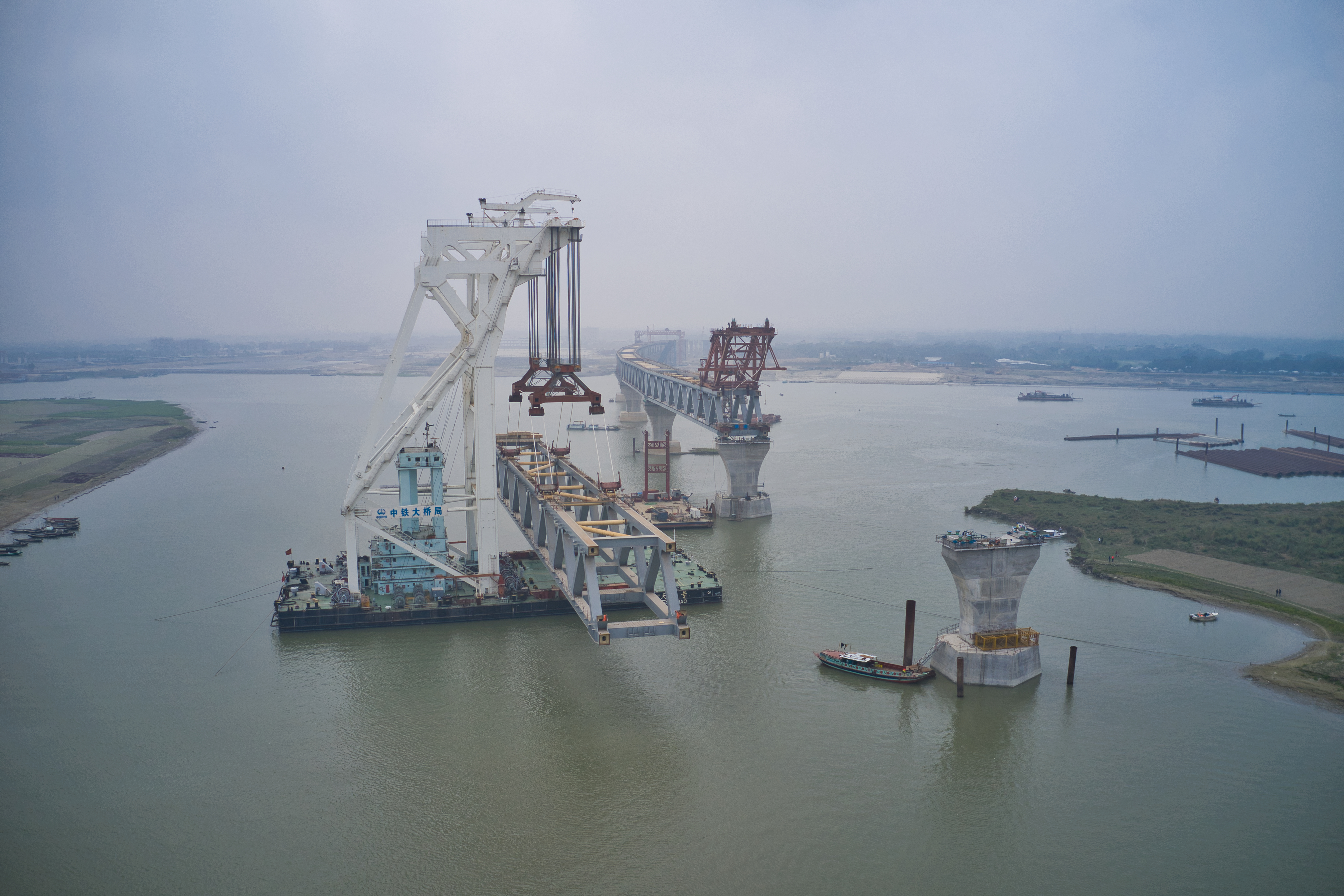
Padma Bridge
For decades, crossing the Padma River - the main distributary of the Ganges as it flows through Bangladesh - meant waiting for a ferry. Southwest Bangladesh, home to 30 million people across 21 districts, remained cut off from Dhaka by a waterway so wide and deep that engineers called bridging it the most challenging construction project in the country's history. On 25 June 2022, then-Prime Minister Sheikh Hasina inaugurated the Padma Multipurpose Bridge, a 6.15-kilometer steel truss structure carrying a four-lane highway above and a single-track railway below. The Bangladesh Air Force marked the occasion with an aerobatics display over the bridge while a commemorative 100-taka note entered circulation. The celebrations were proportional to what the country had endured to get there.
Fifty Years of Waiting
The idea predates Bangladesh itself. In 1971, Japanese survey experts submitted a feasibility report to East Pakistan recommending a bridge over the Padma as part of a Dhaka-to-Faridpur road. After independence, Sheikh Mujibur Rahman, the first president, announced the project - but after his assassination in 1975, it stalled for over two decades. The foundation stone was finally laid by Prime Minister Sheikh Hasina on 4 July 2001. Then politics intervened: the BNP government under Khaleda Zia shelved the project after winning elections that same year. It was not until 2006-2007 that the government readopted the plan. Prequalification tenders went out in April 2010. Construction was supposed to start in 2011 and finish by 2015. That timeline, too, would prove optimistic.
The Scandal That Nearly Killed It
In what became one of South Asia's most consequential corruption controversies, the World Bank withdrew its funding commitment after finding what it called "credible evidence" of "a high-level corruption conspiracy among Bangladeshi government officials, SNC-Lavalin executives, and private individuals." Other international donors followed the World Bank's lead. Communications Minister Syed Abul Hossain resigned under pressure. SNC-Lavalin was barred from World Bank contracts for ten years. The charges later collapsed in a Canadian court on a technicality involving improperly authorized wiretaps, and three SNC-Lavalin executives were acquitted. By then, the damage was done - except that Bangladesh's government made a decision that would define the project's legacy. It would fund the bridge entirely from its own budget, at a final cost of 301.93 billion taka.
Steel Over the Padma
The engineering challenge was formidable. The Padma is not merely wide - it is deep, fast-moving, and geologically unstable, its bed constantly shifting with the sediment load of the Ganges basin. The bridge required 42 pillars, each resting on six piles driven deep into the riverbed. China Major Bridge Engineering Corporation won the main bridge contract; Sinohydro handled river training works; Bangladesh's Abdul Monem Limited built the link roads and service infrastructure. Construction unfolded span by span - the first installed between pillars 37 and 38 in October 2017, the final 41st span set on 10 December 2020. The last road slab was placed on 24 August 2021. Forty-one steel sections, each 150 meters long and 22 meters wide, now march across one of the most powerful rivers in South Asia.
What a Bridge Can Change
On its first day open to the public, 15,200 vehicles crossed the Padma Bridge in eight hours. Within its first year, toll collection reached 8 billion taka. More than 15,000 vehicles now cross daily, connecting 13 of the southwest's 21 districts - regions with above-average poverty rates - to the rest of Bangladesh. The GDP boost has been estimated at 1.23 percent. Seventeen economic zones are planned in the newly connected southwest. Critical patients from the region can now reach Dhaka's hospitals without the delays and uncertainties of ferry crossings. The bridge also provides a faster connection between Dhaka and Kolkata, saving at least two hours of travel time, while its lower railway deck runs as part of the Dhaka-Jessore line at 120 kilometers per hour. Tourist destinations like the Sundarbans, Kuakata, and Barisal are now a straightforward drive from the capital.
From the Air
Located at 23.44°N, 90.26°E spanning the Padma River between Munshiganj and Shariatpur districts. The bridge is an unmistakable landmark from altitude - a 6.15 km steel truss structure crossing the wide, brown expanse of the Padma River, the main Ganges distributary. Hazrat Shahjalal International Airport (VGHS/DAC) in Dhaka is approximately 55 km to the north-northeast. From 5,000-10,000 ft, the bridge's scale relative to the massive river is striking. The double-deck structure and its approach roads are clearly visible against the flat alluvial landscape.