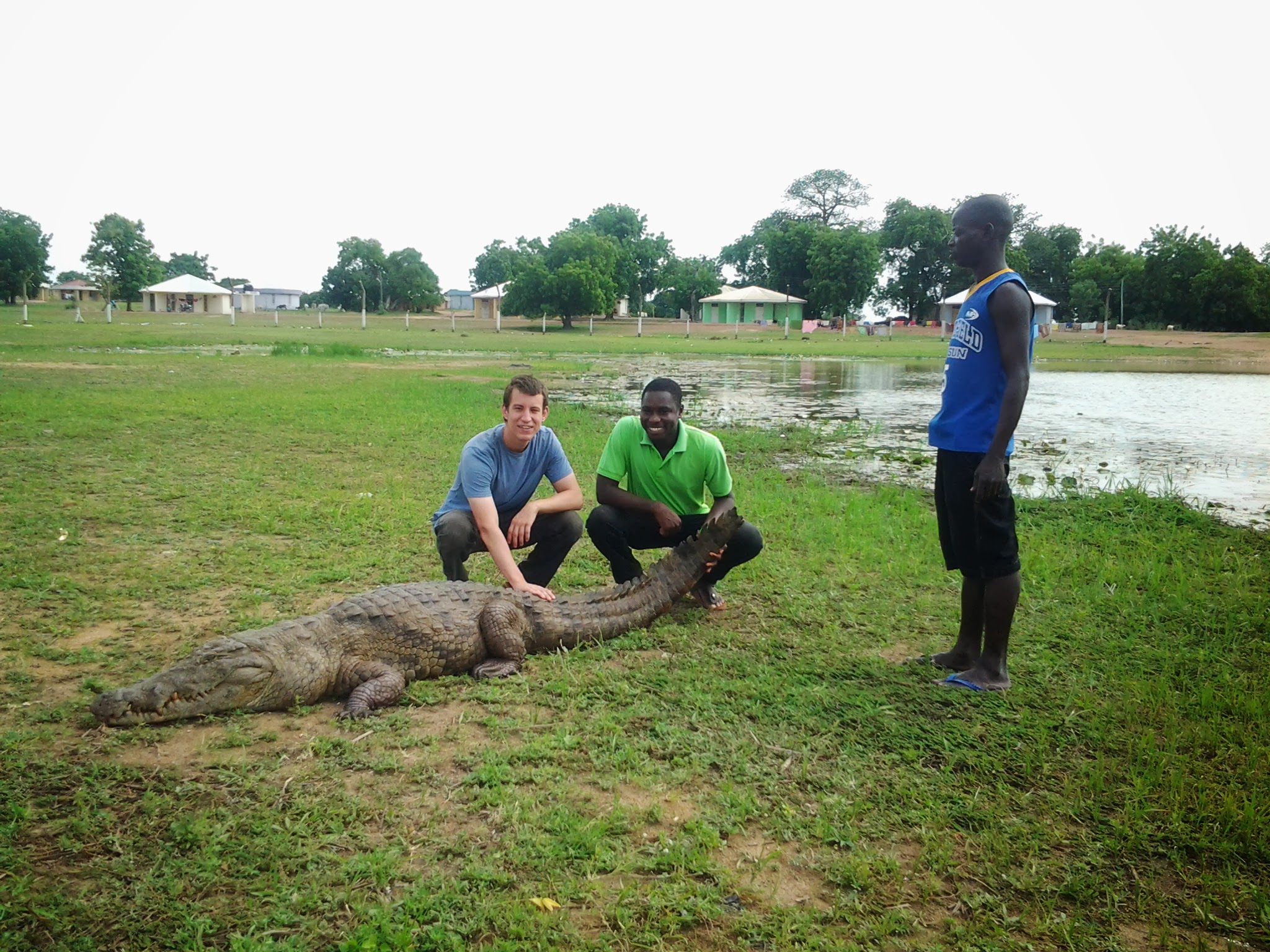
Paga Crocodile Pond
Children splash in the shallows while a two-meter crocodile basks an arm's length away, jaws parted in the midday heat. No one flinches. In Paga, a dusty border town at the northern tip of Ghana, this scene is not reckless -- it is sacred. The crocodiles of the Paga pond have coexisted with humans for roughly six centuries, and in all that time, local tradition holds, not a single person has been harmed. The reason, according to the Kassena people who live here, is straightforward: these reptiles carry the souls of their ancestors.
The Debt of Naveh
Around 1400, according to oral tradition, a young hunter named Naveh found himself dying of thirst during an expedition in the savanna. A crocodile led him to a hidden pond and saved his life. Overcome with gratitude, Naveh abandoned his home village and settled on the spot, founding a place he called Ayipaga -- roughly translated as 'My eye rests on this place' -- later shortened to Paga. He declared the pond and its crocodiles sacred, forbidding any harm to them. More than six hundred years later, his covenant endures. Killing a crocodile here is treated as equivalent to murder, and when a crocodile dies of natural causes, the community buries it with funeral rites ordinarily reserved for a human elder.
Souls in the Shallows
The people of Paga believe that their ancestors' spirits reside within the crocodiles. When a child is born, the community watches for a crocodile to emerge from the water, signaling the arrival of a reincarnated soul. When the reptiles leave the pond to wander into the village, locals interpret it as a warning of impending danger. This is not abstract symbolism -- it is lived practice, woven into daily decisions and seasonal ceremonies. The pond's inhabitants are West African crocodiles, a species once lumped together with the Nile crocodile but now recognized as genetically distinct and generally smaller and more docile. Some of the largest individuals at Paga are estimated to be around ninety years old, their rough hides scarred by decades of Sahelian sun.
Whistles and Chickens
Tourism has become the pond's economic lifeline, and it comes with a ritual of its own. A guide whistles sharply from the bank, and within moments a crocodile glides toward shore. A live chicken is offered, the reptile clamps down, and while it feeds, visitors are invited to crouch beside it -- even rest a hand on its tail -- for photographs. The transaction is quick, transactional, and surprisingly calm. But the system carries fragility. Caretaker Salifu Awewozem warned as early as 2009 that the elderly crocodiles need specialist care they are not receiving, and that the chickens purchased by tourists represent virtually the only supplemental feeding. Without visitors, the financial mechanism that keeps the pond's population healthy simply stops. The sacred and the commercial have become inseparable here, each sustaining the other in a balance that grows more precarious as tourist seasons fluctuate.
A Border Town's Broader World
Paga sits just three kilometers from the Burkina Faso border, and the town has long been a crossroads -- of trade, of peoples, of histories both celebrated and painful. Nearby, the Pikworo Slave Camp preserves the memory of captives who were held among rock formations before being marched south. Visitors to the crocodile pond often combine it with tours of the slave camp, village walks through round Kassena compounds, and evening performances of traditional drumming and dance. The contrast is deliberate: Paga does not shy away from the full arc of its past. Forty-four kilometers to the southeast lies Bolgatanga, the regional capital of the Upper East Region, but Paga's draw is its own -- a small town where the relationship between humans and wild predators has not been tamed so much as trusted, generation after generation.
From the Air
Located at 10.985N, 1.109W in Ghana's Upper East Region, just south of the Burkina Faso border. The pond is a small water feature visible among the scattered trees and compound rooftops of Paga. Nearest airstrip is Navrongo (DGLN), approximately 30 km to the south. Bolgatanga, the regional capital, lies 44 km southeast. Overfly at 2,000-3,000 ft AGL for best visibility of the pond and surrounding town layout. The flat Sahelian terrain and sparse vegetation make orientation straightforward.