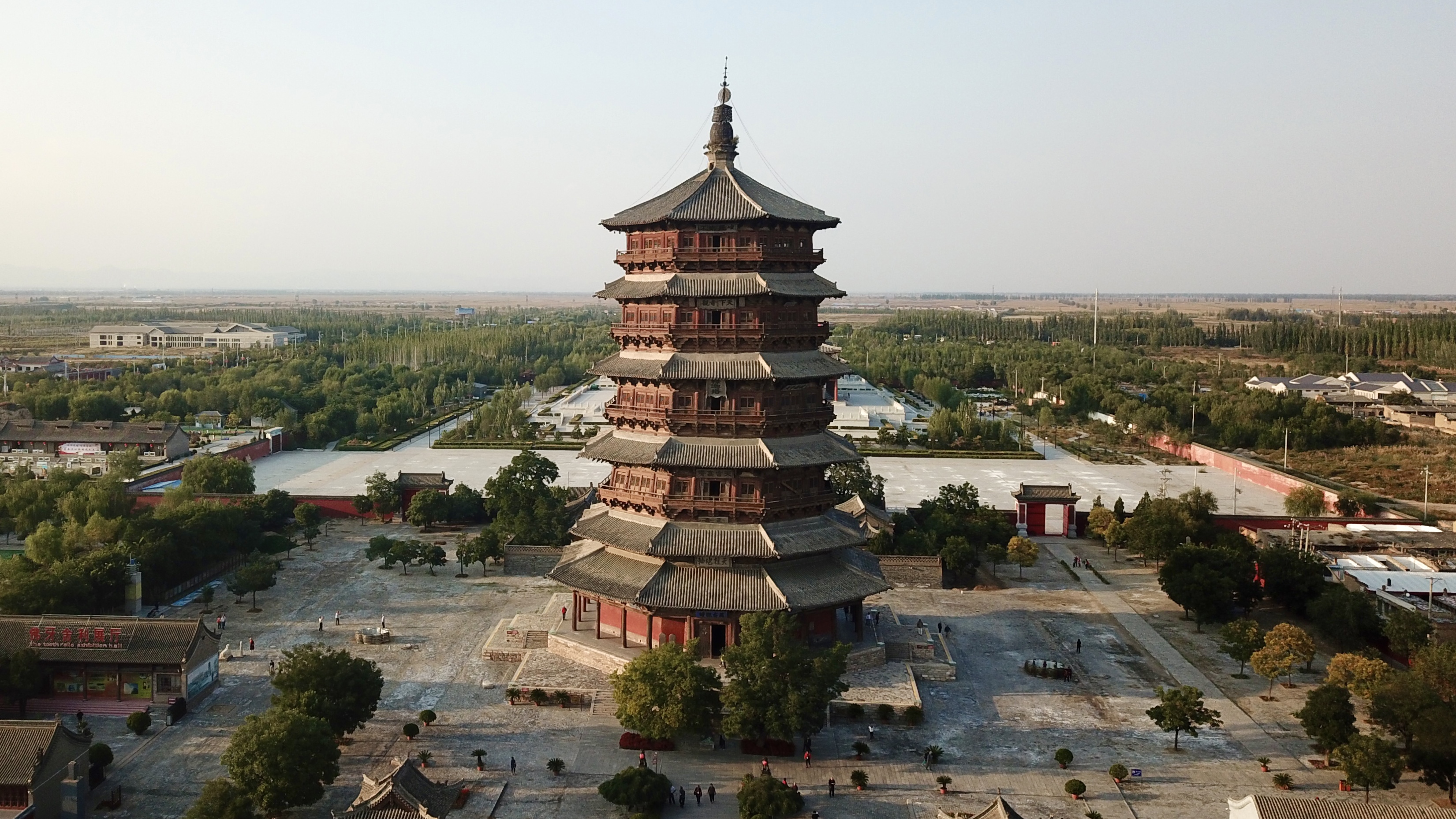
Pagoda of Fogong Temple
Not a single nail holds the Pagoda of Fogong Temple together. Built in 1056 during the Liao dynasty, this 67-meter wooden tower in Ying County, Shanxi, relies entirely on the interlocking of its timber components -- oak crossbeams fitted into chiseled sockets, bracket arms layered into mezzanine floors, thousands of wooden joints working in concert against gravity, wind, and time. The pagoda has endured nearly a thousand years of earthquakes, and it remains the oldest and tallest fully wooden pagoda still standing in China. The Chinese simply call it the Muta -- the Wooden Pagoda -- as though there could only be one.
A Gift for a Grandmother
Emperor Daozong of the Liao dynasty commissioned the pagoda at the site of his grandmother's family home, turning a personal tribute into one of the greatest architectural achievements of medieval China. The structure rises from a four-meter stone platform, its five external stories concealing four hidden mezzanine levels within. At its crown, a ten-meter steeple pushes the total height to 67.31 meters. An earlier pagoda, built between 936 and 943, once stood at this location, but the present tower replaced it entirely. The temple grounds, originally called Baogong Temple, were renamed Fogong in 1315 during the Yuan dynasty.
Engineering Without Iron
The pagoda's survival defies easy explanation. Without nails or iron reinforcements, the structure depends on two principles of traditional Chinese palatial architecture. The first, duodong, describes the bearing blocks and bracket arms that distribute weight outward through the mezzanine layers between each visible story. The second, diantang, refers to the Palatial Hall construction technique used for the main chambers. Between these systems, the pagoda absorbs seismic energy through controlled flexion rather than rigid resistance. Several major earthquakes have tested this design over the centuries, and the tower still stands -- tilting slightly, cracking in places, but structurally intact.
Hidden Treasures Within the Tower
In 1974, workers restoring a Buddha statue on the fourth level made a remarkable discovery: a Buddha tooth relic concealed inside the sculpture. The find confirmed what historians had long suspected -- that the pagoda served not merely as an architectural showpiece but as a reliquary of genuine sacred significance. Buddhist statues occupy every level, with a central Sakyamuni figure commanding the ground floor. The interior stairways, cramped and steep, spiral upward through the hidden mezzanine levels, each transition revealing another set of devotional figures arranged in the dim light filtering through latticed windows.
Standing at the Edge of Recognition
In 2013, the pagoda was placed on China's tentative list for UNESCO World Heritage Site consideration, alongside the Fengguo Temple. The application process has stretched across years, reflecting both the structure's undeniable importance and the complexity of preserving a wooden building that is slowly deteriorating. Shanxi provincial authorities have invested in stabilization efforts, though the pagoda's fundamental challenge remains unchanged: wood decays, even when genius built it. From the air, the pagoda's octagonal silhouette is unmistakable against the flat farmland of Ying County, a single vertical accent in a landscape of horizontal fields, marking the spot where an emperor honored his family and where timber architecture reached its zenith.
From the Air
Located at 39.57°N, 113.18°E in Ying County, Shanxi Province. The pagoda stands 67 meters tall on flat terrain, making it visible from altitude as a distinct vertical structure amid agricultural fields. Nearest major city is Datong, approximately 85 km to the north. Nearest airport is Datong Yungang Airport (ZBDT). Best viewed at 3,000-5,000 feet AGL for scale appreciation.