Paigah Tombs
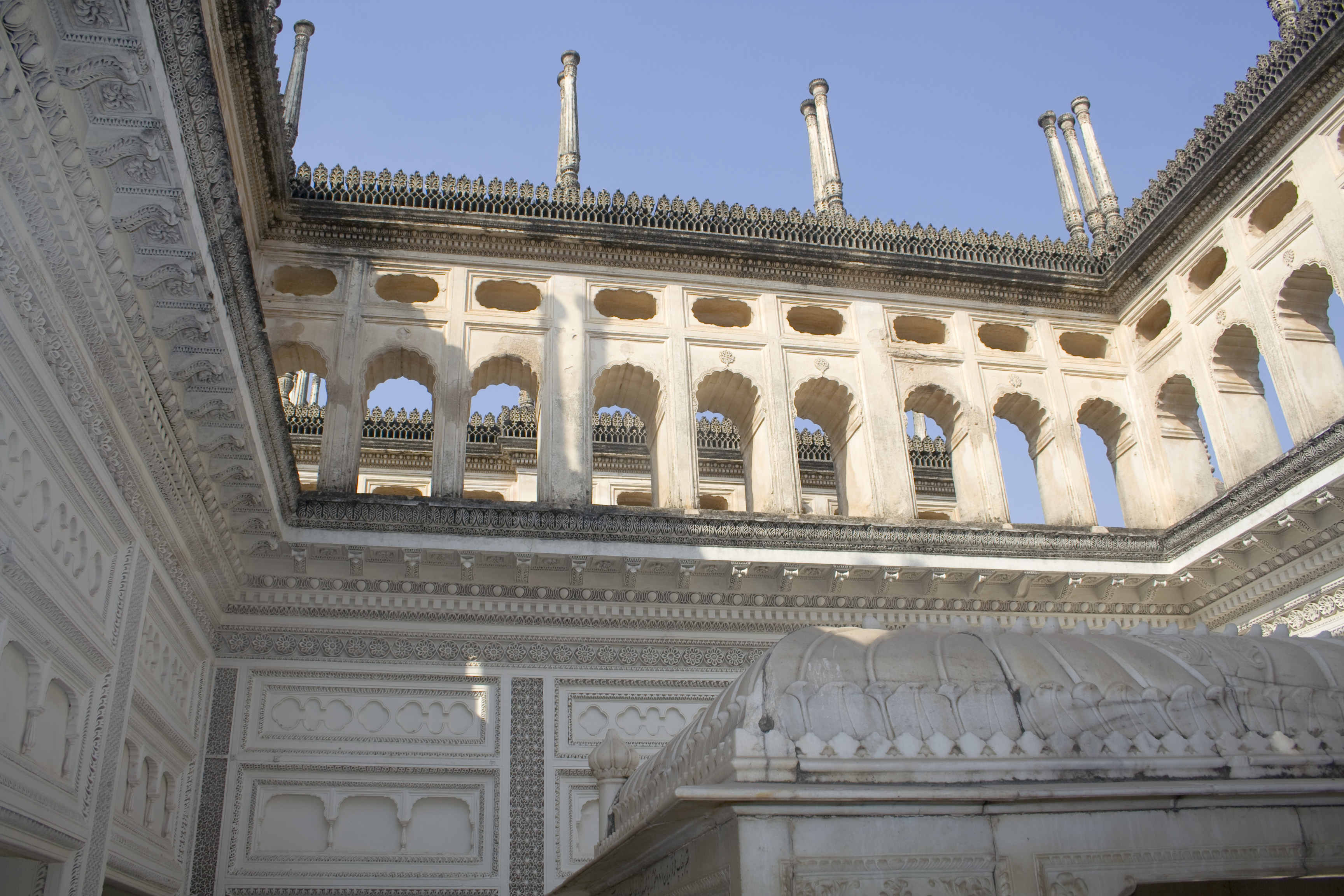
Down a small lane across from Owaisi Hospital, past a sign that barely announces its presence, a labyrinth of concrete houses gives way to something that belongs to another century. The Paigah Tombs sprawl across 35 to 40 acres of Hyderabad's Phisal Banda neighborhood, but the heart of the necropolis -- the tombs of Paigah nobles who married into the Nizam's own family -- occupies a two-acre enclosure of such delicate craftsmanship that first-time visitors often stand frozen at the threshold, recalibrating what they expected to find. None of the designs repeat. Every tomb offers something different in its carvings, its lattice patterns, its stucco ornamentation. The wonder of this place is in discovering each distinction, one carved marble screen at a time.
The Sun Among Nobles
The Paigah family claimed descent from Omar bin Al-Khattab, Islam's second caliph, and they arrived in the Deccan with Asaf Jah I, founder of the Hyderabad dynasty. Their ancestor Abdul Fateh Khan Tegh Jung served the second Nizam, who ruled between 1760 and 1803, and received the title Shams-ul-Umra -- "the sun among the nobles." Through distinguished service and strategic marriages into the ruling family, the Paigahs became the highest-ranking nobles in Hyderabad, second only to the Nizams themselves. They were believed to be wealthier than the average maharajah of the country. They maintained their own courts, their own palaces -- including the famous Falaknuma Palace -- and their own private armies, which often numbered several thousand soldiers.
Open to the Sky
Abdul Fateh Khan Tegh Jung was buried here in 1786, and the site grew into the family necropolis as generations followed. The tombs are shaped as chaukhandis with latticed panels, but they are open to the sky -- a deliberate choice. Until the seventh Nizam's reign, all Nizam tombs were exposed to the elements, emulating the simple grave of Mughal emperor Aurangzeb, under whom the Nizams had served as governors. The Paigah nobles followed this tradition, keeping their burial sites roofless in accordance with what they understood as the simple tenets of their faith. What they did not restrain was the surrounding architecture. The walls enclosing these open-air graves are covered in latticed panels with geometric and floral designs, polished stucco work, and jali screens so finely carved they seem impossible in stone.
Where Granada Meets the Deccan
The architecture defies easy classification. Mughal and Moorish styles merge into something that evokes Granada and Seville as much as it does Delhi or Agra. The crypts themselves, made of lime and mortar, feature intricate marble inlay work alongside stucco that borrows from Greek, Persian, Asaf Jahi, Rajasthani, and Deccani traditions simultaneously. Arches fringed by smaller semicircular arches -- a feature considered unique to India -- frame the entrances. The tomb of Asman Jah and Begum Khurshid Jah draws the most visitors; its marble structures were once adorned with precious and semi-precious stones that changed color with the seasons. Each surrounding wall is decorated differently, with motifs of fruits, drums, serpents, flowers, and vases. Local artisans claim the geometric patterns found here exist nowhere else in the world.
Rescuing What Time Obscured
Concrete houses encroached on the 30-acre property over the decades, and the tombs themselves suffered from neglect and inappropriate repairs -- cement patching over lime-and-mortar originals, cracked stucco left unrepaired, missing minarets. The Aga Khan Trust for Culture, partnering with the Department of Heritage Telangana, undertook a major restoration project with support from the U.S. Ambassadors Fund for Cultural Preservation, which contributed USD 250,000 targeting six tombs built in the eighteenth and nineteenth centuries. More than a hundred minarets have been meticulously reconstructed following traditional construction practices. Workers discovered that what appeared to be solid lime-mortar jali screens were actually built over terracotta tiles and iron cores -- a hidden engineering secret revealed only when restorers began replacing earlier cement patches with the original materials and techniques. The project also includes improved landscaping, visitor paths, signage, and lighting, aiming to make this obscure necropolis accessible without compromising its heritage fabric.
From the Air
The Paigah Tombs sit at 17.34N, 78.50E in southern Hyderabad, roughly 4 km southeast of the Charminar. The site is difficult to spot from altitude as it is surrounded by dense urban development in the Phisal Banda / Santosh Nagar neighborhood. Nearest airport is Rajiv Gandhi International (VOHS/HYD), approximately 15 km to the south. Elevation roughly 530 meters on the Deccan Plateau. Look for a pocket of open space amid the residential grid near Owaisi Hospital.