Paikuli Inscription
A king who seized a throne needs the world to know why he deserved it. In 293 AD, the Sasanian emperor Narseh solved that problem with stone. He erected a tower in the mountain pass between Babylonia and the Iranian plateau, near what is now the village of Barkal in Iraq's Sulaymaniyah Governorate, and covered its walls with inscribed blocks declaring his right to rule. The text appeared in two languages -- Parthian and Middle Persian -- ensuring that every literate subject of his empire, regardless of background, could read exactly how Narseh had overthrown his grandnephew and claimed the crown.
A Throne Won on the March
Narseh was no usurper by his own telling. The Paikuli inscription lays out his case with the precision of a legal brief. He had marched from Armenia with a coalition of supporters and allies, each named in the text, to depose a ruler he considered illegitimate. The inscription records how the provinces of Asuristan -- ancient Babylonia -- rallied to his cause. It names the vassal kings who bent the knee, including Amr ibn Adi, a Lakhmid Arab ruler whose allegiance Narseh considered worth immortalizing in stone. Every ally, every territory, every battle forms part of a narrative designed to make Narseh's seizure of power look inevitable rather than opportunistic.
Two Languages, One Message
The choice to write in both Parthian and Middle Persian was deliberate. The Sasanian Empire had absorbed the old Parthian aristocracy, and many noble families still used the Parthian language in daily life. By inscribing his monument in both scripts, Narseh addressed the full spectrum of his empire's elite. The text also draws a direct line from Narseh back to his grandfather Ardashir I, the founder of the Sasanian dynasty. Some scholars believe Narseh was comparing his own rise to power with Ardashir's original conquest -- casting himself not as a rebel but as a restorer of proper succession.
Ruins in the Pass
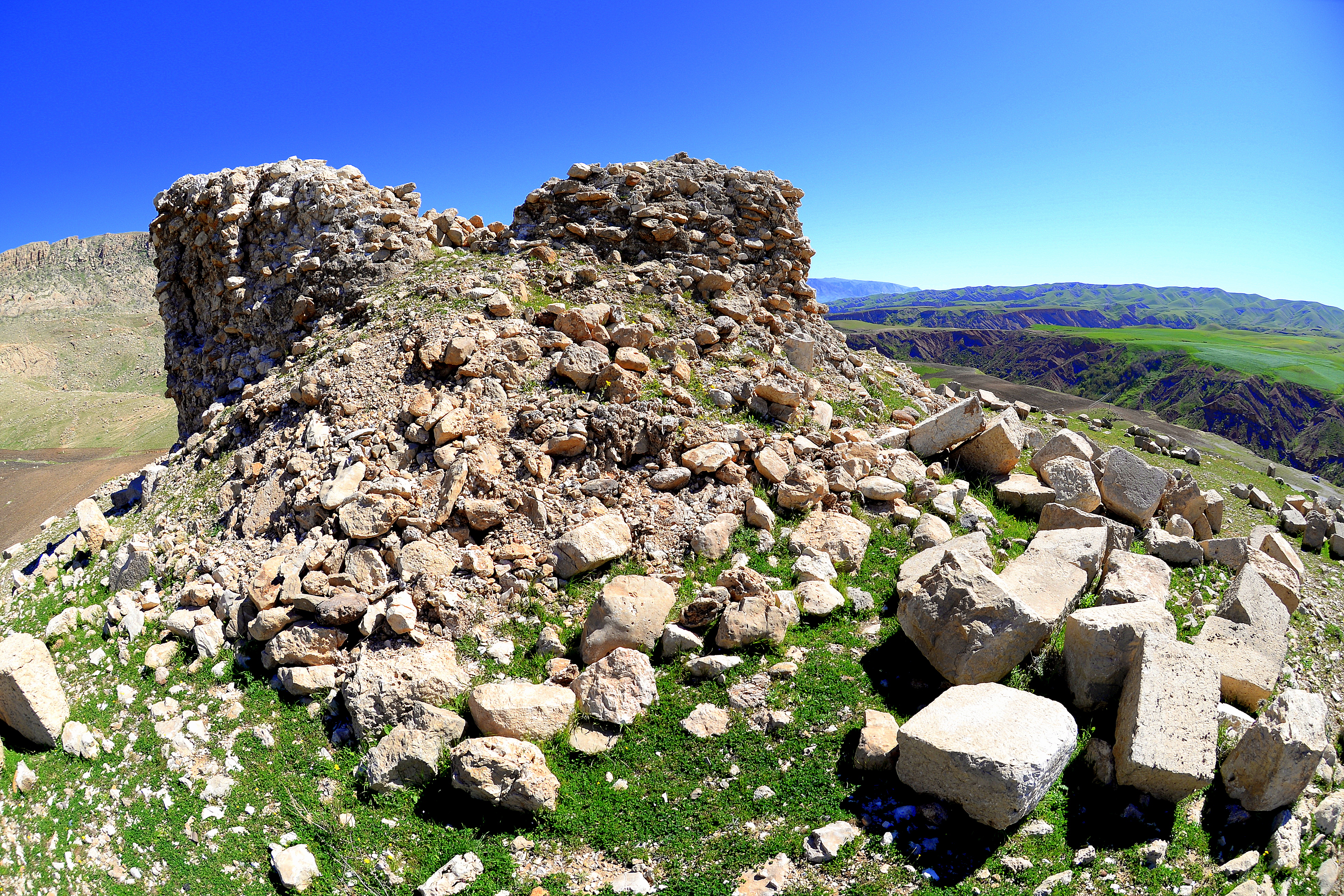
When 19th-century European travelers first reached the site, they found a square tower in ruins, its inscribed stone blocks scattered across the ground like discarded pages of a book. The tower had once stood whole, its four walls sheathed in carved blocks that told Narseh's story to anyone passing through this strategic mountain corridor. Time and neglect had done their work. The blocks lay where they had fallen, some face-down in the dirt, their carefully carved letters pressed into the earth. Busts of Narseh himself had adorned the structure -- fragments of his braided hair and ornate headdress have been recovered, offering a portrait of a king who wanted to be seen as much as read.
Piecing History Back Together
The inscribed blocks now reside in the Sulaymaniyah Museum in Iraqi Kurdistan, the only institution in the world to display relics of the Paikuli Tower. In June 2019, the museum opened a dedicated gallery for the inscription and its associated artifacts. Archaeologists from Sapienza University of Rome have collaborated with Kurdish authorities to document and protect the original field site, where only the uninscribed construction stones remain. New blocks continue to surface -- recently discovered fragments have added previously unknown passages of both the Parthian and Middle Persian texts, filling lacunae that had frustrated scholars for over a century. Each recovered block is another sentence in a story that Narseh intended to last forever.
Legacy in Stone
The Paikuli inscription occupies a unique place in the study of ancient Iran. It is one of the longest Parthian-language texts ever discovered, and one of the most important sources for understanding the internal politics of the Sasanian Empire during a period of dynastic upheaval. The historian al-Tabari preserved parallel accounts of this succession crisis, and the inscription's details largely confirm his narrative while adding names and events found nowhere else. What remains at the field site today is modest -- scattered stones in a Kurdish mountain pass. But what those stones once carried was nothing less than a king's attempt to write his own history.
From the Air
Located at 35.10N, 45.58E in the Sulaymaniyah Governorate of Iraqi Kurdistan. The site sits in a mountain pass between the Mesopotamian lowlands and the Iranian plateau. Nearest major airport is Sulaymaniyah International (ORSU), approximately 60 km northeast. The terrain is rugged limestone hills; best viewed at altitudes of 5,000-8,000 feet AGL. The modern village of Barkal is the nearest settlement landmark.