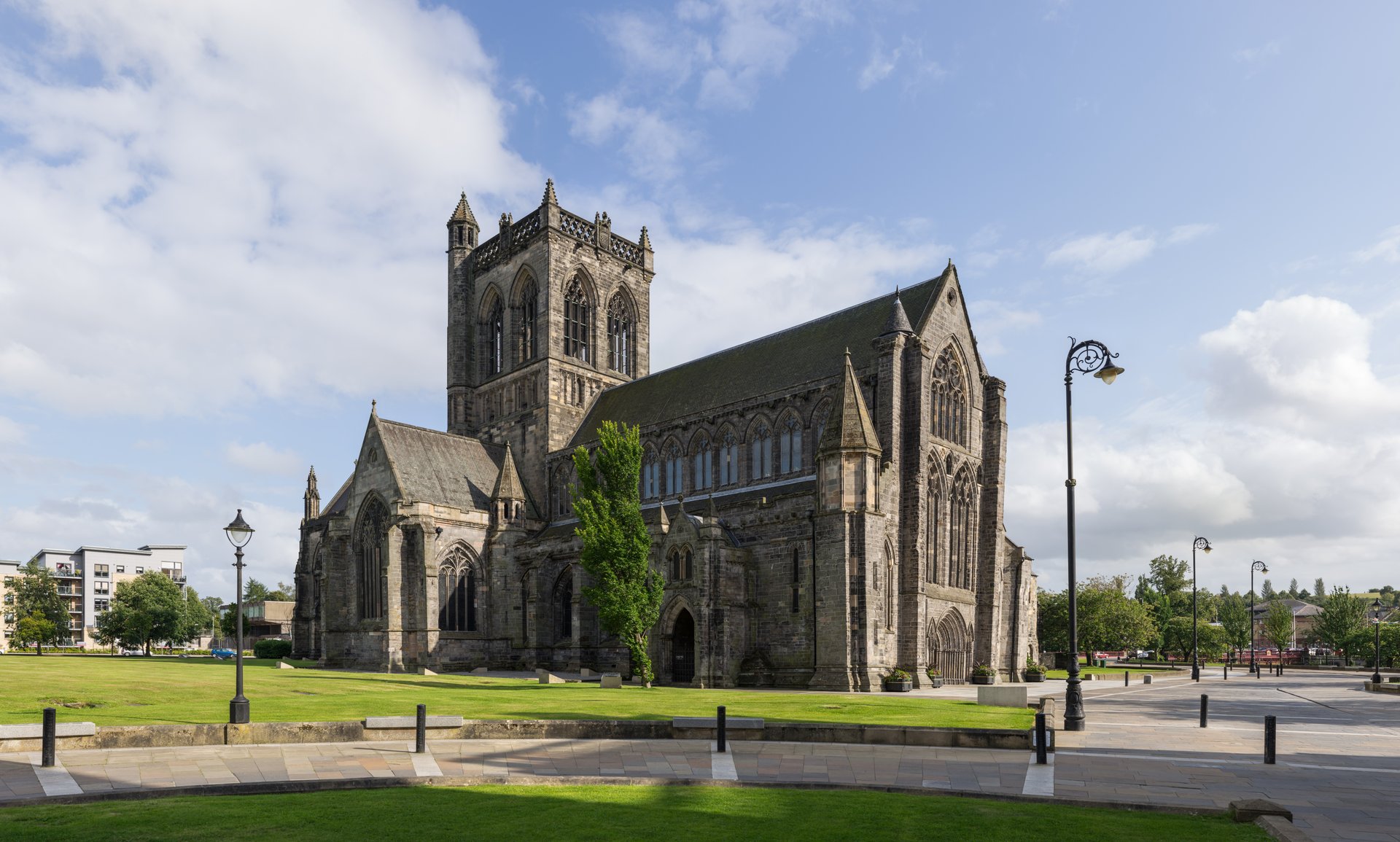
Paisley Abbey
Somewhere on the exterior of Paisley Abbey, among the gargoyles and grotesques that have watched over this Cluniac foundation for centuries, one figure stands out. It has an elongated skull, hollow eyes, and a body that bears a striking resemblance to the xenomorph from Ridley Scott's 1979 film Alien. Erected by a stonemason hired during a 1990s restoration, the gargoyle went viral in 2013 and has become the abbey's most photographed feature. That a building founded in 1163 by monks from Shropshire should be best known in the twenty-first century for a science fiction movie reference says something about the layers of history piled up within its walls.
From Saint Mirin to the High Stewards
The site's religious significance predates the abbey by centuries. Saint Mirin is believed to have founded a community here in the 7th century, and his shrine became a popular place of pilgrimage. The name Paisley itself may derive from the Cumbric word Passeleg, meaning 'basilica' -- a hint of vanished ecclesiastical importance. In 1163, Walter fitz Alan, the first High Steward of Scotland, issued a charter for a priory on his land at Paisley. Around thirteen monks traveled north from the Cluniac priory at Much Wenlock in Shropshire to found the community. The priory grew so rapidly that it was elevated to abbey status in 1245, and its monks went on to found Crossraguel Abbey in Ayrshire.
Fire, Wallace, and a Caesarean Birth
Edward I of England burned the abbey to the ground in 1307, and it was rebuilt later that century. William Wallace, born in nearby Elderslie, is believed to have been educated within its walls as a boy. But the abbey's most extraordinary moment came in 1316, when Marjorie Bruce -- daughter of Robert the Bruce and wife of Walter Stewart, the sixth High Steward -- fell from her horse while riding near the grounds. She was heavily pregnant. Taken to the abbey for medical care, she delivered a son by caesarean section without the benefit of anaesthesia. The child survived to become King Robert II, founder of the Stuart dynasty. Marjorie did not survive. She was buried at the abbey, where a reconstructed tomb bearing a female effigy stands in the choir. A cairn at the junction of Dundonald Road and Renfrew Road marks the place where she fell.
The Great Drain
In 1829, workmen digging in a garden near the abbey fell through the ground into a tunnel. Nobody thought much of it. Fifty years later, the Glasgow Herald mentioned the 'subterranean passage,' and again nobody followed up. It was not until 1990 that a ninety-meter stretch of medieval tunnel was properly explored, running from the abbey to the White Cart Water. Dating to approximately 1350-1400, the Paisley Abbey Drain is up to two meters wide and 2.2 meters high, its stone walls still bearing masons' marks. Archaeologists recovered extraordinary finds: a carved slate marked with what is believed to be the oldest example of polyphonic music found in Scotland, along with imported cloth seals, chamber pots from around 1500, carved bone handles, and pottery fragments.
Absolution and a King's Guilt
Paisley Abbey served as a place of political as well as spiritual power. In 1491, James IV of Scotland came to the abbey seeking absolution for his role in the death of his father, James III, at the Battle of Sauchieburn. Abbot George Shaw, acting as the Pope's representative and in the presence of sacred relics, granted the young king forgiveness. Shaw then commissioned a larger pilgrims' chapel and added a sculpted stone frieze depicting scenes from the life of Saint Mirin -- originally brightly painted, now faded but still visible. All six High Stewards of Scotland are buried within the abbey, as are the wives of Robert II and Robert III himself, making it one of the most significant royal burial sites in the country.
Ruin, Restoration, and an Organ from Paris
Fires and the collapse of the central tower in the 15th and 16th centuries left the eastern half of the abbey in ruins, its stone plundered by locals for building material. The western section continued to serve as a parish church after the Reformation. Reconstruction began in 1858 under architect Macgregor Chalmers and was completed by Sir Robert Lorimer, who designed the ceiling bosses carved by James A. Young. The abbey organ, originally built by the distinguished French firm Cavaille-Coll of Paris in 1874 -- one of only six in the United Kingdom -- was rebuilt four times and restored by Harrison and Harrison of Durham in 2009. The twelve angel corbels and stone communion table are the work of Pilkington Jackson, the same sculptor who created the Robert the Bruce statue at Bannockburn. Paisley Abbey stands as a working parish church of the Church of Scotland, its congregation gathering each Sunday in a building that has seen monks and monarchs, burning and rebuilding, and one stonemason's quiet joke that outlived every serious monument on its walls.
From the Air
Paisley Abbey sits at 55.845°N, 4.420°W on the east bank of the White Cart Water in central Paisley, approximately 7 nm west of Glasgow city center and 2 nm south of Glasgow International Airport (EGPF). The abbey is identifiable from the air by its large Gothic structure near the river, with the town center of Paisley surrounding it. The White Cart Water, flowing past the abbey's western side, provides a useful visual reference.