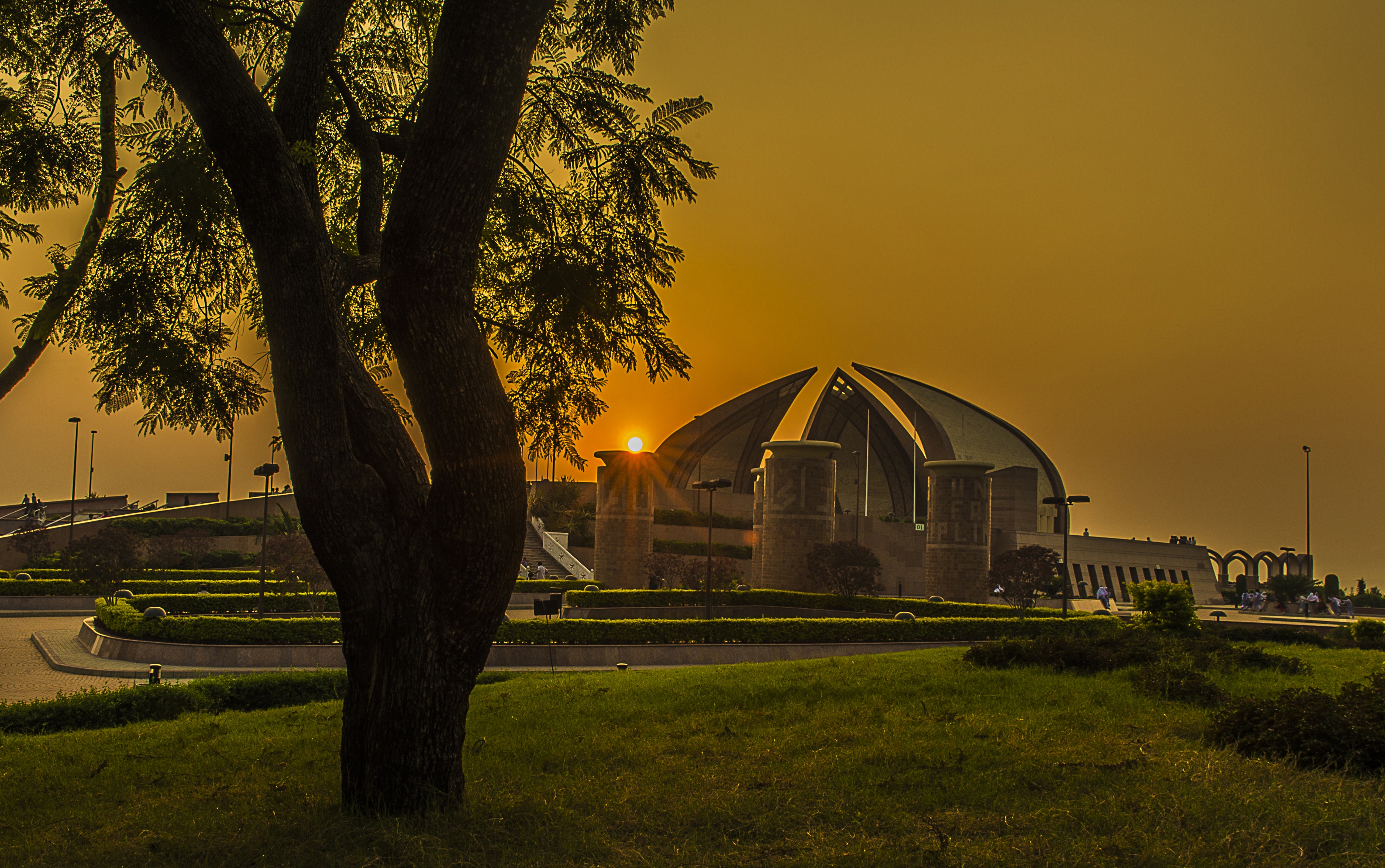
Pakistan Monument
From the air, it looks like a star embraced by a crescent moon -- Pakistan's flag rendered in granite and steel on a hilltop overlooking Islamabad. Get closer, and the crescent resolves into seven massive petals, each one cantilevered outward in a suspended arc that ranks among the largest such structures in Asia. The Pakistan Monument does not whisper its symbolism. It announces it: four large petals for the Punjabi, Baloch, Sindhi, and Pashtun cultures, three smaller ones for the minorities, Azad Kashmir, and Gilgit-Baltistan, all converging over a single platform. Independent but inseparable. That is the idea, anyway, and architect Arif Masoud put it into stone with a conviction that is hard to argue with at this scale.
From Competition to Cornerstone
The idea for a national monument in the capital surfaced in 2002, guided by Uxi Mufti, son of the celebrated Urdu writer Mumtaz Mufti. The Ministry of Culture organized a design competition through the Pakistan Council of Architects and Town Planners, inviting proposals around the theme of national strength, unity, and dedication. Twenty-one architects submitted designs. Three were shortlisted. Arif Masoud's petal concept won approval on July 10, 2003, and the foundation stone was laid on May 25, 2004. Construction took two years. On March 23, 2007 -- Pakistan Day, commemorating the Lahore Resolution of 1940 -- President Pervez Musharraf inaugurated the completed monument on the western shoulder of the Shakarparian Hills.
Mughal Roots, Modern Steel
Masoud drew his inspiration from muqarnas, the honeycomb vaulting that adorns the ceilings and arches of Mughal architecture across the subcontinent. "We should learn from history but not remain in it," the architect has said, and his design translates that medieval ornamental form into something muscular and contemporary. The petals are built from granite, their inner walls covered in artwork depicting landmarks of Pakistani heritage: the Lahore Fort, the Badshahi Mosque, the Khyber Pass, Minar-e-Pakistan. Portraits of figures from the independence movement share the walls with scenes of music and dance. The star at the monument's center is crafted from polished black granite inlaid with golden stars representing those who gave their lives for Pakistan. A crescent of stainless steel carries inscribed words from Quaid-e-Azam Muhammad Ali Jinnah and the poet-philosopher Allama Iqbal.
The Freedom Plaza
The monument and its adjoining museum are linked by a broad piazza that Masoud named the Freedom Plaza. Walk its length, and you pass between long walls where something unusual catches the eye: handprints pressed into the surface, dozens of them. These are not the marks of dignitaries or politicians. They belong to the construction workers who built the monument, placed there at the architect's insistence. Masoud's own name is inscribed in stone on the main dedication plaque outside the plaza, but he chose to share credit with the laborers whose hands shaped the granite. At the plaza's far end, a viewing platform offers a bird's-eye panorama of Islamabad stretching north toward the Margalla Hills.
Half a Million Visitors
The Pakistan Monument Museum adjoins the main structure and narrates the history of Pakistan's creation. Together, the monument and museum drew roughly 1,500 visitors per day on average, totaling 570,000 visits in 2015 and nearly 515,000 in 2018. Covering a total area of 2.8 hectares, the complex has become one of Islamabad's most recognizable landmarks, its elevated position on the Shakarparian Hills making it visible from across the Islamabad-Rawalpindi metropolitan area. For a planned capital city that sometimes struggles with the question of what defines its identity, the monument offers a clear answer -- or at least a compelling argument, written in stone and steel, that the nation's diversity is itself the identity.
From the Air
Located at 33.69°N, 73.07°E on the Shakarparian Hills in Islamabad, Pakistan. The monument is a highly distinctive aerial landmark -- from above, the petal structure forms a star-and-crescent pattern clearly visible against the green hillside. Nearest major airport is Islamabad International Airport (OPIS), approximately 30 km northwest. Chaklala Air Force Base (OPRN) lies about 5 km southeast. Best viewed at 2,000-4,000 feet AGL. The Margalla Hills chain to the north and the broad Islamabad-Rawalpindi urban area provide easy visual orientation.