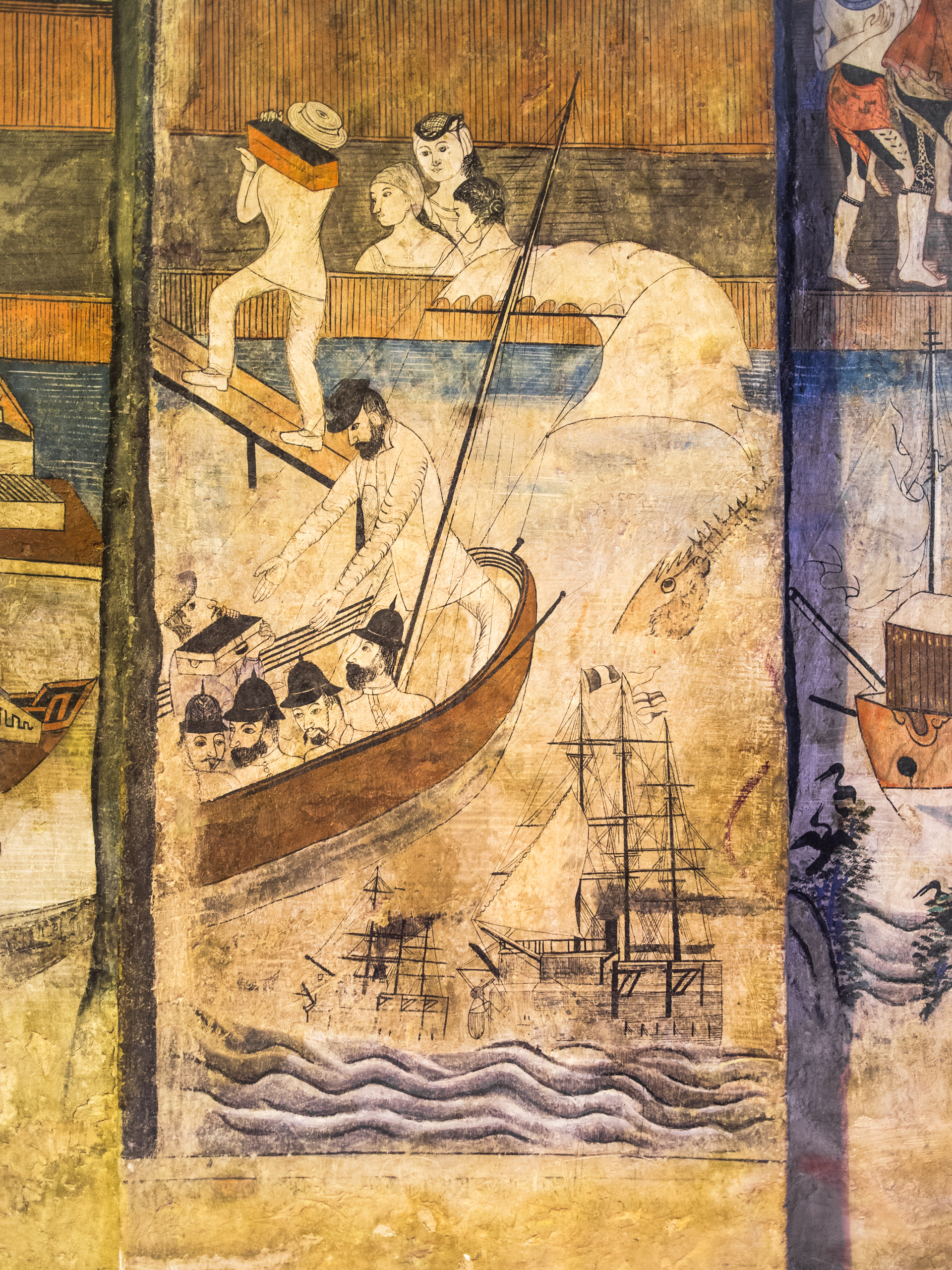
Paknam Incident
The telegram arrived too late. On the evening of July 13, 1893, Captain Borey of the French Navy had already committed to crossing the bar at the mouth of the Chao Phraya River, riding the high tide into Siamese waters with the aviso Inconstant and gunboat Comete. Paris had sent orders to wait, but the French consul in Bangkok would not receive them until the following day. Borey followed his standing orders from Saigon instead. What unfolded over the next 25 minutes -- a confused, rain-soaked naval engagement at the place the Siamese called Paknam -- would cost fifteen Siamese and two French lives, and set in motion the diplomatic crisis that carved modern-day Laos away from Siam forever.
A Fort Commanded in the Wrong Language
Chulachomklao Fort had been recently modernized with seven 6-inch Armstrong Whitworth disappearing guns, and on paper it presented a formidable defense. Its commander was Andreas du Plessis de Richelieu, a Danish naval officer serving the Siamese crown under the noble title Phraya Chonlayutyothin. Three other Danes served under him. The problem was that two of them had just arrived and spoke no Siamese whatsoever. When the French ships appeared through the fading rain at 18:15, the scene inside the fort became something closer to farce than to war. As the British observer Herbert Warington Smyth later recounted, the Danish officers were "running breathlessly to their guns in turn up and down half-finished steps and gun-platforms, avoiding pitfalls as best they might, and communicating their orders in languages which none of the astonished gunners understood." The fort managed to fire warning shots -- two blanks, then a live round that splashed in front of the mail steamer Jean Baptiste Say -- but effective resistance was beyond its reach.
Gunboats in the Rain
Aboard the Siamese gunboats Makhut Ratchakuman and Coronation, the situation was no better. The crews had received almost no gunnery training, so their Danish commanders had to physically run between the guns, the bridge, and the engine room, laying and firing each weapon themselves before sprinting back to steer. After just two shots, the 70-pound gun on the Coronation broke through its deck and could fire no more. In the confusion, the Coronation nearly collided with the Inconstant, which responded by putting two shells into the Siamese vessel. The Jean Baptiste Say, leading the French column, took several hits from cannon fire and ran aground at Laem Lamphu Rai. Not a single Siamese shell struck the fort's intended target -- the French warships pushed through the entire defensive line in under half an hour. As night fell and the ships passed the smaller Phi Seua Samut fortress upstream, Warington Smyth described "five minutes' desultory firing of the wildest kind" before the French gunboats slipped through unhindered. A civilian woman in Paknam was struck and killed by a stray bullet from this final exchange.
Guns Trained on the Royal Palace
By ten o'clock that evening, Captain Borey had anchored off the French Embassy in Bangkok with his ships' guns aimed squarely at the royal palace. The message was unmistakable. The Siamese had tried to block the French from entering the Chao Phraya River, but in doing so they had violated the 1856 Franco-Siamese Treaty, which guaranteed French passage as far as Paknam Island. France now had both military advantage and legal pretext. The following morning, the Siamese managed to capture the grounded Jean Baptiste Say and repelled a French boarding party sent from the gunboat Forfait, but these small victories changed nothing. By July 24, the French gunboats and consul Auguste Pavie had departed Bangkok. Five days later, France imposed a full blockade of the river.
The Map Redrawn
The blockade lasted from July 29 to August 3, and it alarmed Britain far more than France. British trade accounted for 93 percent of Siam's exports, and London had no interest in watching Paris turn Siam into a protectorate. Under British pressure, both sides came to the negotiating table, but the terms heavily favored France. The agreement signed on October 3, 1893, stripped Siam of all territories east of the Mekong River -- land that today forms most of Laos. A 25-kilometer military exclusion zone was established along the Mekong's right bank and around Battambang and Siem Reap, weakening Siamese hold on territories that Cambodia would eventually reclaim. France also took temporary control of the port of Chanthaburi, and Siam was forced to pay an indemnity of three million French francs. A quarter-hour of confused gunfire at the river's mouth had redrawn the borders of Southeast Asia.
From the Air
Located at 13.54N, 100.58E near the mouth of the Chao Phraya River in Samut Prakan Province, south of Bangkok. From the air, the river's wide delta and the site of the former Chulachomklao Fort are visible along the western bank. Nearby airports include Suvarnabhumi (VTBS) approximately 15 km northeast and Don Mueang (VTBD) about 40 km north. Best viewed at 3,000-5,000 feet altitude on approach to Suvarnabhumi, where the river's curving path to the Gulf of Thailand is clearly visible.