Palace Museum
In 1924, the last emperor of China was escorted out of a palace that had been home to royalty for five centuries. A year later, on October 10, 1925, the gates opened to ordinary citizens for the first time. What had been the private domain of emperors became the Palace Museum -- and the Chinese public flooded in to see what their rulers had collected behind those vermillion walls.
Behind the Vermillion Walls
The numbers alone stagger: 980 buildings, 8,707 bays of rooms, 720,000 square meters of space. Built between 1406 and 1420 under the Yongle Emperor, the Forbidden City served as the ceremonial and political heart of China through the Ming and Qing dynasties. The palace complex exemplifies traditional Chinese palatial architecture on a scale that influenced building traditions across East Asia. UNESCO designated it a World Heritage Site in 1987, recognizing it as the largest collection of preserved ancient wooden structures in the world. Today, with more than 17 million visitors annually, it ranks as the most visited museum on the planet -- so popular that management imposed a daily cap of 80,000 visitors in 2015 to protect the ancient structures.
A Collection Scattered by War
The museum's collection began as the personal treasury of emperors. A 1925 audit counted 1.17 million pieces of art stored within the Forbidden City, alongside vast libraries of rare books and government documents spanning centuries. But war would scatter this inheritance across a continent. In 1933, with Japanese forces advancing, curators packed the most important works into 13,491 boxes and evacuated them south. After World War II, the collection was returned to Nanjing -- only to be divided again by civil war. Chiang Kai-shek's Nationalist government shipped 2,972 boxes to Taiwan, where they became the foundation of the National Palace Museum in Taipei. More than 8,000 boxes made it back to Beijing, but 2,221 remain in Nanjing to this day. One imperial collection, three museums, two countries: a physical embodiment of twentieth-century Chinese history.
Treasures That Span Eight Millennia
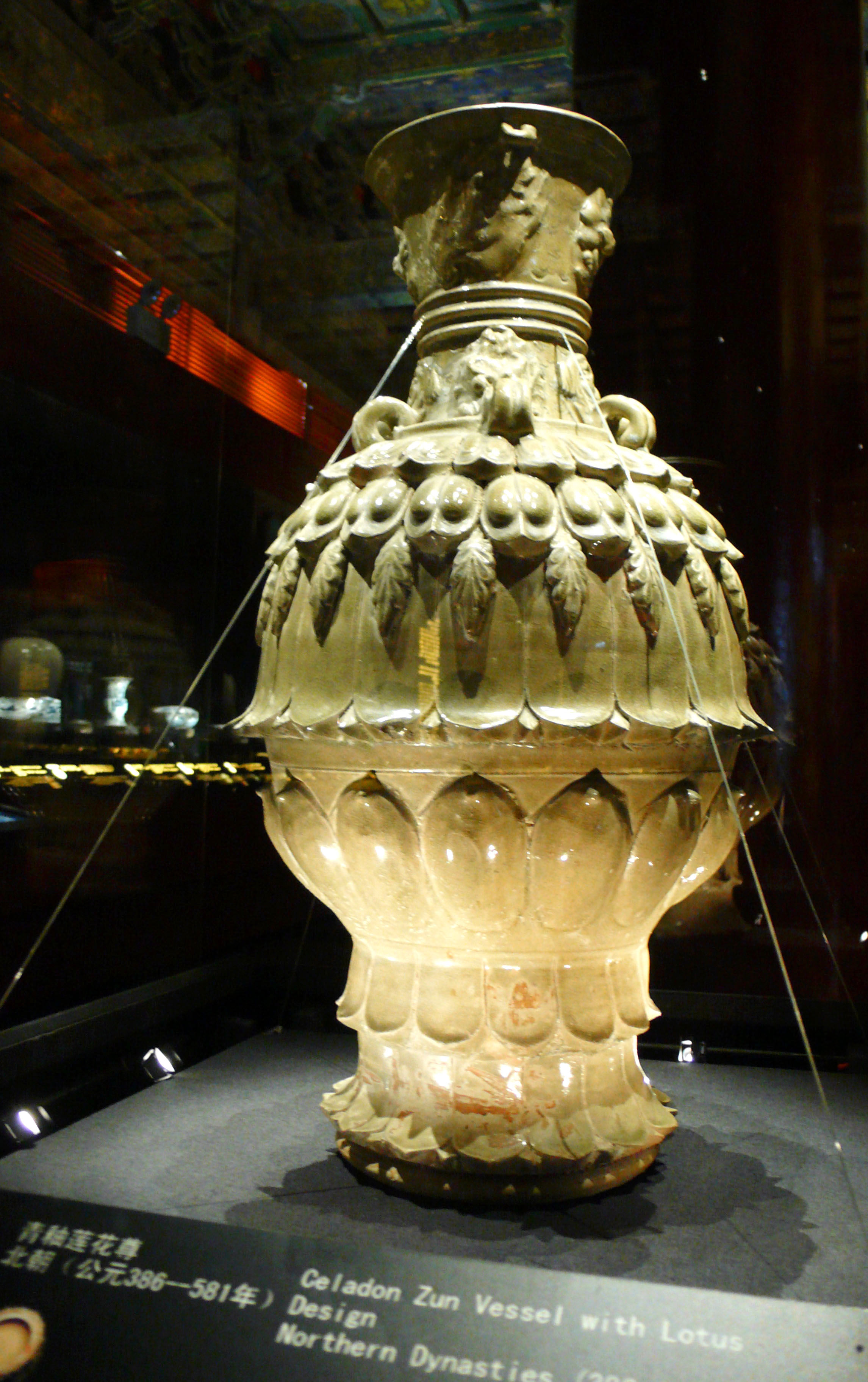
The museum's holdings now total 1,862,690 objects -- a figure that grew by 55,132 when a 2014-2016 inventory uncovered items that had somehow gone unlisted. The ceramics collection alone holds 340,000 pieces, representing 8,000 years of Chinese ceramic production, from Neolithic pottery to imperially commissioned porcelain. There are 30,000 jade objects, some dating to prehistory, and nearly 10,000 bronzes including inscribed ceremonial vessels from the Shang dynasty. Perhaps the most unexpected treasures are the mechanical timepieces: more than 1,000 clocks from the 18th and 19th centuries, sourced from Britain, France, Switzerland, and the palace's own workshops. One remarkable automaton can write auspicious Chinese calligraphy with a miniature brush.
Living Architecture
Beyond its collections, the Palace Museum preserves the daily life of empire. Some exhibitions present rooms exactly as they appeared during imperial times -- thrones positioned, screens arranged, ceremonial objects placed according to protocol. Others fill themed halls dedicated to painting, calligraphy, bronzeware, and opera. The museum's Hospital for Conservation maintains specialized laboratories for everything from textile restoration to computed tomography scanning of fragile objects. The Forbidden City has occasionally served as a performance venue as well: in 1998, Puccini's opera Turandot was staged at the Imperial Shrine just outside the walls, and in 2001, the Three Tenors -- Domingo, Carreras, and Pavarotti -- performed inside the Forbidden City walls.
An Empire's Legacy, Shared
The Palace Museum has grown into a constellation of institutions. The Hong Kong Palace Museum opened in July 2022, and a northern branch in Beijing's Haidian District has been under construction since December 2022. A gallery on the island of Kulangsu in Xiamen displays foreign artifacts from the palace collection. The museum operates research institutes, academic journals, and conservation laboratories that apply modern science to ancient art. What began as one man's forced exit from a palace has become something the emperors never intended: their private treasures made public, their secret world laid open, their legacy belonging not to a dynasty but to everyone who walks through those gates.
From the Air
Located at 39.92N, 116.39E in the exact center of Beijing. The Forbidden City's rectangular footprint is clearly visible from altitude, oriented precisely along the north-south axis. The golden-roofed palace complex stands out against the surrounding modern city. Nearby airports: Beijing Capital International (ZBAA) 25 km northeast, Beijing Daxing International (ZBAD) 46 km south. Best viewed at 2,000-5,000 ft for the full layout.