Palace of Ajuda
The Palace of Ajuda was born from catastrophe and never quite escaped it. After the 1755 earthquake and tsunami leveled much of Lisbon, the royal family sheltered in a temporary wooden building on this hilltop in the civil parish of Ajuda. When it came time to build something permanent, architect Manuel Caetano de Sousa drew plans for a late Baroque-Rococo structure. Then the plans changed. José da Costa e Silva and Francisco Xavier Fabri reimagined the project in the neoclassical style — grand columns, symmetrical façades, restrained ornamentation — and construction lurched forward through decades of political upheaval, financial constraints, and the small matter of a French invasion.
A Palace Interrupted
By 1807, painters, sculptors, and decorators had been contracted, and the building was taking shape. Then Napoleon's general Jean-Andoche Junot marched into Lisbon, and the royal family fled to Brazil. Junot insisted construction continue — apparently even invaders appreciate good architecture — but the 1809 French campaign through Portugal brought work to a halt. The building sat partially finished through the Peninsular War and the long years of political instability that followed. It would not be until the 1860s that the palace found its purpose as a royal residence, and even then it was never completed according to the original plans. One entire wing was never built, giving the palace its characteristic lopsided quality — half monument, half promise.
The Last Royal Home
King Luís I moved to Ajuda in the early 1860s after a series of royal family tragedies made the Palace of Necessidades unbearable. He and Queen Maria Pia of Savoy transformed the unfinished building into a functioning court, filling its interconnecting halls with the decorative arts that now constitute the museum collection. The interior reveals the taste of its last royal inhabitants: the Sala de Saxe with its porcelain collection, the Blue Room, the Pink Room, the banqueting hall — each space decorated with stuccos, painted walls in trompe-l'oeil, azulejo tiles, and furnishings that speak to Portugal's connections with Asia, Brazil, and the European courts. Maria Pia was particularly devoted to the palace, and her influence shaped many of the interiors that survive today.
Republic, Neglect, Revival
The 5 October 1910 Revolution ended the Portuguese monarchy and all work on the palace. A new phase of neglect began, reaching its nadir in 1925 when rainwater flooded the library. In 1934, Duarte Pacheco commissioned architect Raul Lino to develop a completion plan, but it was deferred repeatedly. The palace eventually reopened as a museum, its unfinished state becoming part of its character. Visitors walk through rooms that range from fully decorated state apartments to bare halls where the plaster was never applied, a physical record of Portugal's turbulent 19th and 20th centuries. Recent restoration has stabilized the building and improved the display of its collections, which include some of the finest decorative arts in Portugal.
A Hilltop View of History
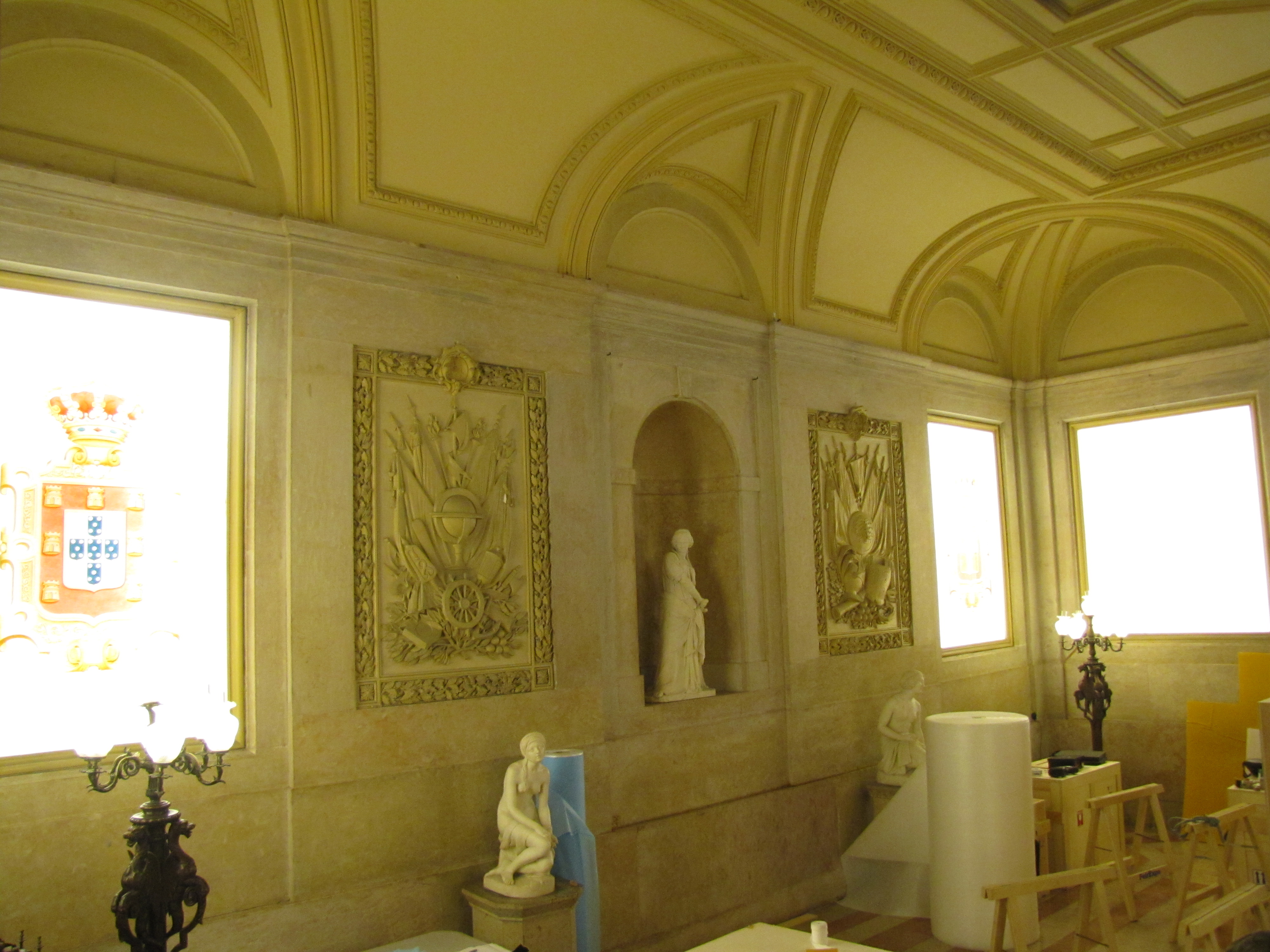
From the palace's elevated position in the Ajuda parish, the view extends across Lisbon's western reaches to the Tagus and beyond. The main entrance hall features figures of Justiça and Prudência flanking the central staircase, an apt pairing for a building whose history has required generous measures of both. The second floor's Escadaria Nobre — the grand staircase used during state functions — zigzags upward through carved ceilings, a processional route designed for a monarchy that would use it for barely four decades. Today the Palace of Ajuda serves as both museum and occasional venue for state functions, a neoclassical shell that tells Portugal's story not through what it completed but through everything it attempted.
From the Air
Located at 38.708°N, 9.198°W on the Ajuda hilltop in western Lisbon. The palace's neoclassical façade faces south with views toward the Tagus River. Look for the large symmetrical building with its distinctive incomplete wing on the Ajuda hill above the Belém waterfront. Recommended viewing altitude: 2,000-3,000 ft. The palace sits uphill from the Belém cultural cluster (Jerónimos Monastery, Tower of Belém). Nearest airport: Lisbon/Humberto Delgado (LPPT) approximately 10 km east.