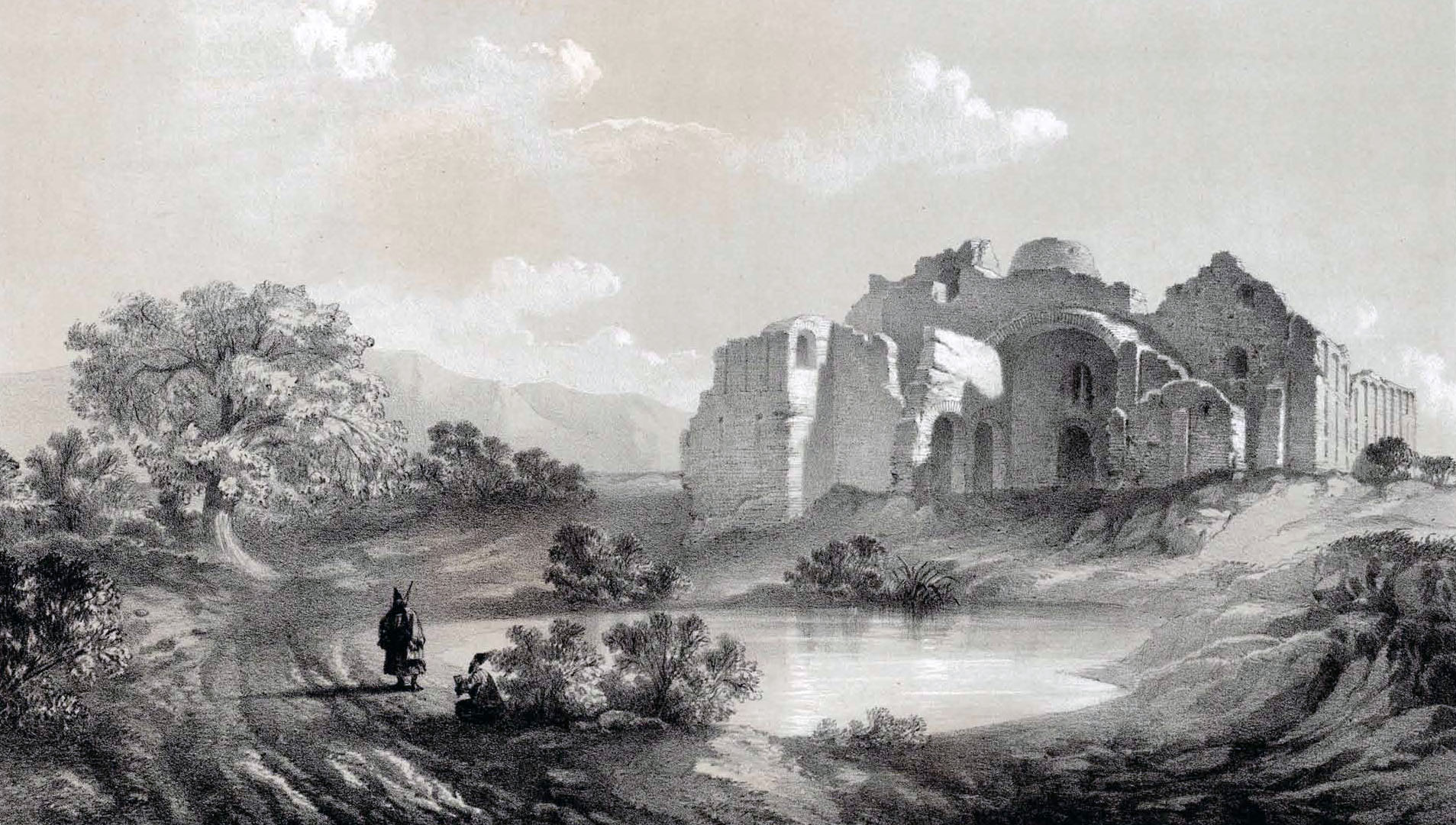
Palace of Ardashir
Without the squinch, there is no dome of St. Peter's. Without the dome of St. Peter's, the Renaissance skyline of Rome looks fundamentally different. The travel writer Robert Byron made this argument in 1934 after visiting a half-ruined palace in southern Iran, and the claim has only grown more persuasive since. The Palace of Ardashir, built around 224 AD at the foot of a mountain near the ancient city of Gor, contains the earliest known examples of the squinch -- an angled arch set across the corner of a square room, transforming it into an octagon capable of supporting a round dome. Every great domed building in the world descends, architecturally, from this solution. And the solution was worked out here, in the Zagros foothills, by the engineers of a king who had just overthrown an empire.
A Palace, Not a Fortress
Ardashir I, founder of the Sasanian Empire, built the palace two kilometers north of his circular capital of Gor -- modern Firuzabad -- on the slopes below the hilltop fortress of Qal'eh Dokhtar. The distinction between the two structures is revealing. Qal'eh Dokhtar, perched on the heights, was built for defense. The palace below was built for display. Its walls are twice as thick as the fortress above, but the layout tells a different story: this was a place for receiving guests, impressing ambassadors, and projecting royal authority. The structure measures 104 meters by 55 meters. Three large domed halls open off a central corridor, their interiors once covered in fine plasterwork. An iwan -- a vaulted open hall -- rises 18 meters, though it has partially collapsed over the centuries.
The Invention That Changed Architecture
The three domed halls are what draw scholars from around the world. Each dome sits atop a square room, and each square room becomes round through the use of squinches -- arch-like structures built across the corners. Before the squinch, builders faced an intractable geometric problem: how to place a circular dome on a square base. The Sasanian engineers at Firuzabad solved it by bridging each corner with an angled vault, creating an octagonal transition zone that could support the dome's weight. This technique -- refined into the pendentive by Byzantine builders -- became the foundation of domed architecture across the Islamic world, medieval Europe, and the Renaissance. The dome of Hagia Sophia, the Dome of the Rock, and the Taj Mahal all trace their structural lineage to this principle.
Water and the Goddess
The palace was not all stone and engineering. Ardashir built it beside a natural spring that fed a large pond, its sides lined with tile and surrounded by pavement where courtiers could gather in the evenings. The spring likely connected the palace to Anahita, the Zoroastrian goddess of water, fertility, and growth. Persian kings had long associated their power with control of water. Cyrus the Great had built his royal garden at Pasargadae around a similar principle -- the Persian word bustan, meaning garden, carries the assumption of flowing water. At Firuzabad, the spring fed not just a decorative pool but likely an entire royal garden, linking Ardashir's new dynasty to the ancient Achaemenid tradition of paradise gardens.
Neither Parthian nor Sasanian
What makes the Palace of Ardashir architecturally strange is that it does not fit neatly into any existing category. It is not Parthian in design, despite Ardashir having grown up under Parthian rule. It is not purely Sasanian either, since it predates the established conventions of that empire's later architecture. Scholars describe it as a design particular to the architects of Fars -- a regional style that drew on local traditions rather than imperial precedents. The interior plasterwork echoes the Tachara palace at Persepolis, the Achaemenid capital just 120 kilometers to the north. Ardashir, it seems, was looking backward to the grandeur of Cyrus and Darius even as he invented something new.
Rediscovery and Recognition
The French archaeologist Jane Dieulafoy visited the site with her husband Marcel-Auguste in the 1880s and described it in their book La Perse, la Chaldee et la Susiane. Robert Byron arrived in February 1934 and recognized the squinches for what they were: the prototype of a structural idea that would shape the skylines of Istanbul, Rome, and Agra. Iran placed the Palace of Ardashir and the surrounding Sasanian sites near Firuzabad on its tentative UNESCO World Heritage list in 1997. The palace stands open to the sky now, its domes partially collapsed, its plasterwork mostly gone. But the squinches remain -- those angled arches in the corners of square rooms, holding up the idea that a circle can grow from a square.
From the Air
Located at 28.90°N, 52.54°E in the Firuzabad valley, Fars province, southwestern Iran. The palace sits on the lower slopes of a mountain, with the hilltop fortress of Qal'eh Dokhtar visible above. The circular outline of ancient Gor (Shahr-e Gour) is visible 2 km to the south. Nearest major airport is Shiraz Shahid Dastgheib International (OISS), approximately 110 km northeast. The site lies in a narrow gorge opening onto the Firuzabad plain, framed by Zagros Mountain ridges. Best viewed at 3,000-5,000 feet AGL.