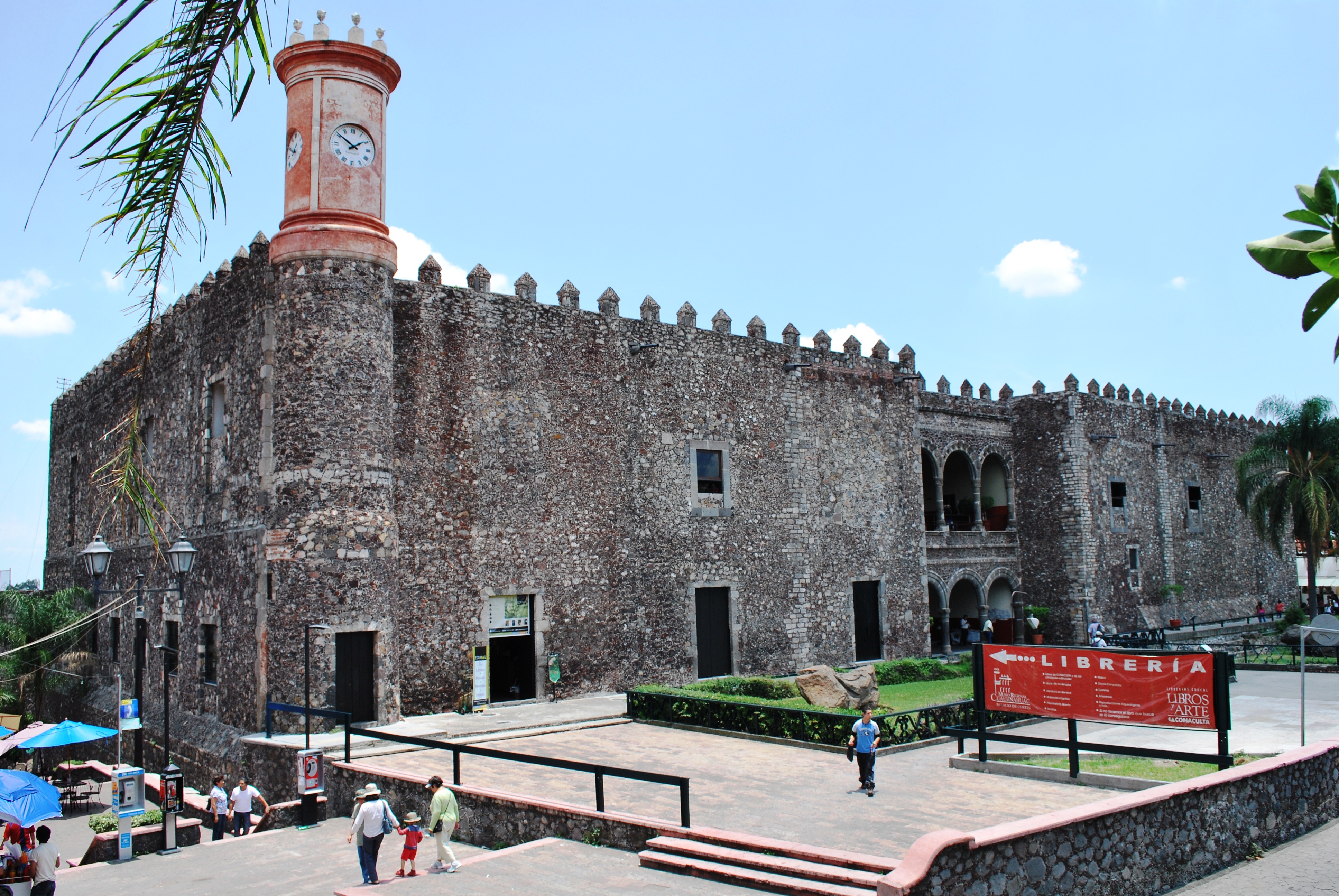
Palace of Cortes, Cuernavaca
Dig beneath the Palace of Cortes and you find the building it was meant to erase. In the courtyards and in front of the structure, the walls and floors of a Tlahuica tribute hall are still visible -- the place where taxes were collected first for local rulers, then for the Aztec empire, before the Spanish destroyed it in 1526 and dropped a fortress on top. Hernan Cortes chose Cuernavaca for the fertility of the surrounding land, but his choice of building site was not about agriculture. It was about power. The oldest conserved colonial-era civil structure in the continental Americas was built as a statement: the old authority is gone, and here is the new one standing on its bones.
A Fortress the Conqueror Barely Used
The original palace was smaller than what stands today. The central section -- marked by arched balconies on the west side, four arches across two levels -- is what Cortes built. Thick walls, merlons, and an armory stocked with arquebuses, muskets, and cannon made clear that this was a fortified position. Cortes had reason to be careful. During one visit, Tlahuican warriors attacked him in what is still called the Callejon del Diablo -- Devil's Alley. A legend claims he escaped by jumping a five-meter crevice on his horse, Rucio, though the attack itself is documented and the jump is not. A watchtower was added when Cortes was named Captain General and Governor of New Spain. Yet the conquistador spent little time here. He was busy organizing Pacific coast expeditions, touring his encomienda holdings, and introducing sugar cane to the region. The palace was a seat of authority he rarely sat in.
From Prison Cells to Government Halls
After the Cortes family abandoned the palace -- ongoing legal troubles made Cuernavaca less appealing -- colonial authorities renovated it in the eighteenth century and repurposed it as barracks and a jail. During the Mexican War of Independence, it held prisoners including Jose Maria Morelos y Pavon, one of the rebellion's most important leaders. After independence, the building became the seat of government for the state of Morelos and served in that role until the late twentieth century. The architecture blends Gothic and Mudejar styles typical of early sixteenth-century colonial construction, modeled after the Alcazar de Colon in Santo Domingo. Each era left its mark: the fortress walls, the prison additions, the government renovations. The 2017 Puebla earthquake caused severe damage and closed the building for years. It reopened on March 30, 2023, as the Museo Regional de los Pueblos de Morelos.
Nineteen Halls of Layered Time
The museum's nineteen halls walk visitors from the region's earliest human settlers to the present day. Mammoth fossils, migration maps, pottery, and carved stone pieces span the pre-Hispanic era, with the most important collection drawn from the archaeological site at Xochicalco. Colonial-period rooms cover religious items, objects connected to Cortes, and trade goods from the commerce that linked Mexico to Asia. The post-independence exhibits focus on the hacienda system -- especially the sugar haciendas that dominated Morelos through the Porfirio Diaz period and into the Mexican Revolution. Modern Morelos is represented through indigenous crafts and living traditions. The range is deliberate: this building, after all, was built over a Tlahuica tribute hall, served a Spanish conqueror, imprisoned an independence hero, housed a state government, and now tells all their stories under one roof.
What the Excavations Found
When the palace was renovated in the 1970s, archaeologist Jorge Angulo Villasenor directed excavations around and under the building. Through strategically placed wells, the team uncovered walls, floors, and burials spanning from the Tlahuica period through the colonial era. The best-preserved areas lie in front of the building and in the interior courtyards. Beneath Aztec-period deposits, they found artifacts from the earlier Teopanzolco period, establishing for the first time a clear timeline of Tlahuica occupation in Cuernavaca. The palace site is one of the few Aztec-era palaces to have been excavated by archaeologists, though little of the original Tlahuica structure survived its destruction by the Spanish. Subsequent excavations have continued to uncover additional ruins. The archaeological site extends from under the palace itself to Cuernavaca's main square, meaning that the modern city, the colonial building, and the pre-Hispanic past all occupy the same physical space -- layered, not replaced.
From the Air
Located at 18.92N, 99.23W in Cuernavaca, Morelos, approximately 85 km south of Mexico City. From altitude, Cuernavaca sits in a valley at around 1,510 meters elevation with the mountains of the Sierra de Chichinautzin to the north. The Palace of Cortes is located on the city's main square. Nearest major airport is Mexico City International (MMMX/MEX). General Mariano Matamoros Airport (MMCB) serves Cuernavaca but has limited traffic. The volcanic peak of Popocatepetl is visible to the east.