Palace of Coudenberg
On the night of 3 February 1731, fire broke out in the palace kitchens. The temperature outside was freezing, the water in the hoses and buckets froze where it lay, and by morning the seven-hundred-year residence of the rulers of the Low Countries was a smoking shell. Tapestries, paintings, governmental archives - gone. The Coudenberg Palace had hosted Charles V's abdication in 1555 and the first meetings of the States General of the Burgundian Netherlands. Now it was a ruin called the Cour brulee, the Burnt Court, and it would sit untouched for more than forty years before anyone could figure out what to do with the wreckage. The answer turned out to be: pave over it and pretend it never existed. Walk across the Place Royale in Brussels today and you are walking on the cellars of an empire's lost capital.
Cold Hill
Coudenberg means "Cold Hill" in Dutch, and the name describes both the geography and, eventually, the fate. Around the middle of the eleventh century, the counts of Leuven moved their seat up from the marshy valley of the Senne river to this higher ground, where the floods could not reach them and where they could see what was coming from any direction. The first castle was a fortified thing, all stone and intent, looking out toward Leuven and the Sonian Forest where the dukes hunted. When Frederick Barbarossa created the Duchy of Brabant in 1183, Coudenberg became important. When the Duke of Brabant in the thirteenth century decided he preferred Brussels to Leuven, Coudenberg became central. The walls thickened, the city wrapped itself around the hill, and the castle - no longer needed for defence - began the slow transformation from stronghold to home.
The Aula Magna
Philip the Good of Burgundy added the room that turned a palace into a stage. The Aula Magna, built after 1430, was a gigantic hall designed for the kind of pageantry that Burgundy did better than anyone in Europe - banquets, receptions, weddings, the orchestrated dazzle of a court trying to convince itself it was as grand as the kingdoms around it. It was here in 1515 that Margaret of Austria handed her regency over the Habsburg Netherlands to her fifteen-year-old nephew, Charles. It was here again in 1555 that the same Charles, now Holy Roman Emperor Charles V, exhausted and gout-ridden, abdicated his thrones in favour of his son Philip II of Spain. Two of the most consequential transfers of power in early modern Europe happened in the same Brussels room. The hall's foundations are still under the Place Royale. You can visit them through the BELvue Museum, and stand more or less where the emperor stood when he gave up the world.
Painters at Court
In the seventeenth century, Archduke Albert and Archduchess Isabella, sovereigns of the Spanish Netherlands, made Coudenberg their court and turned the city around them into a refuge for Catholic Europe during the Wars of Religion. Isabella was devout enough that a special street, the Rue Isabelle, was carved through the medieval fabric so she could walk from the palace to the cathedral without exposing herself to the city. The archdukes were also serious art patrons. They brought Jan Brueghel the Elder and Peter Paul Rubens to decorate the palace - the same Rubens whose oil sketches now hang nearby in the Oldmasters Museum. Court painters of the era documented Coudenberg obsessively: Andreas Martin's 1726 view shows a palace of arcaded courtyards, sloping rooflines, and chapel buttresses, the kind of crowded organic architecture that grows over centuries. Five years after Martin painted it, almost all of it was gone.
Cour Brulee
After the fire, there was no money. Belgium was a possession of the Austrian Habsburgs by then, and the imperial treasury in Vienna had no appetite for rebuilding a palace in a province that did not generate income on the scale of, say, Hungary. The court relocated to the nearby Palace of Orange-Nassau, which they began calling the New Court. The Burnt Court sat behind hoardings, charred timbers and exposed cellars open to the rain. Architects drew up reconstruction plans that nobody approved. In 1769, someone suggested clearing the rubble and using the space as a parade ground for soldiers. That plan was almost finalised when, in 1774, Prince Charles Alexander of Lorraine - the Habsburg governor of the Netherlands - proposed something more ambitious. He had been to Nancy and Reims. He wanted Brussels to have a royal square like theirs, a neoclassical composition of matching facades around an open paved rectangle. Empress Maria Theresa approved. The demolition began.
Excavated and Returned
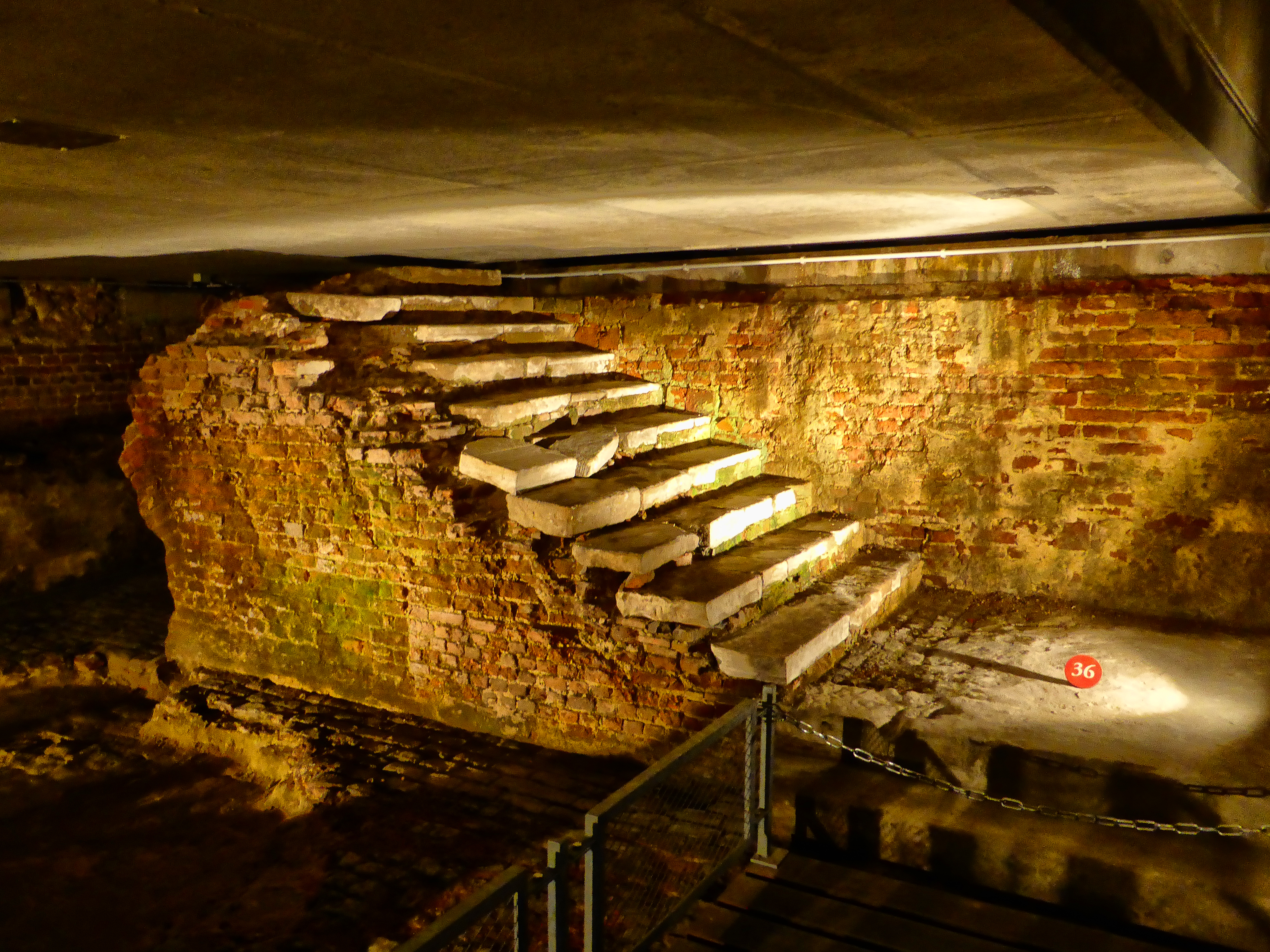
Between 1995 and 2000, archaeologists worked their way down through the layers under the Place Royale. They found what the eighteenth-century engineers had buried rather than destroyed: the lower stories of the palace, partially preserved because they had been below ground level when the new square was paved over them. The cellars of the main palace, the rooms underlying the Aula Magna, the vaulted spaces beneath the great chapel - all of it was still down there, protected by accident. The site opened to the public via the BELvue Museum, with a concrete cap above the ruins and electric light below. You descend stairs and find yourself walking the old palace's basements, looking at fifteenth-century apostles' statues and Gothic stonework that has not seen sunlight since the Habsburgs were in charge. Excavation continues on the other side of the former Rue Isabelle, where the mansion of the Counts of Hoogstraeten is being slowly uncovered. The palace was destroyed. The palace was preserved. Both things are true.
From the Air
The archaeological site sits beneath the Place Royale at 50.8426°N, 4.3607°E, in central Brussels' Royal Quarter atop the Coudenberg ridge - the high ground that divides the upper and lower town. Visible from the air as part of the dense neoclassical fabric around Brussels Park, with the gilded dome of the Palace of Justice on the ridge to the southwest providing the strongest local landmark. Nearest airport: Brussels Airport (EBBR), about 12 km northeast. The site itself is underground and not visible from altitude; the Place Royale paving above is a rectangular paved space about 77 metres long flanked by symmetrical white neoclassical facades and the dome of Saint-Jacques-sur-Coudenberg.