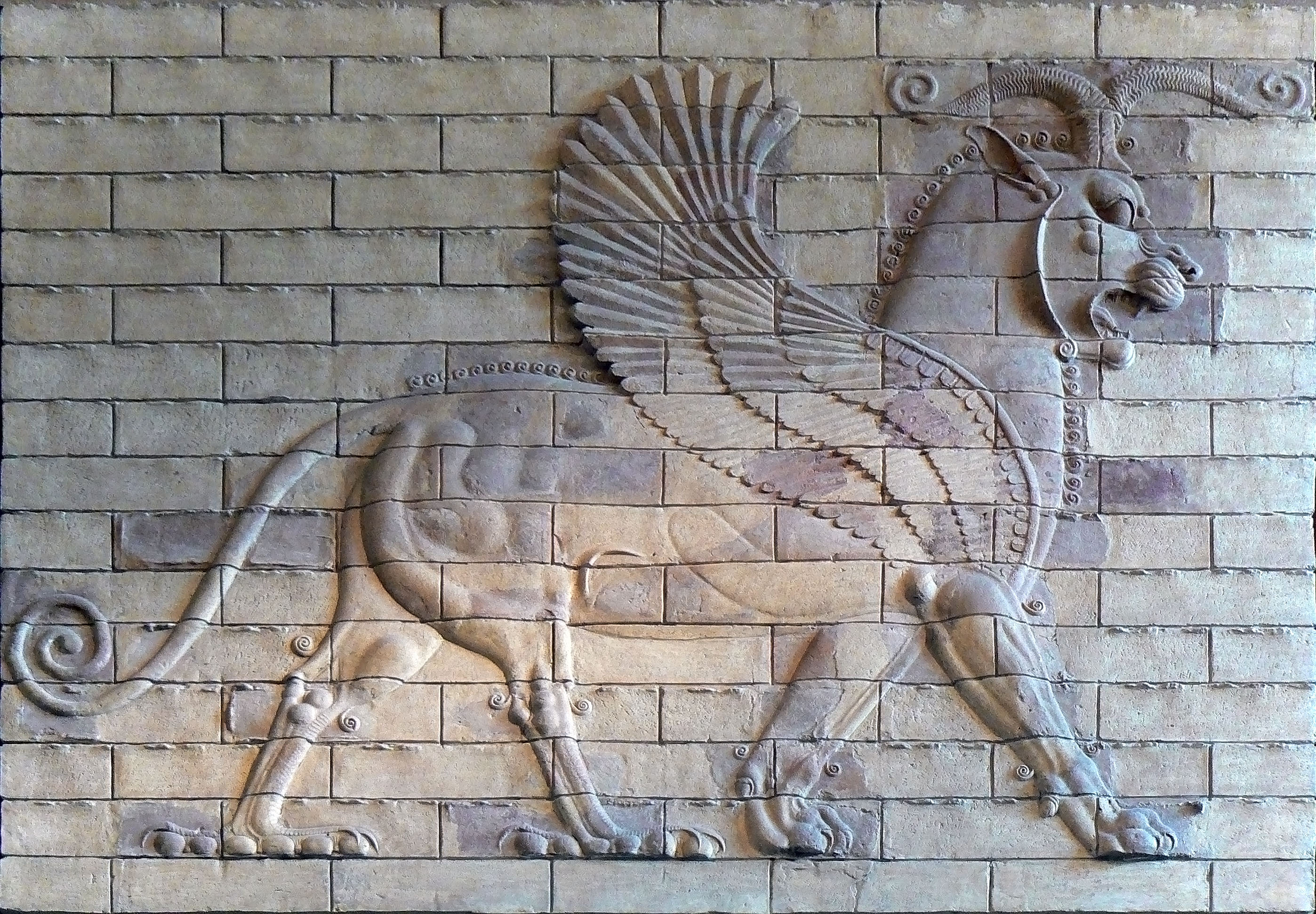
Palace of Darius in Susa
Darius the Great wanted the world to know who had built his palace. So he wrote it down -- in three languages, on stone and clay and glazed tile, in fragments that would survive him by two and a half millennia. The DSf inscription, his "charter of foundation," reads less like a royal decree and more like a supply chain manifest: cedar timber from Lebanon, hauled by Assyrians to Babylon, then carried onward to Susa by Carians and Greeks. Gold from Lydia and Bactria. Lapis lazuli from Sogdia. Every corner of the Achaemenid Empire contributed something to the palace complex at Susa, and Darius wanted that fact carved in stone.
A King's Favorite Capital
Susa was ancient long before Darius arrived. The city had been a center of Elamite civilization for millennia, strategically positioned in the lowlands of what is now Khuzestan province in southwestern Iran. Darius chose it as his favorite capital, the winter residence where the court escaped the harsher climate of Persepolis. Construction of the palace complex began around 521 BC and continued under his son Xerxes, then his grandsons Artaxerxes I and Darius II. The palace was built parallel to the great works at Persepolis, the two projects feeding off each other's innovations. The distinctive Persian column -- topped by paired bull capitals -- was likely developed at Susa before being refined at Persepolis.
An Empire in Brick and Stone
The DSf inscription itemizes the construction with a specificity that borders on obsessive. Babylonians dug the foundations down to bedrock, then packed rubble to depths of 40 cubits. They molded the sun-dried brick. Medes and Egyptians adorned the walls with the glazed siliceous bricks that became Susa's signature -- brilliant panels of archers in procession, winged lions, griffins, and sphinxes, many of which now fill galleries at the Louvre. Lydians and Egyptians worked the wood. Medes and Egyptians crafted the gold. The audience hall, the Apadana, measured 109 by 109 meters, its roof supported by 36 massive columns with three sets of 12 columns holding up the portico roofs. The palace was not merely a building. It was a statement about what an empire could accomplish when it marshaled resources from the Indus to the Mediterranean.
Fire, Restoration, and Plunder
The palace did not survive its own dynasty intact. A fire during the reign of Artaxerxes I, sometime in the mid-fifth century BC, destroyed much of the complex. Fifty years later, Artaxerxes II undertook a partial restoration. But the palace's fate was sealed in December 331 BC, when Alexander the Great's Macedonian army captured Susa and plundered its treasures. By then, Darius III had already fled, and the empire Darius I had built was collapsing city by city. The palace's wealth -- the accumulated gold and silver of generations -- went into Macedonian coffers. What Alexander left behind, time continued to dismantle.
What Remains
Today the palace site in modern Shush is an archaeological landscape more notable for what it has lost than what it retains. Urban development since the 1930s has encroached on the ruins. Erosion has eaten at the remaining walls. Illegal excavations have scattered artifacts. Iraqi bombardment during the 1980-88 Iran-Iraq War added another layer of destruction. The most spectacular surviving elements of Darius's palace are no longer at Susa at all. The Frieze of Archers, the winged lion reliefs, the sphinx panels, the bull capitals -- the artistic achievements that made the palace extraordinary -- sit in the Louvre in Paris, thousands of miles from the Khuzestan plain where they were created. The DSf inscription fragments, scattered across museums, still speak in Darius's voice: Old Persian, Elamite, and Babylonian, enumerating the workers and materials of a palace that was meant to last forever.
From the Air
Located at 32.19N, 48.25E near the modern city of Shush in Khuzestan province, southwestern Iran. The archaeological site sits in flat lowland terrain near the Zagros Mountain foothills. Nearby airports include Ahvaz International Airport (OIAW) approximately 100 km to the south. The ruins of the Apadana and palace foundations are visible from low altitude. The nearby Chateau de Morgan, a French archaeological compound, is a useful landmark. Best viewed at 3,000-5,000 feet.