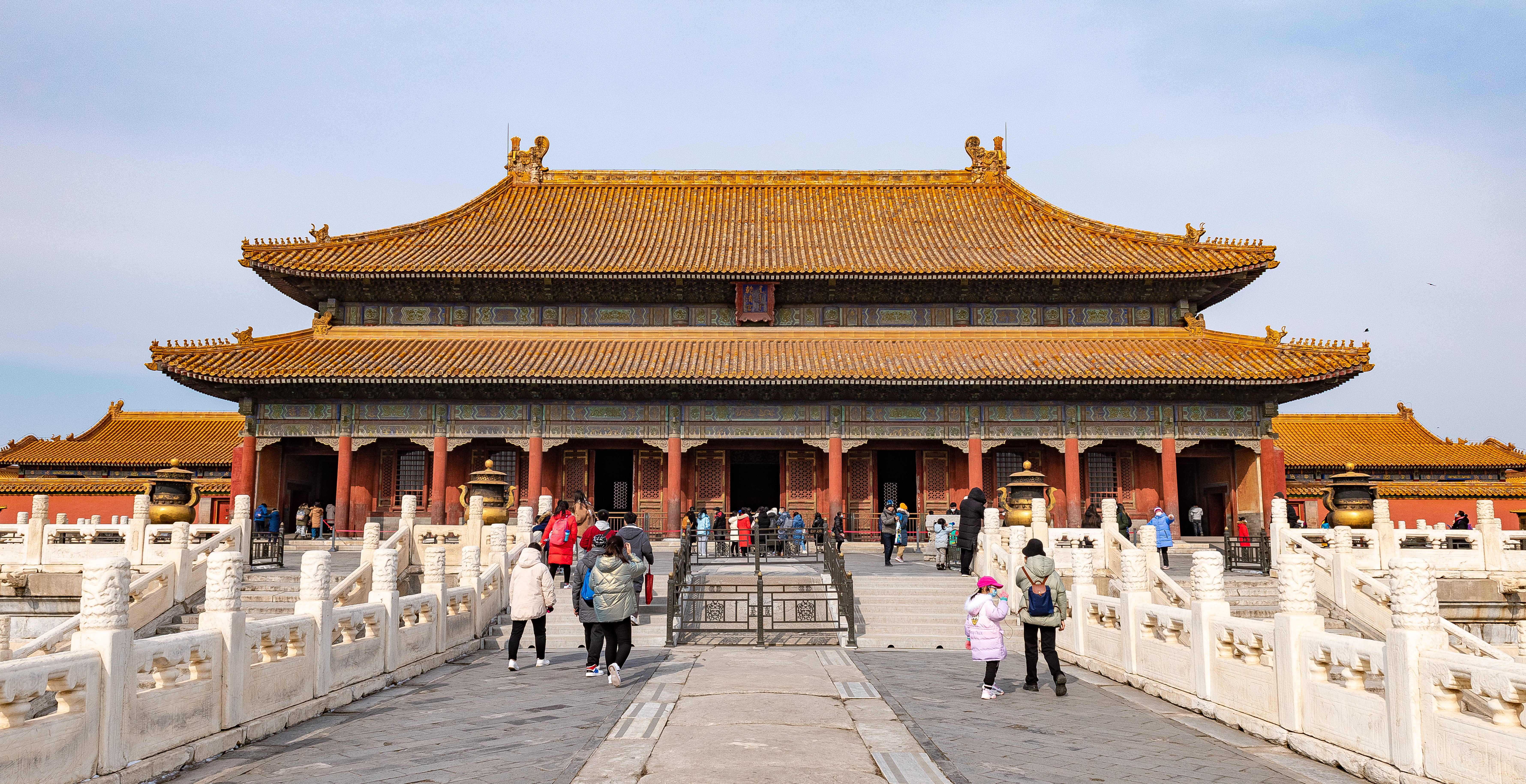
Palace of Heavenly Purity
Twenty-seven beds, arranged across nine rooms on two levels, and each night the emperor chose one at random. It was not indulgence but survival -- the reasoning being that an assassin who could not predict where the ruler slept could not kill him. This was the Palace of Heavenly Purity as it was first conceived in 1420: the most private room in the most guarded complex in China, where even sleep was a matter of statecraft.
From Bedroom to Throne Room
Originally constructed during the early Ming dynasty, the Palace of Heavenly Purity served as the emperor's personal residence. It is the largest of the three halls that compose the Inner Court, the domestic counterpart to the ceremonial Outer Court where the Hall of Supreme Harmony dominates. For generations, the emperor's nights unfolded here behind walls of vermillion and gold. That changed when the Yongzheng Emperor took the throne in the early 18th century. Unwilling to sleep in the chambers his father, the Kangxi Emperor, had occupied for 60 years, Yongzheng relocated to the smaller Hall of Mental Cultivation to the west. His successors followed suit. The Palace of Heavenly Purity was transformed from a royal bedroom into an audience hall -- a place for receiving ministers, hosting banquets, and conducting the business of governing an empire.
The Secret Behind the Tablet
Above the throne hangs a tablet inscribed with four characters by the Shunzhi Emperor: zheng da guang ming -- loosely translated as "let the righteous shine" or "to be decent, honest, and magnanimous." The phrase became one of the most famous idioms in the Chinese language, but the tablet conceals something more than calligraphy. The Yongzheng Emperor, who had ascended the throne amid a bitter succession dispute, devised a system to prevent future power struggles. Each emperor would write the name of his chosen heir on a document and hide one copy behind this very tablet. The emperor carried a second copy on his person at all times. Only upon the emperor's death would the two copies be compared to confirm the new ruler. For generations, the fate of the Chinese empire was literally sealed behind four golden characters urging righteousness.
Reading the Roofline
In the architectural language of the Forbidden City, nothing is decorative without being symbolic. Nine statuettes sit atop the roof of the Palace of Heavenly Purity, a number signifying its status as one of the most important buildings in the complex. Only the Hall of Supreme Harmony, the single most significant structure, carries ten. A caisson set into the ceiling features a coiled dragon, and a raised walkway connects the palace southward to the Gate of Heavenly Purity. Every element -- the number of steps, the placement of screens, the orientation of the throne -- communicated rank and cosmic order to anyone literate in the grammar of imperial architecture.
Echoes and Replicas
The last person to reside within the Palace of Heavenly Purity in any meaningful way was Puyi, the final emperor, photographed as a young man in its halls before his eviction in 1924. By then the palace had long since ceased to be a home, serving instead as a stage for political ceremony in the waning years of the Qing dynasty. Today it stands as part of the Palace Museum, its throne and desk preserved exactly as they were during imperial audiences. Remarkably, a near-full-scale replica of both the palace and the entire Forbidden City exists at the Hengdian World Studios in Zhejiang Province, where Chinese period films and television dramas are regularly filmed -- a testament to the enduring power of these spaces in the national imagination.
From the Air
Located at 39.919N, 116.391E within the northern section of the Forbidden City's Inner Court. From the air, the palace sits along the central north-south axis, between the Gate of Heavenly Purity to the south and the Palace of Earthly Tranquility to the north. Nearby airports: Beijing Capital International (ZBAA) 25 km NE, Beijing Daxing International (ZBAD) 46 km S. Best viewed at 1,500-3,000 ft.