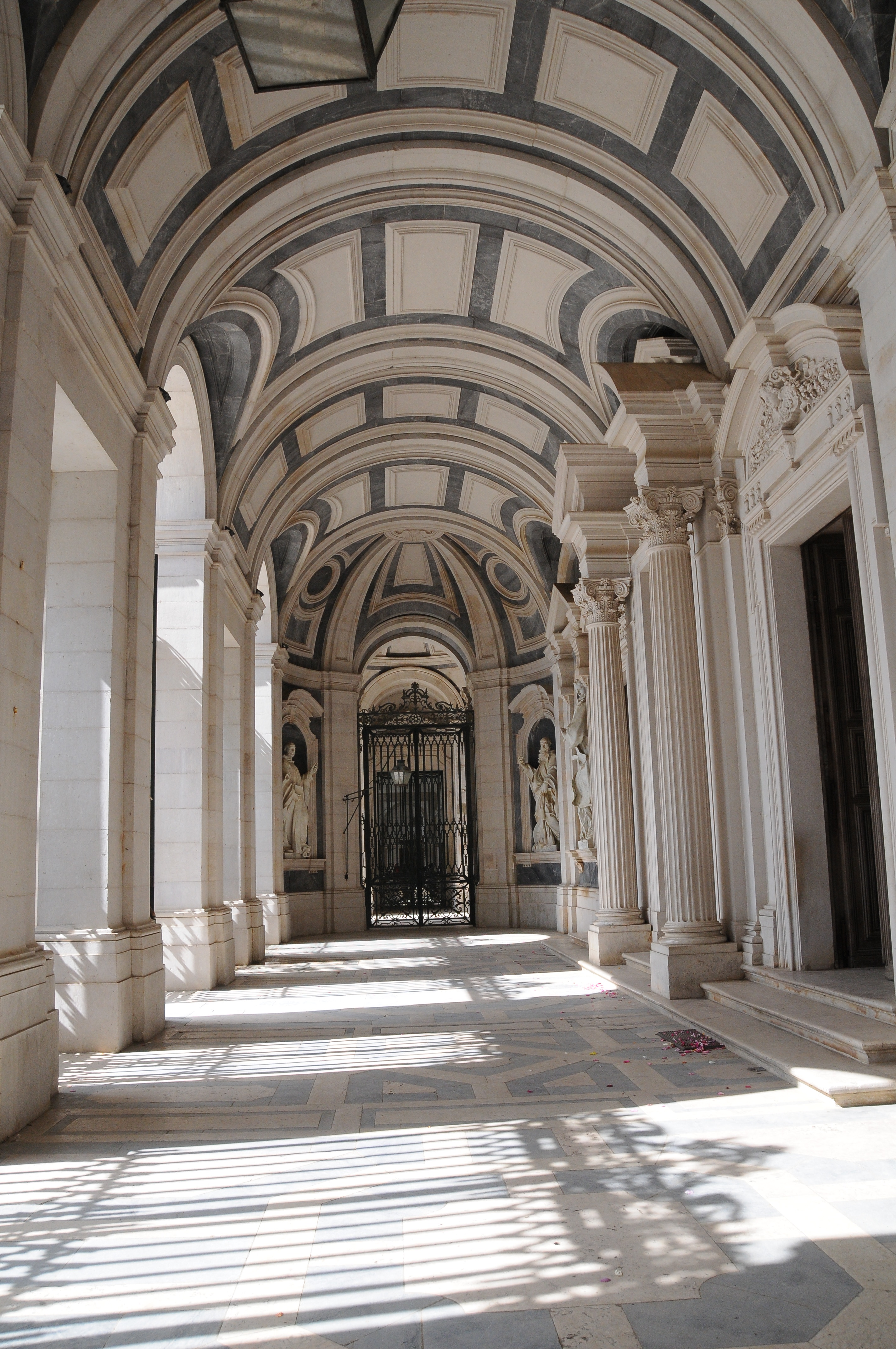
Palace of Mafra
King John V of Portugal made a vow: if his queen, Maria Ana of Austria, bore him an heir, he would build a monastery. In December 1711, Infanta Barbara was born. John kept his word — and then some. What began in 1717 as a modest Franciscan convent for thirteen friars grew into the largest royal building in Portugal: a monumental palace-monastery-basilica complex covering 40,000 square meters, with 1,200 rooms, 156 stairways, 29 courtyards, and a library holding 36,000 volumes. Construction consumed the wealth of Brazilian gold, employed as many as 45,000 workers at its peak, and was not completed until 1755 — the same year a catastrophic earthquake destroyed much of Lisbon, as if Portugal's luck and its treasury had been exhausted simultaneously.
A Vow That Outgrew Itself
The architect João Frederico Ludovice, a German Jesuit goldsmith turned architect, designed the complex in a Baroque-Neoclassical style that reflected John V's ambition to rival the great courts of Europe. The original plan for thirteen friars expanded to eighty, then to three hundred, as the king's vision inflated alongside Portugal's colonial revenues. The basilica at the center, modeled partly on St. Peter's in Rome, houses six organs commissioned simultaneously from different builders so they could be played together. The carillon of 92 bells, cast in Antwerp and Liege, remains one of the largest in the world. Ludovice's design synthesizes Italian, German, and Portuguese influences into a building of overwhelming scale — the façade alone stretches 220 meters.
The Library at the End of the World
The palace library is one of the most beautiful rooms in Portugal: a vaulted Rococo space 88 meters long, its shelves holding 36,000 leather-bound volumes spanning theology, philosophy, history, and the sciences. A colony of small bats lives among the shelves, feeding on the insects that would otherwise devour the books — a biological pest control system that has operated for centuries. The floor is polished marble, the ceiling painted with allegorical scenes, and the overall effect is of a place where knowledge has been made physical, given weight and architecture. The library survived the 1755 earthquake, the Napoleonic Wars, and the transition to republic, arriving in the 21st century with its collections largely intact.
From Royal Retreat to Military Post
The palace served as a royal residence and hunting retreat, its tapada (hunting park) extending across thousands of hectares of walled forest that still shelter deer and wild boar. But Mafra's distance from Lisbon and its association with monarchical excess made it an easy target for republican sentiment. After the 1910 revolution, the palace became a military installation, a role it served for much of the 20th century. Nobel laureate José Saramago set his 1982 novel Baltasar and Blimunda partly at the Mafra construction site, portraying the human cost behind the king's magnificent vow — the workers who died, the families displaced, the fortune consumed. The novel gave Mafra a literary fame that complemented its architectural renown.
World Heritage Recognition
The Palace of Mafra was classified as a National Monument in 1910 and was a finalist in the Seven Wonders of Portugal competition. On 7 July 2019, UNESCO inscribed the Royal Building of Mafra — palace, basilica, convent, Cerco Garden, and Hunting Park — as a World Heritage Site, recognizing it as an exceptional example of the artistic and technological ambitions of the Portuguese monarchy during its wealthiest period. Today the palace-monastery operates as a museum, its rooms restored to display the furnishings, artworks, and ecclesiastical objects that accumulated over three centuries. The basilica continues to function as a place of worship, its six organs occasionally played in concert during special events — a sonic experience as excessive and magnificent as the building that houses them.
From the Air
Located at 38.934°N, 9.326°W in the town of Mafra, approximately 28 km northwest of Lisbon. The palace-monastery complex is enormous (220-meter façade) and clearly visible from altitude — look for the large rectangular building with twin bell towers flanking a central dome. The surrounding tapada (hunting park) provides a distinctive green perimeter. Recommended viewing altitude: 3,000-5,000 ft. Nearest airport: Lisbon/Humberto Delgado (LPPT) approximately 35 km southeast. The Sintra Mountains are visible to the south. Maritime influence from the nearby Atlantic coast can bring rapid weather changes.