Palace of Queluz
Someone once described the Palace of Queluz as looking like a very expensive birthday cake. The comparison is apt. One of the last great Rococo buildings designed in Europe, Queluz sits in a secluded hollow in the Sintra Municipality — all pink façades, gilded interiors, topiary parterres, and an azulejo-lined canal where the royal family once rowed small boats on summer afternoons. It was conceived as a summer retreat for Peter of Braganza, younger brother of King Joseph I, who began construction in 1747 with architect Mateus Vicente de Oliveira. But Queluz's lightness masks a darker history: the palace eventually served as a discreet place of incarceration for Queen Maria I, who descended into severe mental illness after Peter III's death in 1786.
Gold, Frivolity, and the Marquis of Pombal
Queluz's architecture reflects an extravagant period in Portuguese culture that followed the discovery of Brazilian gold in 1690. Foreign artists and architects flooded Portugal to serve a newly enriched aristocracy, bringing classical ideas that they filtered through the lighter, more playful lens of Rococo. Where the contemporary Palace of Mafra is sombre and monumental, Queluz is its temperamental opposite — described as 'exquisite rather than magnificent.' This frivolity was partly by design and partly by circumstance: while Portugal was nominally ruled by Joseph I, real power belonged to the Marquis of Pombal, who encouraged the royal family to while away their days in the country and leave affairs of state to him. Queluz was the perfect backdrop for a family that had been, in effect, put out to pasture.
A Stolen Estate, a Second Son's Dream
The site had originally belonged to Manuel de Moura y Corte Real, the 2nd Marquis of Castel Rodrigo. When the ruling Spanish were driven from Portugal in 1640, the Marquis was accused of collaboration and the property was seized by the Crown. John IV designated it for second sons of the reigning monarch, which is how it reached Peter of Braganza, the second son of John V. The architect Mateus Vicente de Oliveira had trained under João Frederico Ludovice during construction of the imposing Palace of Mafra, but his design for Queluz rejected Mafra's gravity entirely. The palace's public façade gives nothing away — its most architecturally severe elevation faces the town, presenting an impassive front with simple classical pediments above the windows. The exuberance waits behind.
The Robillon Wing and the Gardens
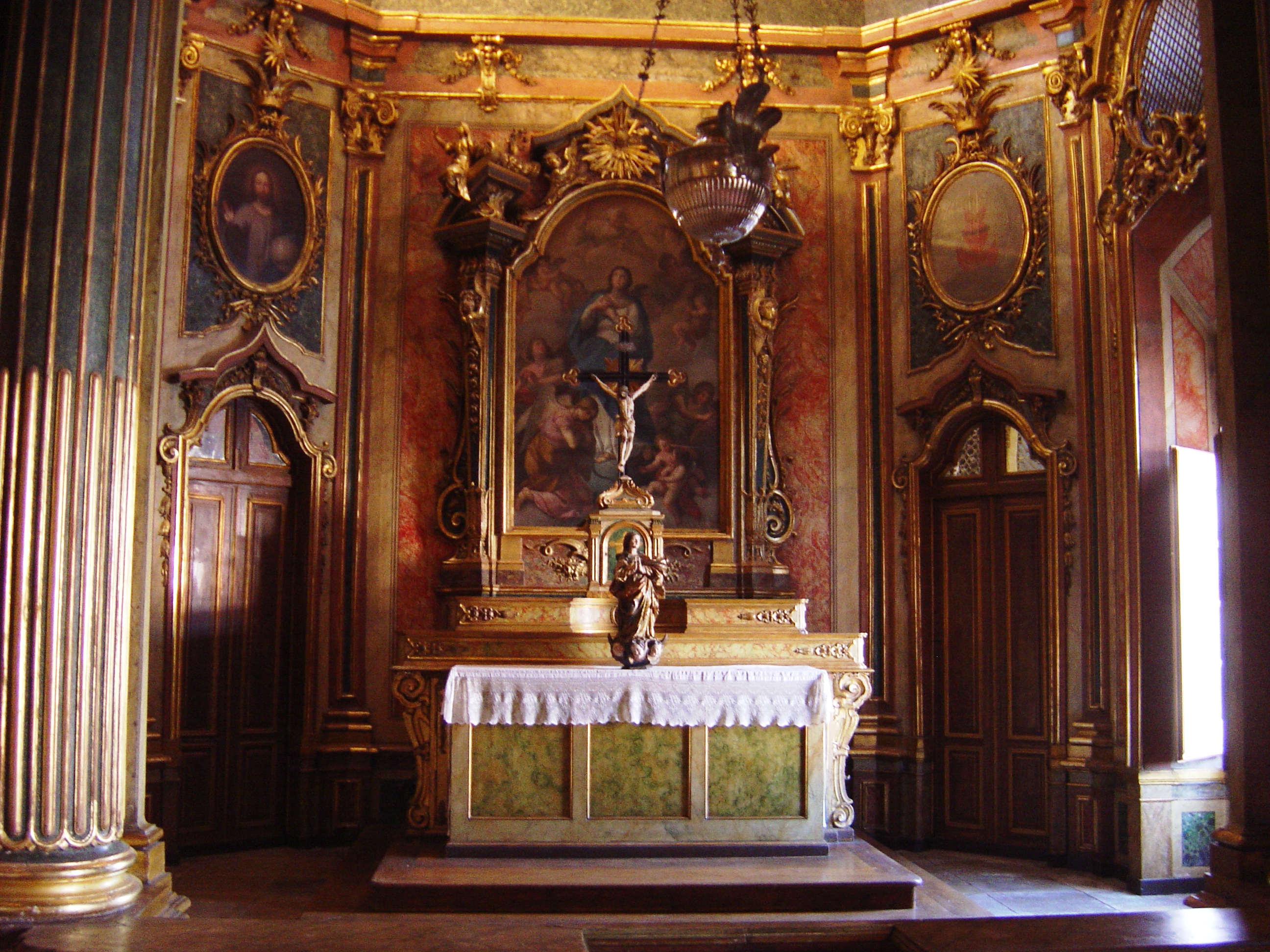
French architect Jean-Baptiste Robillon designed the palace's most theatrical spaces: entrance steps adorned with statuary that employ forced perspective to dramatic effect, and a south façade that opens onto the Hanging Garden with its Triton fountain. The gardens are the palace's equal in ambition, featuring a topiary parterre, a magnolia avenue, and a canal lined with azulejo tile panels depicting harbors, ships, and coastal scenes. The chapel, terminated by an onion dome, anchors the southern quadrant wing and contains elaborate gilded woodwork. After the Palace of Ajuda burned in 1794, Queluz became the official residence of Prince Regent John and his family, a role it held until the royal family fled to Brazil in 1807 following Napoleon's invasion of Portugal.
Fire, Restoration, and State Dinners
The palace slowly fell from favor after 1826 and became state property in 1908. A serious fire in 1934 gutted one-third of the interior, but extensive restoration returned the surviving rooms to something approaching their former splendor. Today one wing — the Queen Maria I Pavilion, built by Manuel Caetano de Sousa — serves as Portugal's official state guest house, hosting foreign heads of state in rooms where a queen once paced in madness. The rest of the palace is open to visitors, its restored interiors offering a rare glimpse of Portuguese court life at its most extravagant and self-consciously lighthearted. Queluz is not Versailles. It never wanted to be. It wanted to be a party, and its pink walls still carry the echo.
From the Air
Located at 38.750°N, 9.258°W in Queluz, a city in the Sintra Municipality on the Portuguese Riviera, approximately 15 km northwest of central Lisbon. The palace's pink façade and formal gardens are visible from moderate altitude. Look for the semi-circular cour d'honneur facing the town square and the distinctive onion-domed chapel. Recommended viewing altitude: 2,000-3,000 ft. Nearest airport: Lisbon/Humberto Delgado (LPPT) approximately 15 km southeast.