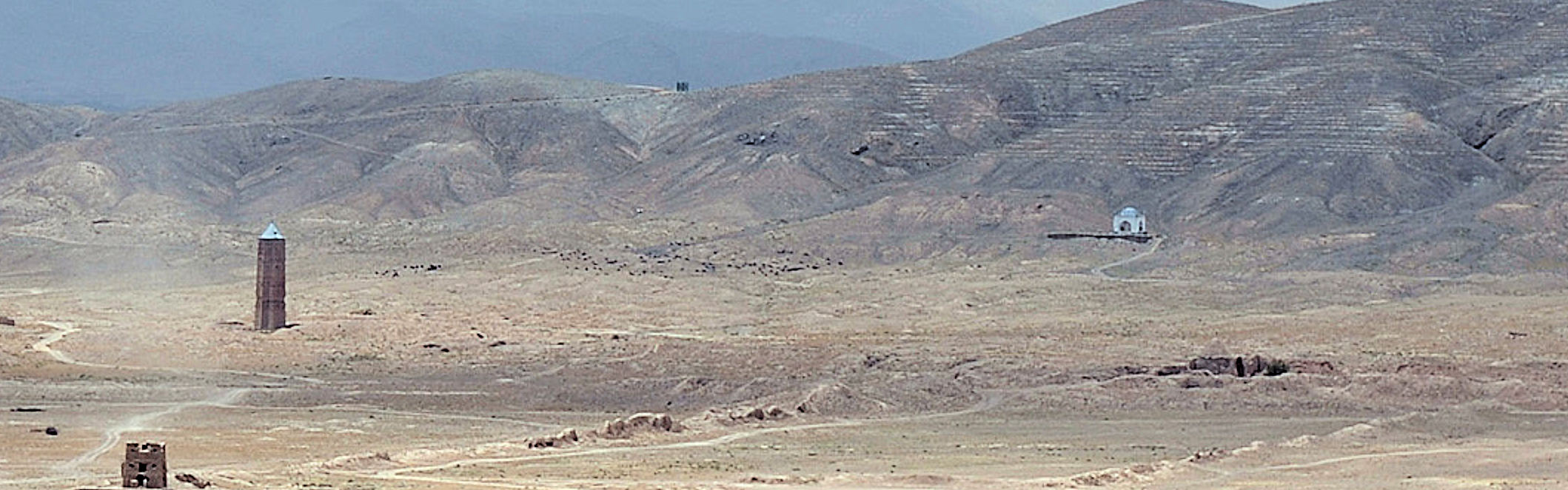
Palace of Sultan Mas'ud III
The marble speaks in two languages. Kufic Arabic runs along one band, Persian poetry along another, and together they proclaim the glory of a dynasty that once ruled from the Hindu Kush to the plains of northern India. The Palace of Sultan Mas'ud III, built around 1112 in the Afghan city of Ghazni, was designed to make exactly this kind of statement. More than nine centuries later, the fragments of that statement are scattered across museums in Brooklyn, San Francisco, Hamburg, and Kabul, and the question of who owns them has become as complicated as the geopolitics of the country where they were carved.
An Empire Written in Stone
Sultan Mas'ud III ruled the Ghaznavid Empire from 1099 until his death around 1114 or 1115. His father, Ibrahim of Ghazna, had already established a tradition of monumental building in Ghazni, but the younger sultan pushed further. The palace he commissioned was enormous by any standard of its era -- archaeologists estimate it stretched over 100 meters on each side, roughly comparable to the famous Ghaznavid complex at Lashkari Bazar. A central courtyard anchored the design, with four vaulted halls, or iwans, opening off it and connecting to throne rooms, government offices, royal apartments, and smaller courtyards beyond. Despite its scale, the structure appears to have been a single story, its grandeur expressed through the soaring height of its vaulted spaces rather than stacked floors. The builders used baked brick and lime mortar for the bones of the structure, then dressed key surfaces in white carved marble -- geometric patterns, vegetal motifs, and long bands of calligraphic inscription that celebrated the kingship and divine favor of the Ghaznavid line.
Unearthed by Italian Hands
For centuries, the palace lay buried beneath the Afghan earth, its bricks slowly scavenged by locals for new construction, its marble dado panels cracked by harsh winters and spring rains. Then, in the summer of 1957, an Italian archaeological team arrived under the direction of Alessio Bombaci, a professor from Naples. When Bombaci was unavailable for the second campaign in 1958, Umberto Scerrato -- an archaeologist who would later found the Islamic works section of the University of Naples Museum -- took over. Scerrato brought students, the architect Alberto Davico (who held the palace's architectural plans), and Mr. Sadiq Khan from the Museum of Kabul. Together they excavated the courtyard, several hallways, and portions of the iwans, though much of the complex remains only partially explored. Among the finds were carved marble panels, terracotta basins, a door-frame, and fragments of the dado that once lined the courtyard walls. Many pieces were preserved at the National Museum of Afghanistan in Kabul. The Taliban later destroyed several works housed there, though whether palace artifacts were among them remains unknown.
A Palace Divided
How carved marble panels from a palace in Ghazni ended up in museums across the world is a story that traces the tangled routes of wartime looting, antiquities markets, and diplomatic limbo. Germany was the first to act: on October 8, 2021, Hamburg's MK&G museum returned a frieze fragment from the palace's inner courtyard. San Francisco's Asian Art Museum followed, voting to return a panel it had received as a gift under assumptions of legal acquisition -- assumptions now questioned. But the museum set a condition: it would not physically hand over the marble until Afghanistan's consulates were functioning in coordination with the United States. The Brooklyn Museum, which holds another dado panel, went further. It declined even to acknowledge Afghan ownership, though it left the door open to future discussions. The impasse reflects a broader dilemma. Museums want to do the right thing. Governments want to protect cultural heritage. But when the government in question is the Taliban, and diplomatic recognition is absent, the marble waits in climate-controlled galleries an ocean away from where it was carved.
What the Ruins Still Say
Ghazni today is a provincial capital shaped by decades of conflict, a city where ancient minarets compete for attention with blast walls and checkpoints. The palace ruins sit within what was once a walled compound separating the royal complex from the rest of the city, its perimeter gates designed for processions and court ceremonies. Alongside the palace stands a small cemetery containing the domed ziyarat of Ibrahim of Ghazna, Mas'ud's father, linking two generations of builders in a single archaeological footprint. Sultan Mas'ud III also erected one of Ghazni's two famous victory towers, which still stand as landmarks. The palace itself, though, yields its story reluctantly. Harsh winters, spring rains, and centuries of brick scavenging have reduced it to low walls and fragmentary foundations. What survives above ground is modest. What survives in museum collections and archaeological records, however, paints a picture of a place where Islamic architecture reached a distinctive regional expression -- carved marble against stucco, Persian poetry beside Arabic calligraphy, political power made visible through ornamental ambition.
From the Air
Located at 33.57°N, 68.44°E in Ghazni, eastern Afghanistan. The site lies within the modern city of Ghazni at approximately 2,219 meters (7,280 feet) elevation. The two Ghaznavid victory towers nearby serve as visual landmarks. Nearest airports include Ghazni Airport (no ICAO) and Kabul International Airport (OAKB), approximately 150 km northeast. Best viewed at medium altitude; the palace footprint is not easily distinguishable from the surrounding urban fabric without prior knowledge of its location.