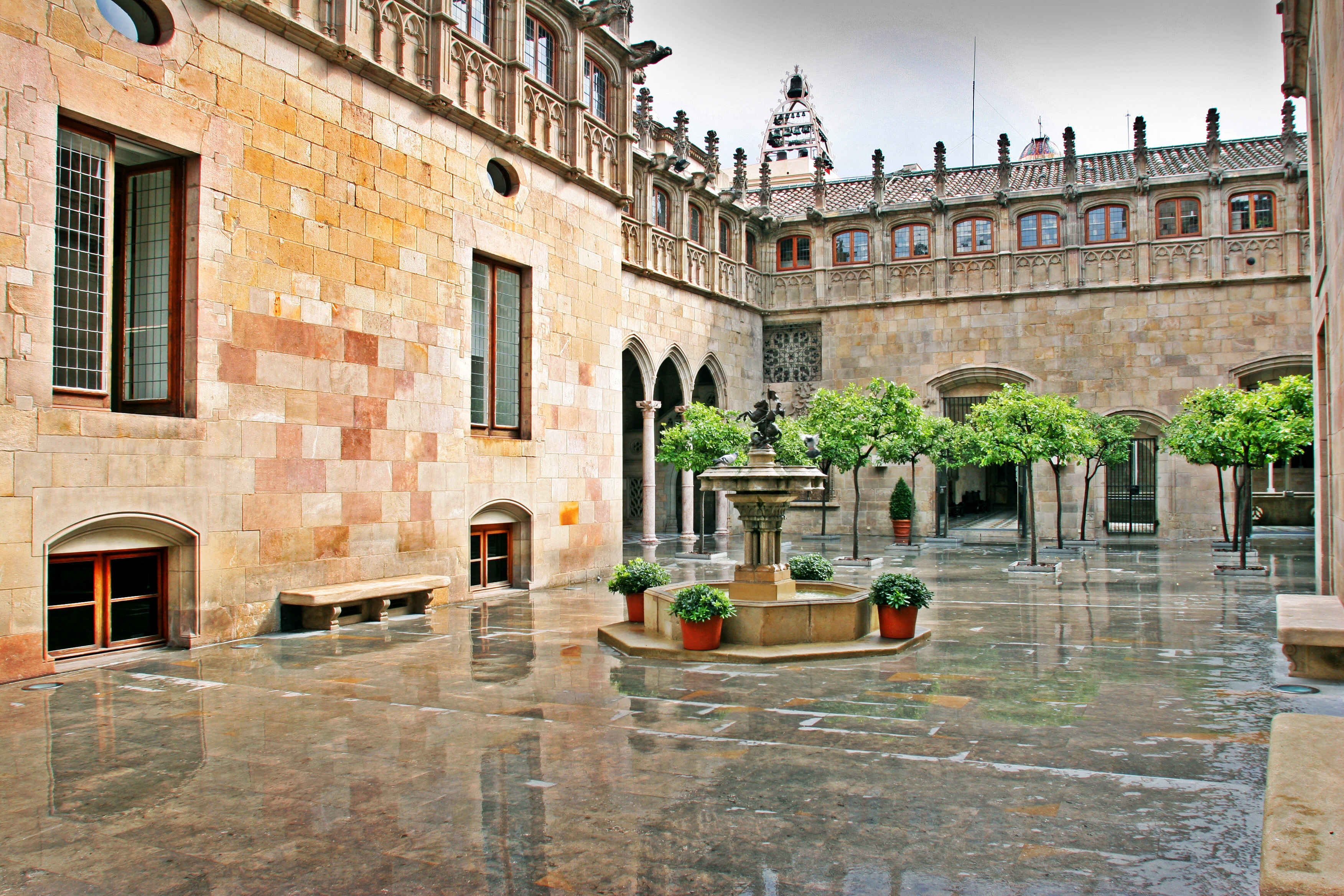
Palace of the Generalitat of Catalonia
Four dark granite columns guard the main entrance to the Palace of the Generalitat. They were carved in Troy nearly nineteen hundred years ago, shipped to Tarragona when Emperor Hadrian wintered there in 122-123 AD, and eventually installed in the Renaissance facade that architect Pere Blai designed in 1596. Columns that began as Roman decoration in Asia Minor now frame the doorway of Catalan democracy. It is the kind of layered improbability that defines this building -- a palace purchased in 1400 from a private citizen in Barcelona's Jewish Quarter, expanded over centuries, abolished twice, and still functioning as the seat of the government that built it. One hundred and thirty-three presidents have governed from within these walls, from Berenguer de Cruilles in 1359 to the present day.
From Tax Collectors to Sovereign Power
The Generalitat began modestly in 1289, when the Catalan Corts -- the parliament -- formed a commission to collect taxes granted to the king. By 1359, the commission had been formalized as the Diputacio del General, with deputies representing three estates: the nobility, the clergy, and the citizens of towns directly subject to the crown. In the 15th century, this tax-collecting body evolved into something more ambitious, gradually replacing royal authority by implementing the Corts' decisions. The institution needed a home, and on December 3, 1400, its representatives purchased Pere Brunet's house on the Carrer de Sant Honorat for 38,500 sous. The house had a small courtyard, a facade on the street, and a modest orchard. From this kernel, one of Europe's most enduring governmental palaces would grow -- though nobody standing in that courtyard in 1400 could have imagined how dramatically.
Abolished, Restored, Abolished Again
The pattern repeated with the relentlessness of a historical rhyme. When Barcelona fell to Philip V's forces on September 11, 1714, ending the War of the Spanish Succession, the king abolished the Generalitat and the Catalan parliament and turned the palace into a royal court. Two centuries of silence followed. Then, in 1931, Francesc Macia rode the momentum of a sweeping municipal election victory to negotiate the Generalitat's restoration, becoming its president and returning the palace to its original purpose. The Statute of Autonomy of 1932 granted Catalonia its own parliament, justice system, and police force. Macia's successor, Lluis Companys, consolidated this autonomy -- until the Spanish Civil War swept it away. Franco abolished the Generalitat again, and Companys was executed at Montjuic Castle in 1940. The palace became the seat of the provincial council imposed by Madrid, and the Generalitat survived only in exile.
Gothic Heart, Renaissance Face
The building's architecture is a palimpsest of Catalan history. The oldest elements are Gothic: a central courtyard with a grand staircase and surrounding galleries, the flamboyant Gothic facade on the Carrer del Bisbe, and the chapel of Sant Jordi, built by master builder Marc Safont in 1434. Pere Blai's 1596 Renaissance facade on the Placa de Sant Jaume was the first grand Renaissance facade in Catalonia, its columns from Troy lending it an almost archaeological authority. After the Nueva Planta Decree of 1716, the Royal Audience carved the palace into functional partitions with little regard for its architecture. Recovery came in the early 20th century, when architect Josep Puig i Cadafalch led a restoration that recovered original spaces and added neo-Gothic touches -- including the famous bridge over Carrer del Bisbe, linking the palace to the Casa dels Canonges, which opened in 1928 and has become one of Barcelona's most photographed streetscapes.
The Palace Endures
After democracy returned to Spain and the 1977 general elections, the Generalitat was restored on September 29, 1977 -- before the Spanish Constitution of 1978 was even approved. A new Statute of Autonomy became law in December 1979, and elections in March 1980 seated 135 deputies in the Parliament of Catalonia. The palace on the Placa de Sant Jaume resumed its role as the seat of the presidency, facing Barcelona's City Hall across the square in an arrangement that places municipal and regional power in permanent visual dialogue. The Palau de la Generalitat is now one of Catalonia's most valued symbols, a building that has survived every attempt to silence the institution it houses. Its courtyard of orange trees, its Gothic galleries, its gargoyles and sculptured beadle over the Sant Honorat doorway -- all persist, outlasting the empires and dictatorships that tried to repurpose them.
From the Air
Located at 41.383N, 2.177E in the heart of Barcelona's Ciutat Vella district, on the Placa de Sant Jaume. The palace is surrounded by the dense medieval street grid of the Gothic Quarter and is difficult to distinguish individually from the air, but the open square it faces is visible as a gap in the roofline. Nearest airport: Barcelona-El Prat (LEBL), approximately 13 km southwest. Barcelona Cathedral, 200 meters to the northeast, provides a useful aerial reference. Best viewed at low altitude.