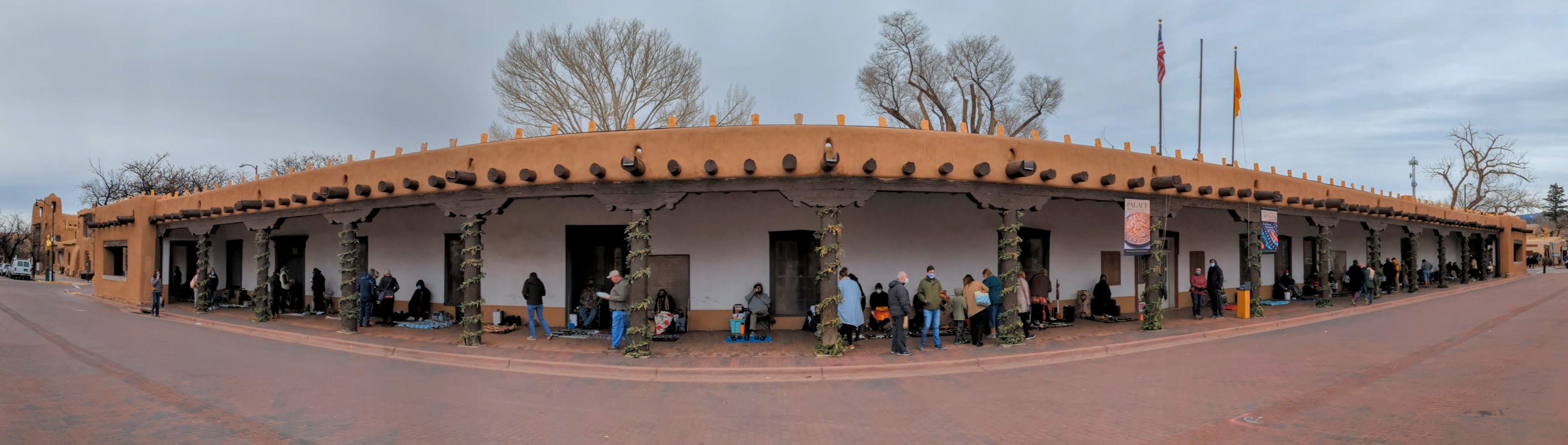
Palace of the Governors
One spring night in 1879, territorial governor Lew Wallace sat in the shuttered study of the Palace of the Governors, writing by lamplight. He had just returned from a tense meeting with Billy the Kid in Lincoln County, and he feared a bullet through the window. Outside, a thunderstorm hammered the old adobe walls. Inside, Wallace was composing the climactic crucifixion scenes of Ben-Hur: A Tale of the Christ. It is exactly the kind of story this building collects -- improbable, layered, spanning centuries. The Palace has housed Spanish conquistadors, Pueblo revolutionaries, Mexican officials, and American territorial governors. It has been a seat of power since before the Pilgrims landed at Plymouth.
An Empire's Northern Outpost
Pedro de Peralta, the newly appointed governor of Santa Fe de Nuevo Mexico, began construction of the Palace around 1610, though some historians place the start closer to 1618. The building anchored Spain's administrative control over a territory that once encompassed present-day Texas, Arizona, Utah, Colorado, Nevada, and New Mexico. It was an ambitious claim for a mud-brick building on the northern frontier of an empire stretched thin across two continents. The Palace was built in the Territorial Style of Pueblo architecture -- low, thick adobe walls designed to hold warmth in winter and cool air in summer. From its long covered portal, governors dispatched orders along El Camino Real, the royal road stretching south to Mexico City.
The Building That Changed Hands
No building in America has served so many masters. In 1680, the Pueblo Revolt drove the Spanish out of New Mexico entirely, and the Pueblo peoples governed from the Palace for twelve years. The Spanish returned in 1692 under Diego de Vargas. After Mexican independence in 1821, the building became the administrative center of the Mexican province of Santa Fe de Nuevo Mexico. When the United States annexed the territory in 1848 following the Mexican-American War, the Palace became the first territorial capitol. It served as New Mexico's seat of government until 1901 -- nearly three centuries of continuous political use under four flags.
Fitted Into the Color of Earth and Sky
By 1909, the Palace had fallen into serious disrepair. Anthropologist Edgar Lee Hewett recruited young archaeologist Jesse L. Nusbaum to oversee its restoration. Nusbaum, who would become the first employee of what evolved into the School of American Research, approached the work with an almost spiritual sensitivity. In his journal, he wrote that 'the Palace was begun with an adaptation to climate and atmosphere and had been fitted into the color of earth and sky.' He carried that philosophy forward as Superintendent of Mesa Verde National Park. The restored Palace became home to the Museum of New Mexico in 1909, anchoring a century of public service as a history museum. It was declared a National Historic Landmark in 1960, and the U.S. Postal Service commemorated it with a turquoise stamp that same year.
Still Standing on the Plaza
In 2009, the New Mexico History Museum opened adjacent to the Palace, absorbing its museum functions into a larger campus. The Palace itself remains one of eight museums overseen by the New Mexico Department of Cultural Affairs. Under its portal -- that long covered porch facing the Plaza -- Native American artisans continue to sell handmade jewelry, pottery, and textiles, a tradition that connects the building's present to the indigenous history that predates its construction. The Plaza it faces has watched Spanish soldiers, Pueblo warriors, Mexican traders, American cavalry, and Confederate troops pass through. The Palace outlasted them all, its thick adobe walls still holding the warmth of four centuries.
From the Air
The Palace of the Governors is located at 35.688N, 105.938W on the north side of the Santa Fe Plaza. It is a long, low adobe structure not individually distinguishable from cruise altitude but located within the easily identifiable historic downtown core. Santa Fe Regional Airport (KSAF) is approximately 10 miles southwest. The Plaza and surrounding historic district form the compact center of the city visible when approaching from any direction at lower altitudes. The Sangre de Cristo Mountains rise to the east.