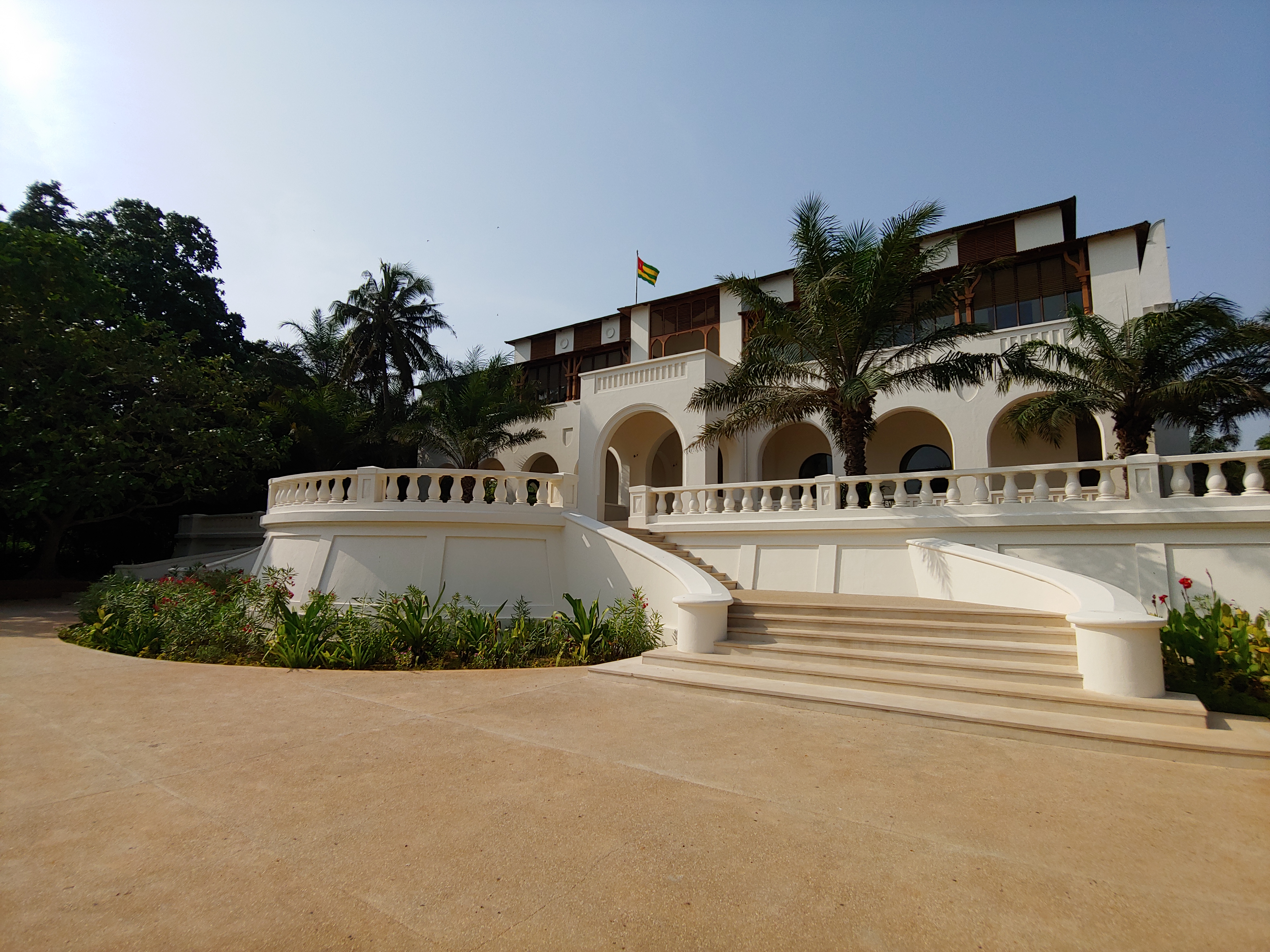
Palace of the Governors, Togo
The entrance to the Palace of the Governors in Lome was once framed by a gate made from two elephant tusks, each more than two meters long. The gesture was deliberate -- a display of colonial wealth and dominion meant to awe visitors before they even stepped inside. Built between 1898 and 1905, this German colonial palace was designed with a specific audience in mind: the captains and passengers of ships approaching Lome's harbor. Governor August Kohler wanted the building visible from the sea, a declaration in brick and iron that Togoland was a colony worth noticing.
Built to Be Seen
The palace was commissioned shortly after Lome became the capital of the German colony of Togoland, one of Germany's most profitable colonial territories in Africa. A joint team of German and Togolese architects and engineers designed the building, blending European colonial ambitions with local building knowledge. The materials reflected this duality: red bricks and cement imported from Germany alongside local hardwoods sourced from Togolese forests, bound together with iron structural elements. The result was a two-story building set within a vast park, surrounded by terraces and featuring a patio that drew comparison to the Royal Palace of King Toffa I in neighboring Benin. Administrative offices occupied the ground floor while the governors' private quarters filled the upper level. The building is considered a characteristic example of German colonial architecture in West Africa.
Three Flags, One Palace
The palace's history tracks the turbulent political life of Togo itself. When World War I ended German colonial rule in 1914, the French authorities who took control of the territory expanded the palace to suit their own administrative needs. For the next four decades, French governors walked its terraced corridors. Independence arrived in 1960, and the palace became the seat of the Togolese presidency -- the new nation's leaders governing from rooms originally built to project foreign power. President Gnassingbe Eyadema used the palace until 1976, when a new presidential residence was constructed nearby. The old palace was then converted into a guest residence for visiting dignitaries, a quieter role that kept the building relevant without requiring the heavy security of an active head of state.
Scars of 1991
In 1991, Togo erupted in political and social upheaval as pro-democracy movements challenged decades of authoritarian rule. The palace did not escape the turmoil. It suffered damage during the unrest -- a physical reminder that the building, for all its architectural grandeur, has always been entangled with the exercise of power and the resistance it provokes. That same year, the palace took on its current official function as the seat of the Prime Minister. The choice carried symbolic weight: housing the head of government in a building originally designed to project colonial authority represented both continuity and transformation. The palace sits on the southwestern side of Lome, adjacent to the presidential residence, its park now a quieter patch of green in a capital city that has grown dense around it.
From Colony to Culture
The Palace of the Governors has been placed on UNESCO's tentative list for World Heritage consideration, recognized not for celebrating colonialism but for documenting it. The building embodies the layers of Togo's modern history -- German ambition, French administration, national independence, political crisis -- all compressed into a single structure. Its red-brick facade and terraced gardens remain intact enough to convey the original architects' intent, while the modifications and damage accumulated over more than a century tell the rest of the story. In recent years, the palace grounds have been reimagined as a cultural space. The Palais de Lome now hosts contemporary art exhibitions and cultural events, transforming a building designed to project imperial authority into a platform for African artistic expression. The elephant-tusk gate is long gone, but the palace endures, its meaning shifting with each generation that claims it.
From the Air
The Palace of the Governors sits at 6.120N, 1.212E in southwestern Lome, Togo, near the Gulf of Guinea coastline. From 2,000-4,000 feet AGL, the palace's park and terraced grounds are visible as a green patch among the dense urban fabric of Lome's city center. The building lies adjacent to the presidential residence and near the coast. Lome-Tokoin Airport (DXXX) is approximately 5 km to the northeast. The flat coastal terrain and the distinct boundary between urban development and the Gulf of Guinea shoreline make the area easy to identify from the air.