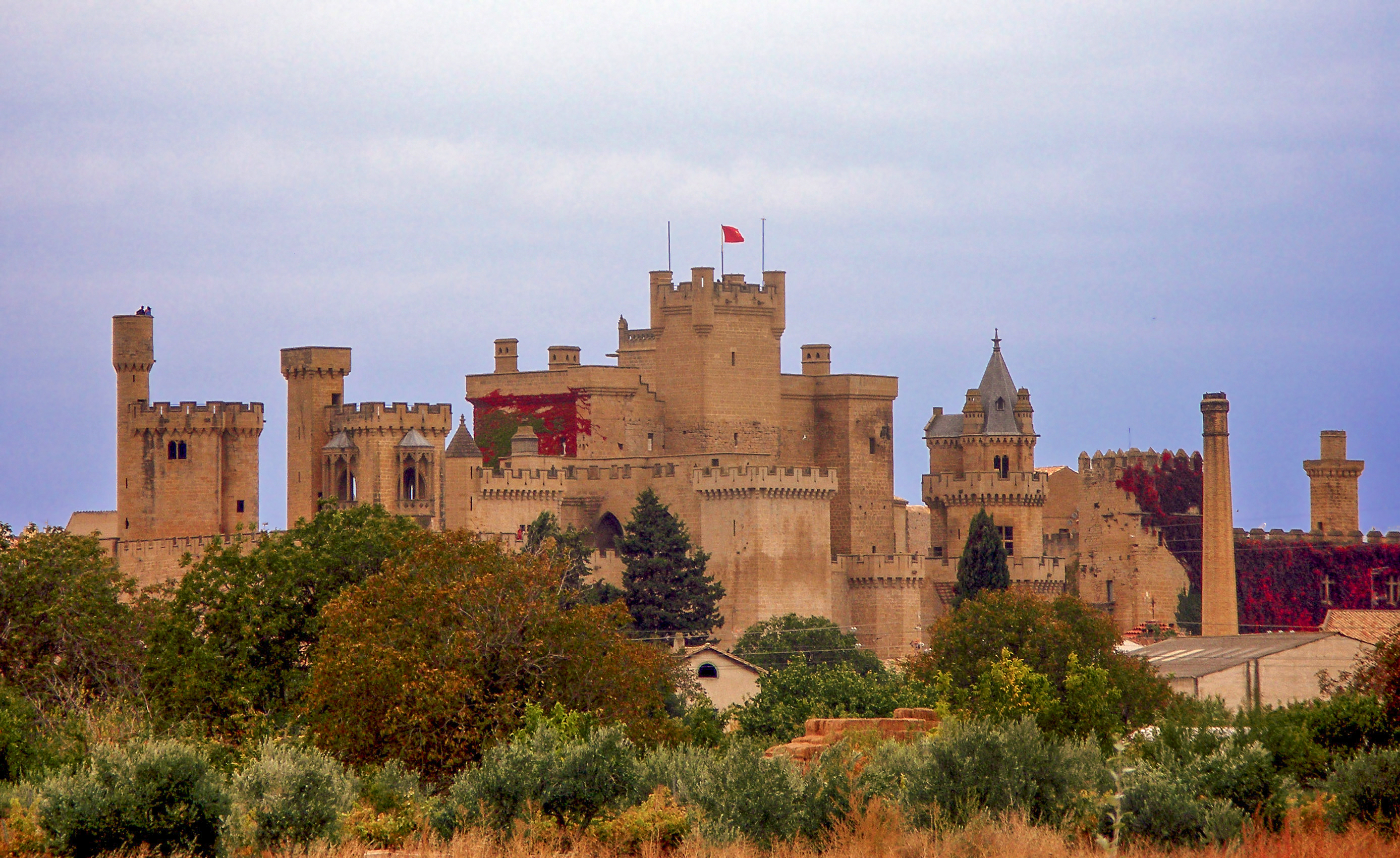
Palace of the Kings of Navarre of Olite
The kings of Navarre kept a giraffe. Also African buffalos, a camel, a lion gifted by the King of Aragon, parrots, hawks, and hunting dogs. They kept them in a moat at the foot of the Cistern Tower, a pit the locals called "the liony." Above the menagerie, hanging gardens grew twenty meters in the air, watered through lead pipes engineered by Juan D'Espernou in 1409. The Royal Palace of Olite was not a fortress pretending to be a palace. It was a palace barely pretending to be a fortress.
A Queen's Displeasure
The palace began as a thirteenth-century castle built atop ancient Roman foundations during the reign of Sancho VII "the Strong." For generations, the Navarrese court was itinerant, and the kings visited Olite intermittently. Everything changed when Charles III "the Noble" married Eleanor of Castile in 1375. Eleanor found the Old Palace uncomfortable and outdated. Her displeasure became the catalyst for one of the most ambitious royal building projects in medieval Iberia. Between 1395 and 1400, houses adjacent to the Old Palace were purchased and demolished. Construction of the New Palace began in earnest in 1406 under master builder Saul de Arnedo, and by 1424 it was largely complete.
Gardens in the Sky
The New Palace was a sensory extravagance. Its interiors were decorated with plasterwork by Morisco masters, azulejo tiles, stained glass, and gilded coffered ceilings. Floors and walls were hung with tapestries. Artists of French, Spanish, and Islamic traditions worked side by side, producing an eclectic mix that contemporaries considered among the most luxurious in Europe. The hanging gardens, some nearly twenty meters above ground, required an entire support structure: the Sala de los Arcos, a vast dark room whose sole purpose was to bear the weight of the Queen's garden overhead. Gardeners tended orange trees, lemon trees, jasmine, and mulberries, while in winter, awnings attached to the walls formed primitive greenhouses to protect the plants from cold.
Towers and Watchmen
The palace bristles with towers, each with its own character. The Torre del Homenaje rises 40 meters, the highest point, with a spiral staircase of 133 steps -- its name, Torre de la Vit, comes from the French word for snail. The Torre de la Atalaya, also called the Joyosa Guarda, is so small at its summit that only one watchman could fit. The Torre de las Tres Coronas is octagonal and built in three descending tiers, its top once used for raising pigeons. From the Torre de los Cuatro Vientos, balconies face the cardinal points so the royal family could watch spectacles performed at the castle's foot. In the courtyard called Patio de la Morera, a white mulberry tree, tradition holds, was planted by Charles III himself. It still stands, declared a Natural Monument of Navarre.
Fire and Resurrection
When Castile annexed Navarre in 1512, the palace began its long decline. Centuries of neglect followed, and by the time the poet Gustavo Adolfo Becquer visited in the late nineteenth century, the castle was a romantic ruin of bare rooms and crumbling walls. The worst blow came in 1813 during the Napoleonic invasion, when guerrilla leader Espoz y Mina ordered the palace burned to prevent the French from using it as a fortress. Only the Gothic church of Santa Maria la Real survived intact. Reconstruction began in 1937 under architects Jose and Javier Yarnoz Larrosa and took thirty years, funded by the Foral Government of Navarre. The work restored the exterior to something close to its original appearance, though the interior decorations were lost beyond recovery.
Jousts and Pelota
Daily life at Olite was anything but austere. Jousting tournaments were held in 1439 for the wedding of the Prince of Viana and German princess Agnes of Cleves. Charles II "the Bad" organized a bullfight in 1387 featuring three Muslim toreros. Basque pelota was played regularly; a 1408 document records repairs to the fronton's roof. The Patio de la Pajarera, an inner courtyard netted at the top, served as an aviary where birds lived and nested in plaster structures that survive in fair condition today. The Old Palace, meanwhile, has been reborn as a Parador hotel called Principe de Viana, where guests sleep within walls that once housed the Navarrese court.
From the Air
Located at 42.48N, 1.65W in the small town of Olite, Navarre. The palace's cluster of towers and crenellations is visible from the air rising above the compact medieval town. Nearest airport is Pamplona (LEPP), approximately 40km to the north. Best viewed at 2,000-4,000 feet AGL. The surrounding landscape is flat agricultural land with vineyards.