Palace of Versailles
It started with jealousy. In August 1661, twenty-two-year-old Louis XIV attended a lavish party at the Château de Vaux-le-Vicomte, the magnificent new estate of his finance minister Nicolas Fouquet. The gardens, the fountains, the architecture -- everything outshone anything the king possessed. Within weeks, Louis had Fouquet arrested and imprisoned for life. Then he hired Fouquet's architect, gardener, and painter, and set them to work transforming his father's hunting lodge at Versailles into something the world had never seen. The result, expanded over half a century, became the de facto capital of France, the physical expression of absolute monarchy, and a palace so influential that rulers from Russia to Bavaria copied its design.
From Swamp to Seat of Power
Louis XIII built the original hunting lodge in 1623 on a wooded hill twelve miles west of Paris. His courtiers sneered. François de Bassompierre wrote that it "would not inspire vanity in even the simplest gentleman." Louis XIII rebuilt it as a small château between 1631 and 1634, but he forbade his queen, Anne of Austria, from staying overnight there. When Louis XIV inherited the throne as a child in 1643, the château was abandoned. It was not until after the Fronde -- the series of civil wars that traumatized the young king between 1648 and 1653 -- that Louis XIV returned to Versailles with a transformative vision. The experience of aristocratic rebellion had convinced him that the nobility must be kept close and controlled. Versailles would become the instrument of that control.
The Hall of Mirrors and the Art of Display
Between 1678 and 1684, architect Jules Hardouin-Mansart built the Hall of Mirrors, a 73-meter-long gallery lined with 357 mirrors facing 17 arched windows overlooking the gardens. In an age when mirrors were among the most expensive luxury goods in Europe, the effect was deliberately extravagant -- an exercise in state power expressed through interior design. Louis XIV moved the seat of government to Versailles in 1682, compelling the aristocracy to attend him there. Court etiquette became a tool of governance: nobles competed for the privilege of holding the king's shirt during his morning dressing ceremony. Every meal, every walk in the gardens, every theatrical performance was choreographed to reinforce the hierarchy that radiated outward from the king. At its peak, the palace housed the entire French government and roughly 3,000 courtiers, with another 15,000 soldiers and servants in the surrounding town.
Gardens as Geometry
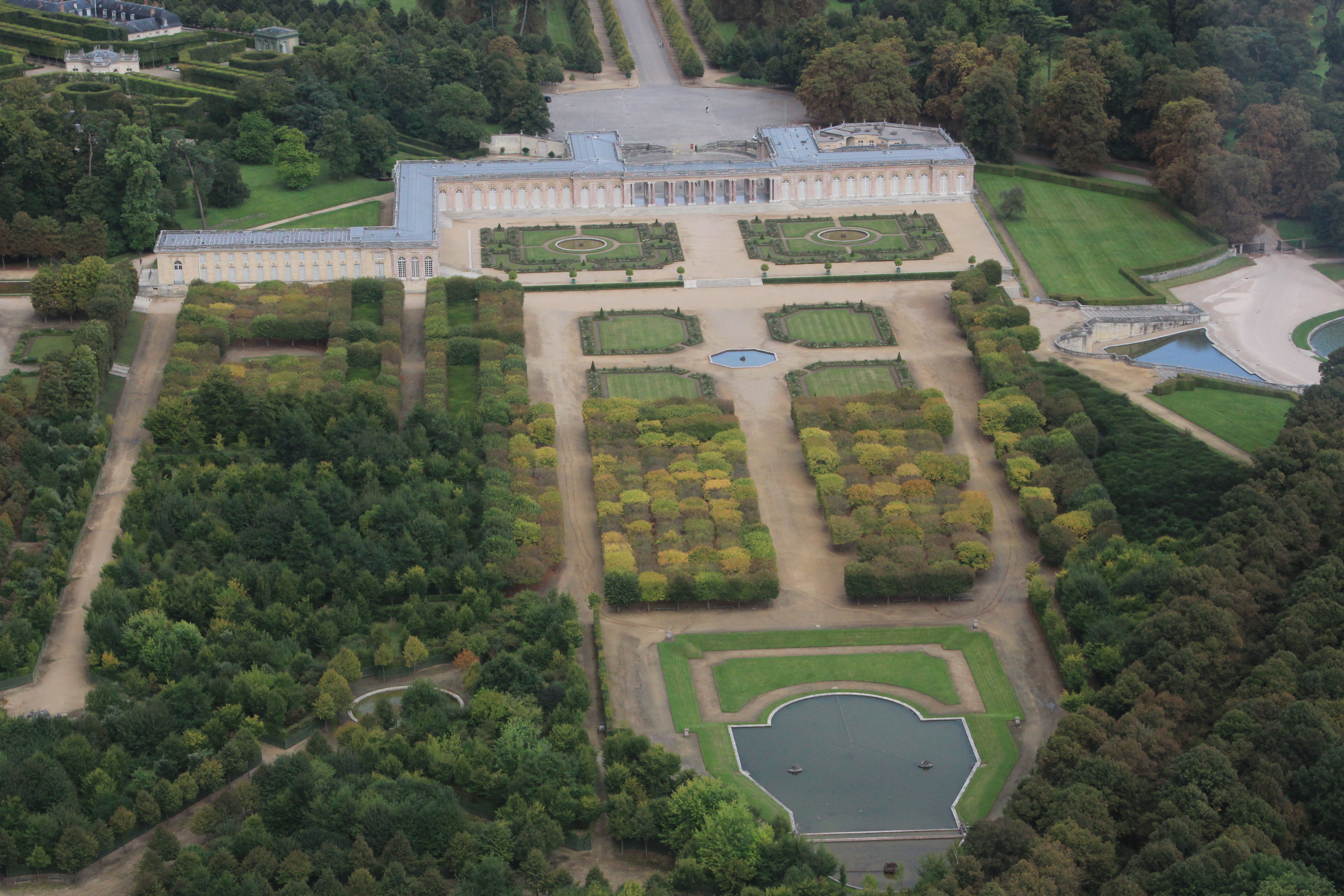
André Le Nôtre's gardens extend over 800 hectares and represent the apex of the French formal garden tradition. The central axis stretches from the Hall of Mirrors westward through parterres, fountains, and the Grand Canal -- a cruciform artificial lake 1,670 meters long where Louis XIV staged mock naval battles. Every hedge, gravel path, and fountain placement expresses mathematical order imposed on nature, a landscape metaphor for the king's authority over the natural world. The hydraulic system required to power 1,400 water jets across its fountains was one of the great engineering challenges of the era; the Machine de Marly, an enormous pumping station on the Seine, fed water uphill through a system of aqueducts. Today roughly 15 million people visit the palace, park, and gardens each year.
The Women's March and the Fall
On October 5, 1789, thousands of Parisian women, furious over bread shortages, marched twelve miles from the markets of Paris to Versailles. They breached the palace gates, killed two guards, and nearly reached the queen's apartments. The next morning, the royal family was escorted back to Paris under armed guard. They never returned. The palace was emptied over the following years: the Revolutionary government auctioned 17,000 lots of furnishings between 1793 and 1794, from mirrors to kitchen equipment, in a sale that lasted nearly a year. Fleurs-de-lys and royal emblems were chiseled from every surface. Napoleon considered making Versailles his residence but chose the subsidiary Grand Trianon instead, finding the main palace too associated with the old regime.
Mirror of History
The Hall of Mirrors hosted two events that bookended modern European conflict. On January 18, 1871, after France's defeat in the Franco-Prussian War, the German Empire was proclaimed in the very room designed to celebrate French glory -- a deliberate humiliation. On June 28, 1919, the Treaty of Versailles was signed in the same hall, ending World War I and imposing terms on Germany that would seed the next war. Designated a UNESCO World Heritage Site in 1979, Versailles today functions as a museum, a venue for state occasions, and a monument to the ambitions and excesses of absolute power. From the air, its geometry is startling: the town, the palace, and the gardens radiate outward from a single point like a compass rose, as if the entire landscape bows toward where the Sun King once stood.
From the Air
Located at 48.8047°N, 2.1203°E in Versailles, approximately 18 km southwest of central Paris. From the air, the palace's strict east-west axis, the Grand Canal, and the radiating town grid are unmistakable. Best viewed from 3,000-4,000 feet AGL on a westerly approach. The massive estate covers 800 hectares. Nearest airports: Versailles-Saint-Cyr (LFPZ) 5 km south, Paris-Orly (LFPO) 18 km southeast, Paris-Le Bourget (LFPB) 25 km northeast.