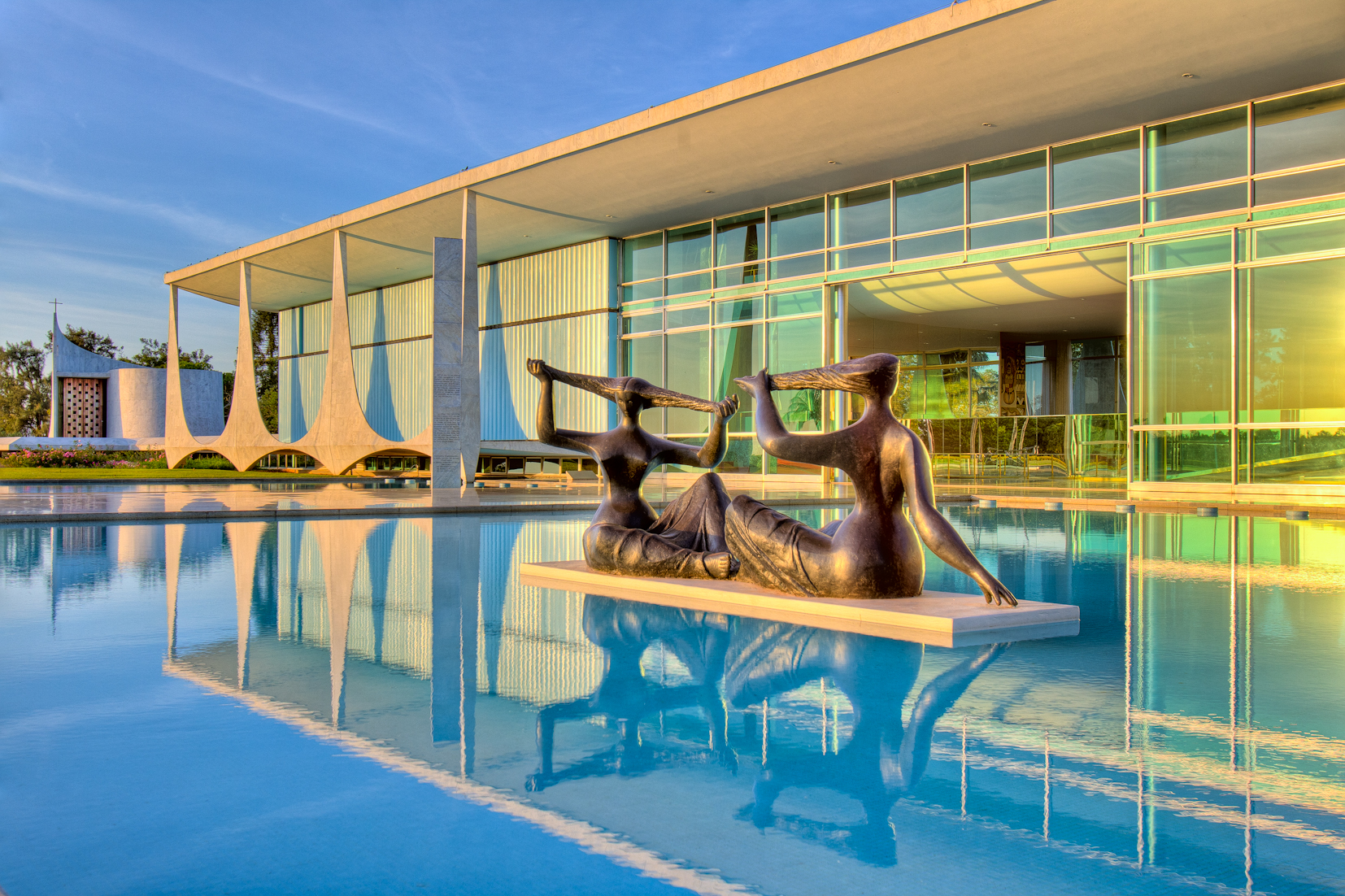
Palácio da Alvorada
"What is Brasília, if not the dawn of a new day for Brazil?" Juscelino Kubitschek said it in the late 1950s as his administration pushed to carve a new capital out of the empty central plateau, and the name stuck to the first building he moved into: Palácio da Alvorada, Palace of Dawn. Construction began on 3 April 1957 and finished on 30 June 1958. The palace was the first government structure ever built in Brasília, completed before there was a city around it. Oscar Niemeyer designed the building with the principles of simplicity and modernity, the same principles that would define the rest of the capital. Every Brazilian president since Kubitschek has lived here, on a peninsula jutting into Paranoá Lake.
Dawn Of A New Brazil
The Alvorada is a long horizontal composition of glass and white concrete, supported by columns that flare at the top and bottom into curved shapes that Niemeyer famously said he had borrowed from the lines of Brazilian women. The building covers 7,000 square meters across three floors: a basement with the movie theater and game room and kitchen, a ground floor of state rooms for official receptions, and an upper residential floor with four suites for the presidential family and two guest apartments. The peninsula siting puts water on three sides. A chapel and a heliport occupy adjacent buildings on the palace grounds. The architecture was revolutionary in 1958 and has influenced presidential palaces around the world - the Indian parliament building, for example, shows traces of its logic. It is listed as a National Historic Heritage Site.
The Rooms
Walking through the state rooms you pass between centuries. The Library holds 3,406 volumes spanning arts, philosophy, politics, Brazilian history, and general history, along with framed seventeenth-century maps: South America from 1645, the Captaincies of Brazil from 1656. The walls carry a Di Cavalcanti tapestry called Músicos. The Dining Room, added in 1992, features seventeenth-century Flemish paintings by Cornelis de Heem and Jan van Huysum, two baroque-style angels from Minas Gerais, and eighteenth-century porcelain from the East India Company. The Noble Room displays two Victor Brecheret sculptures alongside Mies van der Rohe furniture, Candido Portinari paintings of northeastern jangadas, and eighteenth-century sacred pieces. The Mezzanine holds three indigenous funerary urns from Marajó Island - pottery made centuries before the Portuguese arrived. Past and present sit in the same room, politely declining to compete.
The 2004 Restoration
In 2004 First Lady Marisa Letícia directed the most extensive restoration the palace had ever received. The project took two years to complete and cost 18.4 million US dollars. Rooms were researched and brought back to their original configurations. Furniture and decorative objects were restored. The electrical and central air conditioning systems were replaced. Floors and ceilings were redone. Contrary to popular belief, the restoration was not funded by the government - the money came from private corporations donating through a National Institute of Historic and Artistic Heritage program that allowed them to claim tax deductions. When Lula da Silva's government left office in 2010, the palace was in the best condition it had been in since Kubitschek.
January 2023
When Luiz Inácio Lula da Silva returned to the presidency in January 2023, his team inspected the palace he was moving back into. What they found, widely reported in Brazilian and international media, was damage consistent with years of deferred maintenance and active neglect. Torn carpets and sofas. Leaking ceilings. Broken windows and floorboards. A tapestry by Di Cavalcanti had been moved from the library and hung in direct sunlight, requiring restoration. Artworks were missing entirely. A Brazilian cactus that Lula had planted during his previous term, which Bolsonaro had removed, was nowhere to be found. On the presidential desk someone had left a ballpoint pen - a reference to the Bic pens Jair Bolsonaro had used as a symbol of his administration. First Lady Janja da Silva called the condition shocking. Work to restore the palace began again.
Viewing From The Water
The Alvorada sits on a peninsula of the Paranoá Lake, and the view from the water is the one Niemeyer most likely imagined. The building floats - the fine-line columns give the illusion of the roof slab hovering independent of ground. At dawn, when Kubitschek's name for it makes the most sense, the white concrete catches the first light and the glass walls reflect the lake. The Presidential Guard Battalion provides security. One hundred sixty employees work the palace: secretaries, assistants, waiters, cooks, doctors. Guided tours run during the week when the president is not in residence. From the air the peninsula shape and the long white rectangle of the building are unmistakable against the lake.
From the Air
Coordinates: 15.79 S, 47.82 W. Best viewing altitude: 1,500-3,000 feet AGL. Nearest airport: Brasília International (SBBR), 7 nautical miles west. The peninsula jutting into Paranoá Lake is the key visual identifier. The Monumental Axis extends westward from the palace toward the Three Powers Plaza and the other Niemeyer buildings.