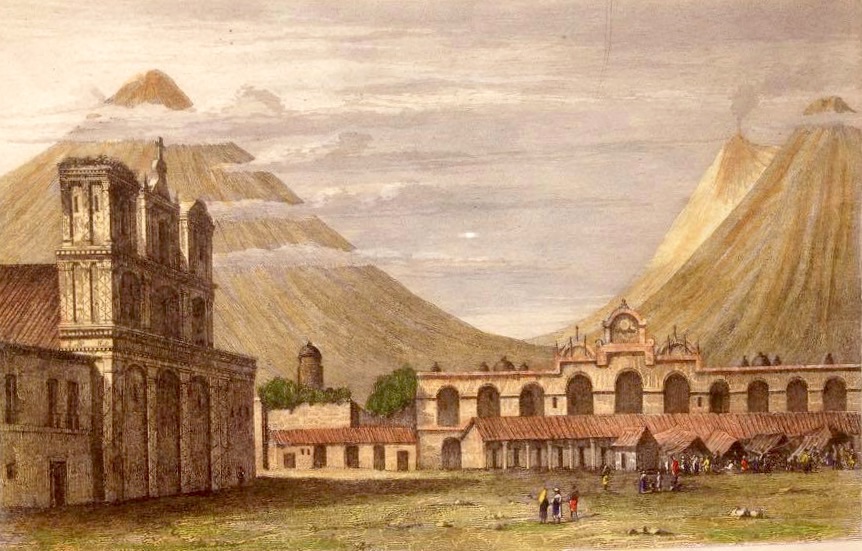
Palacio de los Capitanes Generales, Antigua Guatemala
On January 16, 1775, master builder Bernardo Ramirez began pulling doors, windows, balconies, and ornaments from the Captain General's Palace under legal order. Everything reusable was to be hauled to the new capital in the Ermita Valley. The building that had served as the nerve center of the Kingdom of Guatemala -- governing territory from southern Mexico to Costa Rica -- was being dismantled like a quarry. Yet here it stands today, its double-arched facade lining the entire south side of Antigua Guatemala's Central Square, housing the tourism institute, the departmental government, the National Museum of Guatemalan Art, and even a branch of the National Police. The palace's story is Guatemala's story compressed into stone: ambition, catastrophe, abandonment, and return.
The Seat of a Kingdom
Construction began in 1558, making the palace the first two-story building on the Central Plaza. Wooden floors and arches supported a structure that served as both residence and administration -- the Captain General lived in luxury with his family while government offices, the Real Audiencia, the Royal Tax office, an army headquarters, a jail, horse stables, and warehouses all operated under the same roof. By 1678, the building had grown into a substantial two-story complex with a wooden main entrance and stone columns. From here, the General Captaincy of Guatemala governed a domain stretching from the present-day Mexican state of Chiapas through all of Central America. The Captain Generals who occupied it wielded military, judicial, and administrative authority over an enormous territory, and the palace's scale reflected that reach.
Earthquake After Earthquake
The 1717 San Miguel earthquake damaged rooms and walls badly enough to provoke the first serious discussion of relocating the capital. Citizens stormed the palace to oppose the move, requiring a considerable military deployment to restore order. Diego de Porres repaired the damage by 1720, with improvements continuing until 1736. Then the San Casimiro earthquakes struck in 1751, destroying the facade and multiple levels. Reconstruction on the surviving foundations lasted from 1755 to 1764. Nine years later, on July 29, 1773, the Santa Marta earthquake hit at approximately 3:00 p.m. An hour later, an even stronger tremor -- lasting about a minute and arriving amid a violent thunderstorm -- leveled churches, government buildings, and homes. It severed the city's water and food supply as indigenous communities that provisioned the capital fled to the mountains.
A Capital Abandoned
Within days, Captain General Martin de Mayorga convened meetings with Archbishop Pedro Cortes y Larraz, the city council, and clergy. They agreed to inform King Carlos III and the Council of the Indies of the destruction and propose relocating to the Ermita Valley, farther from the volcanoes blamed for the devastation. When two more powerful earthquakes struck on December 13, 1773, the case for relocation became irresistible. The Council of the Indies approved the move in 1774, and Matias de Galvez coordinated the transfer between 1779 and 1783. But it was the systematic stripping of buildings that truly killed the old capital. After Bernardo Ramirez removed the palace's fittings in 1775, the structure stood as an empty shell -- no doors, no windows, no balconies, no ornaments. The damage from abandonment may have exceeded what the earthquake itself inflicted.
Slow Return
Through the nineteenth century, Guatemala's archbishop sold off remnants of monasteries and churches to ordinary citizens. Families trickled back to Antigua, and some form of local government reestablished itself in the old buildings. The palace's stone columns -- too heavy to transport to the new capital -- had sat for nearly a century in makeshift warehouses on the Central Square. Toward the end of the 1800s, workers finally used them to reconstruct the facade. The least damaged sections reopened: the jail and government offices resumed operations. Then, on February 4, 1976, a magnitude 7.5 earthquake struck Guatemala, destroying much of the country's infrastructure and severely damaging the palace once more. Its eastern facade had to be demolished entirely. Three years later, in 1979, UNESCO declared Antigua Guatemala -- palace included -- a World Heritage Site, granting international protection to a building that had spent two centuries learning how to survive.
From the Air
Located at 14.556N, 90.734W on the south side of Antigua Guatemala's Central Square. The palace's long double-arcade facade is clearly visible from altitude, running the full length of the plaza's southern edge. The Central Square itself, with the cathedral to the east and the palace to the south, forms the identifiable heart of Antigua's colonial grid. Volcan de Agua rises dramatically to the south beyond the city. Nearest major airport is La Aurora International Airport (MGGT) in Guatemala City, approximately 25 km east. The distinctive red-tile roofline and extended arcade colonnade distinguish the palace from surrounding structures.