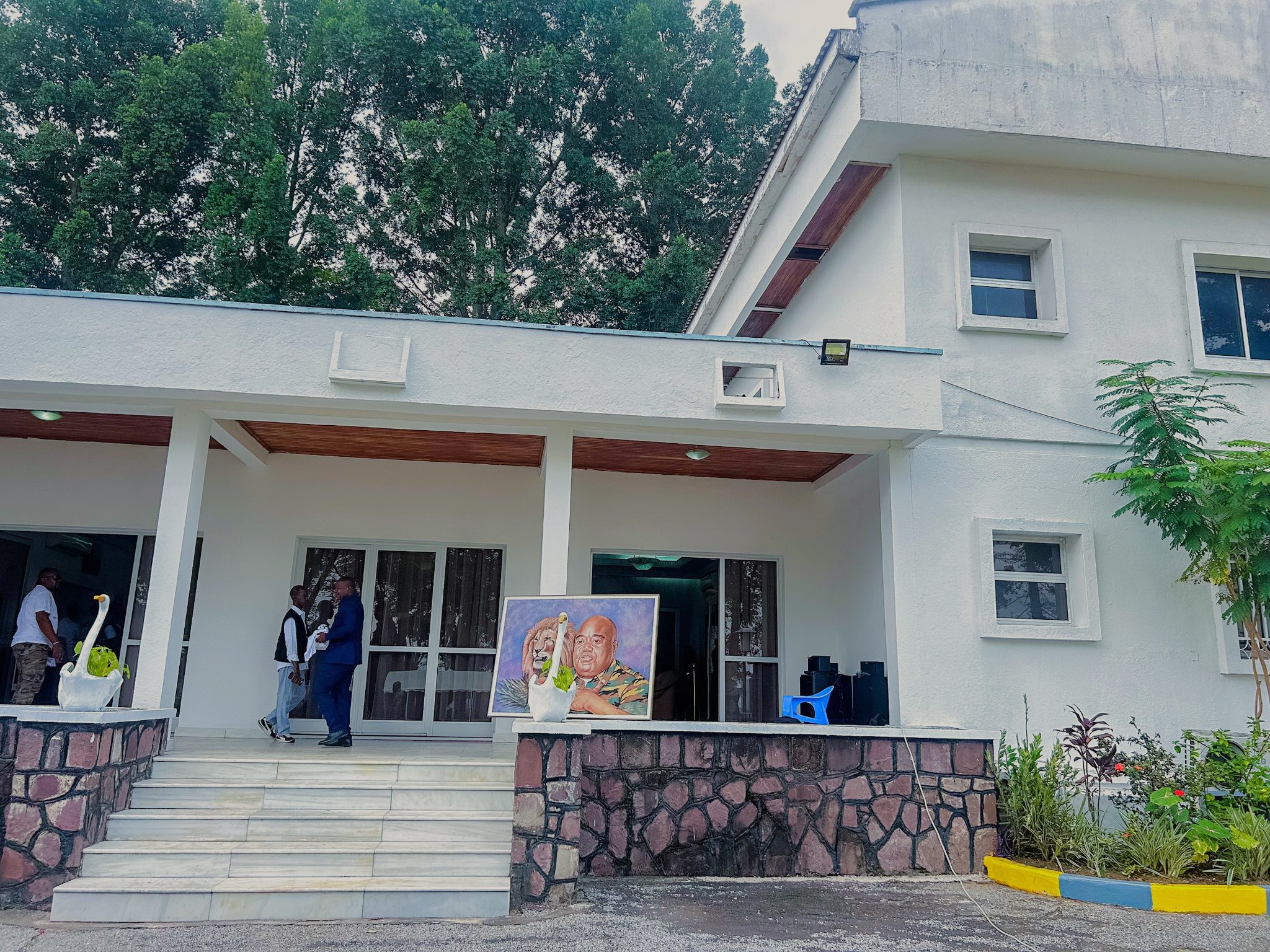
Palais de Marbre
The bloodstained chair is still there. In a circular palace atop the Binza hills of Kinshasa, behind walls of Italian marble and beneath a hypermodern dome designed to echo the shape of the Congo itself, the chair where Laurent-Desire Kabila was shot on January 16, 2001, sits preserved as both artifact and warning. The Palais de Marbre was never meant to be a memorial. It was built as a private residence, confiscated by a dictator, inherited by a revolutionary, and transformed by assassination into something no architect could have planned.
A Banker's Ambition
In 1970, Albert Ndele Bamu, governor of the National Bank of the Congo, commissioned something extravagant for himself. He hired the design team of Eugene Palumbo and Fernand Tala N'Gai, architects already renowned for their work on the Ministry of Foreign Affairs complex and the Supreme Court. What they produced was a circular, hypermodern structure perched in the Ngaliema commune's Ma Campagne neighborhood, incorporating the surrounding garden into its design and clad in marble imported from an Italian quarry. A statue of a prodigious lion guarded the main entrance. The building's shape, following the site's topography, was said to resemble the map of the Congo. Ndele barely enjoyed it. He was demoted to Minister of Finance in September 1970, then dismissed entirely in 1971. The National Bank claimed the property in its inventory, but it hardly mattered. President Mobutu Sese Seko simply took it, converting the palace into another of his opulent residences and a guesthouse for visiting dignitaries.
From Mobutu to Kabila
For decades, Mobutu used the Marble Palace as he saw fit, hosting high-ranking visitors amid its imported stone and garden terraces. But on May 17, 1997, everything changed. Troops from the Alliance of Democratic Forces for the Liberation of Congo entered Kinshasa, and Mobutu fled into exile in Morocco, where he later died. The presidential compound on Mont Ngaliema was looted in the chaos of the First Congo War's conclusion. Laurent-Desire Kabila, the rebel leader who had marched his forces across the country, took up residence in the Palais de Marbre instead. It became the seat of a new kind of power in Kinshasa, less a palace of luxury than a fortified command post for a president who had risen through decades of guerrilla warfare in the eastern maquis.
The Assassination and Its Aftermath
On January 16, 2001, Kabila was shot inside the palace by one of his own bodyguards. The assassination remains shrouded in mystery and competing narratives, but its physical evidence has been meticulously preserved. The chair where Kabila sat when the bullets struck, still bearing bloodstains, anchors an exhibition that chronicles his political journey from the maquis to the presidency. Photographs line the walls, tracing his path from rebel fighter to head of state. Works of art honoring his legacy adorn the rooms. His son, Joseph Kabila, succeeded him and became the de facto owner of the property. When Felix Tshisekedi won the 2018 elections and received the keys to the Palais de la Nation, the Marble Palace was not part of the handover. Tshisekedi spent his first night as president at the Kempinski Hotel before relocating to the Cite de l'Union Africaine.
Two Martyrs, One Calendar
The Congolese calendar marks January 16 and 17 as consecutive days of remembrance. The first honors Kabila, assassinated in the Marble Palace. The second honors Patrice Emery Lumumba, the country's first democratically elected prime minister, assassinated in Lubumbashi on January 17, 1961. The proximity of the dates has bound the two leaders together in national memory, though their stories and legacies differ enormously. The palace now serves as a memorial site open to the public, a place where Congolese citizens come to pay respects and reckon with the violence that has shaped their country's leadership. It also functions as a guest residence during certain official visits, maintaining a thread of its original diplomatic purpose even as its primary identity has shifted from private luxury to public mourning.
Power Written in Marble
From the air, the Palais de Marbre sits atop the Binza hills in the Ngaliema commune, its circular form visible against the green canopy of Kinshasa's western neighborhoods. The Congo River curves in the distance to the north, and the city sprawls eastward in every direction. The palace's story is Kinshasa's story compressed into a single compound: colonial-era wealth, post-independence ambition, authoritarian seizure, revolutionary upheaval, and political assassination, all layered into walls of Italian marble. Every president since Mobutu has had to contend with it, whether as residence, prize, or memorial. The chair remains.
From the Air
Located at 4.36S, 15.25E in the Ngaliema commune of western Kinshasa, DRC. The palace sits atop the Binza hills, visible from moderate altitude. The Congo River lies to the north. Nearest major airport is N'djili International Airport (FZAA), approximately 20 km to the east. Best viewed at 3,000-5,000 feet AGL approaching from the river side.