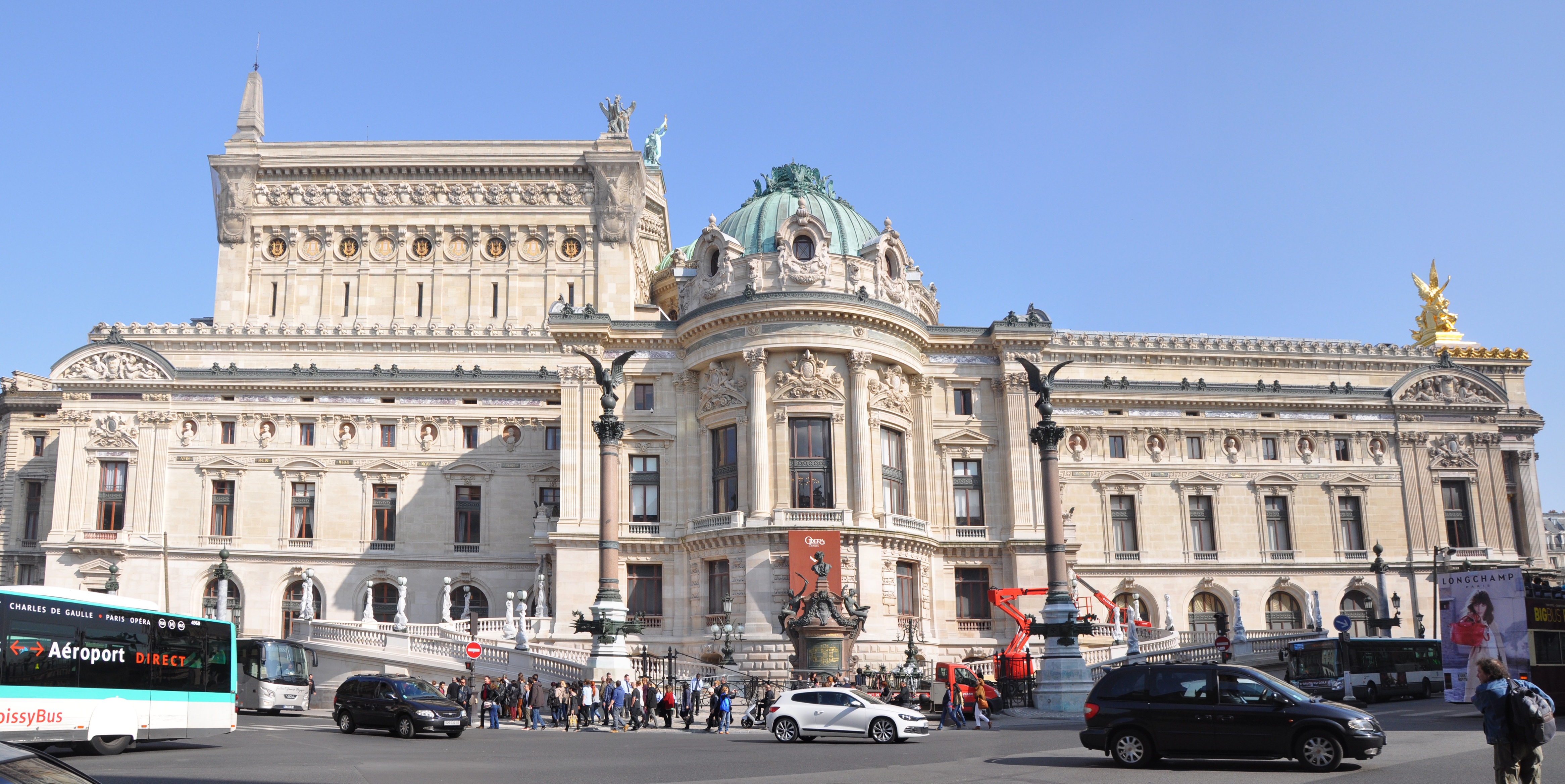
Palais Garnier
Charles Garnier was thirty-five and virtually unknown when he beat 170 rivals to design the new Paris opera house. The Empress Eugenie, unimpressed, asked him what style it was supposed to be. "It is in the Napoleon III style, Madame," he replied. The exchange became legend, but the building would take fourteen years, survive a revolution, an imperial collapse, and the destruction of the old opera house by fire before it finally opened its doors on a freezing January night in 1875.
A Lake Beneath the Stage
The troubles began underground. When workers started excavating in 1861, they hit water that eight steam pumps running day and night could not drain. Garnier's solution was ingenious: he designed a double foundation incorporating an enormous concrete cistern beneath the stage, relieving pressure from the groundwater while doubling as a fire reservoir. The persistent underground water spawned a legend about a subterranean lake that Gaston Leroux would later immortalize in The Phantom of the Opera. The cistern is real, and the Paris fire brigade still maintains it. Above this hidden reservoir, Garnier raised a building of staggering ambition. The structure stretches 155 meters long and rises 56 meters to the apex of its flytower, with an iron-framed interior concealed behind walls of masonry and marble.
Every Surface Tells a Story
Garnier left no surface unadorned. The facade carries gilded copper figures by Charles Gumery, bronze busts of Rossini, Beethoven, and Mozart, and Jean-Baptiste Carpeaux's scandalous sculpture The Dance, which caused such outrage that someone hurled a bottle of ink at it. Inside, a ceremonial staircase of white marble branches into two divergent flights beneath ceiling paintings by Isidore Pils. The artist was sixty-one and had to rework his canvases overhead while they were already mounted; he fell ill before finishing, and his students completed the paintings the day before opening night. The Grand Foyer stretches 54 meters long and 18 meters high, its ceiling painted by Paul Baudry with scenes from the history of music. Garnier designed it not as a corridor but as a drawing room for all of Paris, a space where being seen mattered as much as seeing the performance.
Political Storms and a Phantom's Chandelier
The opera house nearly died several times. When Napoleon III fell in 1870, the new Republic's leaders regarded Garnier as a holdover from the despised regime. They slashed his budget and demanded economies. Then, on the night of October 28, 1873, the old Salle Le Peletier burned to the ground, and suddenly completing the new theatre became urgent. The cash-strapped government borrowed 4.9 million gold francs from Francois Blanc, the Monte Carlo Casino financier, at six percent interest. Garnier and his team worked feverishly through 1874, and the house opened on January 5, 1875, to a gala audience that included the Lord Mayor of London and King Alfonso XII of Spain. The seven-ton bronze and crystal chandelier that Garnier designed for the auditorium became infamous on May 20, 1896, when one of its counterweights broke free, crashed through the ceiling, and killed a concierge. This incident inspired the most famous scene in Leroux's novel.
A Blueprint for the World
The Palais Garnier proved so compelling that it spawned imitations across four continents. The Thomas Jefferson Building at the Library of Congress in Washington modeled its facade and Great Hall on Garnier's design. The Hanoi Opera House, built during French colonial rule between 1901 and 1911, is a direct adaptation. So is the Theatro Municipal in Rio de Janeiro and the Juliusz Slowacki Theatre in Krakow. Garnier himself went on to design the concert hall at the Monte Carlo Casino. Today, the Palais Garnier serves primarily as the home of the Paris Opera Ballet, with new operas staged at the Opera Bastille since 1989. But the building remains what it has always been: not just a theater but a monument to the idea that public architecture should overwhelm the senses and elevate the spirit.
From the Air
Located at 48.87N, 2.33E in the 9th arrondissement of Paris, on the broad Boulevard des Capucines. The distinctive green copper roof and Apollo sculpture atop the flytower are identifiable from the air. Nearby airports include Paris-Charles de Gaulle (LFPG, 25 km NE) and Paris-Orly (LFPO, 14 km S). Best viewed at 2,000-3,000 ft AGL in clear conditions; the building sits at the terminus of the Avenue de l'Opera, creating a clear visual axis from the Louvre.