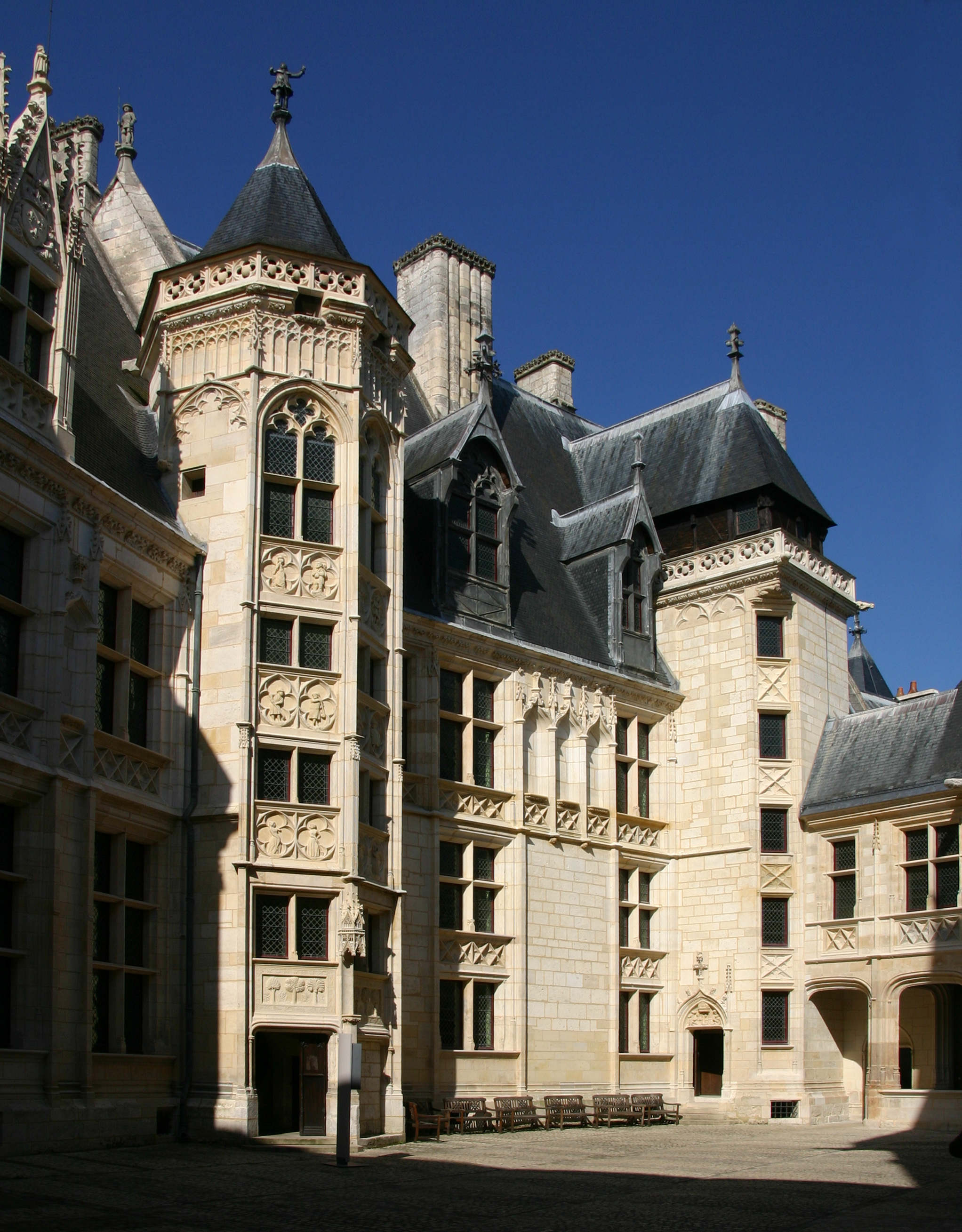
Palais Jacques Coeur
Jacques Coeur never slept in the palace he built. The richest merchant in fifteenth-century France, he purchased the land in Bourges in 1443, commissioned a residence so lavish it became one of the most celebrated examples of civilian architecture in the kingdom, and was arrested in 1451 before the builders had finished. Construction was completed in 1453 -- while Coeur sat in prison. King Charles VII seized the property, and Coeur died in exile in 1456 without ever having crossed his own threshold. The Palais Jacques Coeur stands today as a monument to ambition that outran its owner, a building whose beauty was finished by one set of hands while the man who imagined it languished under another's authority.
A Merchant's Rise and Fall
Jacques Coeur was born in Bourges, the son of a furrier, and built a commercial empire that stretched from the ports of the Mediterranean to the courts of northern Europe. He traded in silk, spices, armor, and silver. He served as argentier -- master of the royal mint -- to Charles VII, financing the king's campaigns during the final decades of the Hundred Years' War. His wealth made him indispensable and his influence made him dangerous. In 1451, accused of poisoning the king's mistress Agnès Sorel (a charge almost certainly fabricated by jealous courtiers), Coeur was arrested, tried, and sentenced. His properties were confiscated. He escaped from prison in 1454 and fled to Rome, then joined a papal military expedition to the Aegean, where he died on the Greek island of Chios in 1456. Charles VII, perhaps recognizing the injustice, restored the palace to Coeur's children the following year.
Flamboyant Stone, Worldly Ambition
The palace Coeur commissioned is a grand hôtel particulier built in the Flamboyant Gothic style -- the exuberant late phase of Gothic architecture characterized by flame-like tracery, intricate stone carving, and a profusion of decorative detail. It is widely considered one of the most prominent examples of French civilian architecture from the fifteenth century. The building was not a fortress or a church but a private residence, and its scale announced that a merchant could live as grandly as a nobleman. The decorative program reflected Coeur's commercial reach: carved stonework incorporates motifs from his far-flung trading network, and the building's organization around a central courtyard anticipated the Renaissance emphasis on domestic comfort and display. Above the main entrance once stood a large equestrian statue of Charles VII -- a gesture of loyalty that did not prevent the king from confiscating the building when it suited him.
Centuries of Other People's Uses
After the Coeur family, the palace passed through a succession of owners. One of Jacques Coeur's grandsons sold it in 1501 to Antoine Turpin, a local notable. In 1552 it went to the diplomat Claude de l'Aubespine, baron de Châteauneuf. Jean-Baptiste Colbert -- Louis XIV's chief minister -- received it in 1679 but returned it to the city of Bourges three years later. The building then hosted various municipal offices. The French Revolution caused fresh damage when the equestrian statue of Charles VII above the entrance was destroyed. In 1820 the palace became a courthouse, housing both the tribunal d'instance and the cour d'appel of the Cher department -- courts of law operating inside a building whose original owner had been convicted in one. The writer Prosper Mérimée, serving as Inspector of Historic Monuments, identified the palace in 1837 as a major cultural property. It was listed on France's first official inventory of historic monuments in 1840.
Restoration and Recognition
The city of Bourges sold the palace to the département and the French state in 1858, and a first restoration campaign ran until 1885. A second, more careful restoration led by architects Henri Huignard and Robert Gauchery lasted from 1927 to 1937, after the Cher département had sold its share to the state and the courts had vacated the premises. The stonework was cleaned again in the early 2000s. Today the Palais Jacques Coeur is managed by the Centre des monuments nationaux and open to the public. Visitors walk through rooms that Jacques Coeur designed but never inhabited, past fireplaces he commissioned but never warmed himself beside. The palace sits near the Bourges Cathedral, another monument to ambition on a different scale, and together they anchor the historic center of a city that has been shaping stone into statements of power since the Romans knew it as Avaricum. From the air, the palace's courtyard and Flamboyant roofline are visible just south of the cathedral's unmistakable silhouette.
From the Air
Located at 47.085°N, 2.394°E, in the historic center of Bourges near the cathedral. The palace courtyard is visible from the air in close proximity to the much larger Bourges Cathedral. Nearest airports: Bourges Airport (LFLD) approximately 5 km northwest. Best viewed at 1,500-2,500 ft AGL. The cathedral serves as the primary visual reference for locating the palace.